With another Carolina-Clemson football game eying the endzone, let’s take a cockeyed gander at the rivalry’s 19th century roots, which began not on the gridiron but in the Palmetto State’s newspapers, on the campaign stump, at the State House and in the public square.
It also began as a question of curriculum — specifically, whether or not the state’s flagship public university put enough emphasis on farming. Or too much emphasis on Greek and Latin. Or offered too much “free tuition” and “free board,” and too many “free books,” including scientific ones.
In the words of Edgefield firebrand and future Governor Benjamin R. Tillman, who had it in for USC ever since he didn’t attend, the college in Columbia was cranking out “drones and vagabonds” who “don’t sweat none the four years.”
In the words of Tillman’s supporters — and those of his denominationalist allies at schools like Wofford, Erskine and Newberry College, who lobbied to end all that free-tuition malarky — the vibrant classrooms and stately library on the Horseshoe were an elite haven for “‘college dudes’ …. [who] read big books about strange things and lived a life of gaiety and ease.”
That’s USC historian Daniel Walker Hollis two paragraphs up, quoting historian Francis B. Simkins’ Pitchfork Ben Tillman, South Carolinian (Louisiana State University, 1944). After that, that’s Hollis quoting an article from the Charleston News and Courier dated Aug. 2, 1888. Oh, and the bit about those college dudes reading big books about strange things? That’s Hollis’s own clear-eyed take, though he slaps quotes around “college dudes” because “college dude” at this time and in this context was a pejorative, not high praise.
Tillman, of course, had his own ambitions — namely to start a separate school in the Upstate that would cater to the needs and wishes of his aggrieved agrarian base and meanwhile stick it those well-read college dudes.
Except it wasn’t that the University of South Carolina/South Carolina College (the name changed every Tuesday in the 19th century) didn’t provide a well-rounded education. As Hollis explains in University of South Carolina Vol. II: College to University, the university/college leaned into the classics but also made a genuine foray into the advancement of animal husbandry and what-be-not.
As a wise man never said, there are as many ways to detassel an ear of corn as there are ways to dissect Cicero’s De Natura Deorum. Both have their applications. And both, we imagine, were on the syllabi at USC.
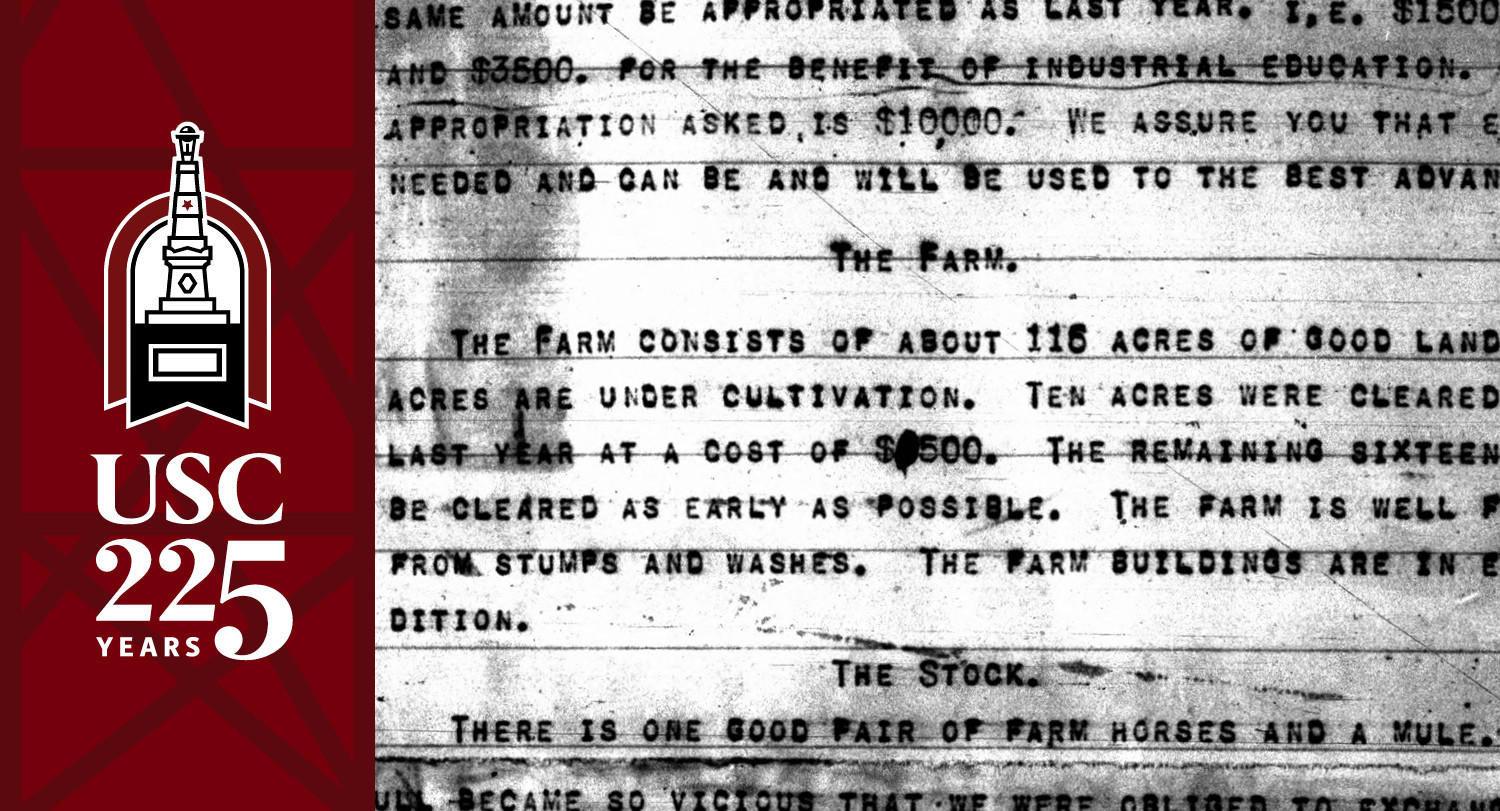
Follow Hollis down the rabbit hole into the board minutes of 1888 and you learn all sorts of marvelous things. Perhaps most notably, there was a 116-acre experimental farm at USC “one mile from campus by path, and one and one-half by public road.” This farm, which featured “over 200 experimental plats in cotton, and 150 in corn,” plus enough grains and legumes to fill a gunnysack, was “well fenced and free from stumps and washes” and featured “farm buildings . . . in excellent condition.”
And that’s not all. The farm’s livestock, according to blurry scans of those long-ago minutes, consisted of “one good pair of farm horses and a mule,” plus eight hogs, a few cows and a Jersey bull that “became so vicious that we were obliged to exchange him for an Ayrshire.”
Nobody’s kicking cow patties here. Hollis did his research. We did, too. Here’s Hollis on the university’s larger commitment to the science and practice of agriculture circa 1888, a full year before USC’s upstart rival got its own patty rolling:
“The work required for the B.S. degree in agriculture was a blend of the theoretical and the practical. In addition to fundamental study in general culture and science, thirteen courses in three departments of agriculture, agricultural chemistry, and the veterinary sciences were required. Attention was paid to such practical matters as cattle-feeding, manures, farm implements, and animal obstetrics. A three-year course in agricultural practice was devoted to the study of plants in the greenhouse . . . No one could claim with honesty that agricultural training at the University was not pertinent to the actual labors of South Carolina farmers.”
The real issue, it turns out, wasn’t so much curriculum as federal money, or more specifically, two federal acts that directed federal money to the states.
The Morrill Act of 1862 ceded federal land to the states for the development of experimental farms and whatnot and paved the way for the creation of land-grant institutions (like Clemson). The Hatch Act of 1887 provided federal funding for those experimental farms.
Tillman didn’t like that USC was getting all that land and money when it could be used instead to fund a separate school with other ideals, and he played every card in the deck to redirect it.
And did it ever get nasty. Accusations were leveled, fingers were pointed, epithets were ascribed. In the end, Tillman moved into the governor’s mansion and put the screws on USC for real, nearly putting it out of business.
But there was an upside. Tillman’s efforts to take down the university brick-by-historic-brick also insured that the red-hot rivalry between the Palmetto State flagship and the ag school up the road would endure for all time. For that, if nothing else, both schools can thank him.
Now, what channel’s the game on again?
Editor's Note: This piece borrows heavily from Daniel Walker Hollis’ unbiased history, University of South Carolina Vol. II: College to University (University of South Carolina Press, 1956) and from the blurry scans of the Board of Trustees’ minutes circa 1888. For an alternate perspective, there’s probably a history of Clemson University published by Clemson University Press, which was founded in 2000.