When SOMG opened to its inaugural class in 2012, founding dean Jerry Youkey, MD, knew lifestyle medicine belonged in the curriculum—not just as an elective, but as an integrated part of every basic science course and clinical training.
“One of the things I wanted in the curriculum was not only instruction on how to take care of sick patients but also instruction on how to take care of patients from a prevention and wellness standpoint,” said Youkey. “This is usually restricted to primary care nonspecialists, but, as a vascular surgeon, I saw the ravages among the patients of not taking care of themselves over the years, and I felt lifestyle medicine needed to be in the curriculum.”
Youkey recruited and worked with lifestyle medicine expert Jennifer Trilk, PhD, to train SOMG’s charter class and all subsequent medical students in the six pillars of lifestyle medicine: optimal nutrition, physical activity, restorative sleep, stress management, social connectedness, and risky substance avoidance. Today, our students receive over 100 hours of lifestyle medicine instruction across all four years of medical education curriculum, and SOMG is one of only two medical schools in the nation to earn the “Platinum Plus” certification from the American College of Lifestyle Medicine. In 2024, SOMG’s current dean Phyllis MacGilvray, MD, launched SOMG’s new mission statement—Educate. Innovate. Serve. Where Lifestyle is Medicine. —and became the first medical school dean in the country to be board-certified in lifestyle medicine.
Lifestyle Medicine works across medical specialties to help patients. Three SOMG charter-class
alumni share how they incorporate lifestyle medicine in their practices today, one
decade after graduating from SOMG. Read their stories here:
Andrew See, MD, FAAFP
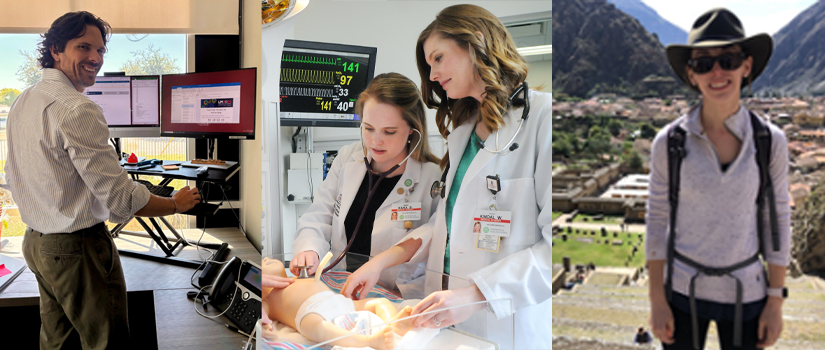
Family medicine physician and American Academy of Family Physicians fellow Andrew See, MD, doesn’t just talk the talk about lifestyle medicine. He walks the walk. Literally. He uses a walking pad to exercise while conducting phone calls in his office, and he makes walking-and-talking look easy. In his personal life, See spends much of his free time kayaking, rock climbing, hiking and cooking. Looking back, See shared that SOMG’s focus on lifestyle medicine and the opportunity to have a hands-on role in his medical education were two driving factors in his decision to enroll in the brand-new medical school in 2012.
“In their vision from the very beginning, people at SOMG talked about holistic, patient-first medicine and really advocated for lifestyle medicine training. I still remember how our exercise physiology professor Dr. Trilk was so passionate about it,” said See. “Also, because the school was new, we had a lot of say in our education. It was exciting to be able to build and be a part of something from the very beginning. We were the first students to plan out the medical roots garden. I was on the committee for buying furniture for the building. All these different aspects of building up the school together made our class’s experience so unique.”
Today, one of See’s favorite aspects of incorporating lifestyle medicine into his family medicine practice in California is working longitudinally with patients to help them become their best selves.
“It’s so cool to see people become on the outside who they always felt like they were on the inside. I love having conversations with patients about nutrition, coming up with exercise plans, going over food logs, and all of that came from medical school,” said See.
See is proud to cultivate long-term relationships with patients, sometimes treating multiple generations of the same family, and to offer cutting edge obesity and lifestyle medicine treatments to patients.
“I love that I’m able to develop relationships with my patients where we can really
take a look at what they’re doing and how they’re living their life, and I can help
empower them as a person,” said See. “A lesson I’m deeply grateful for from medical
school is understanding the perspective that medicine isn’t just about prescribing
pills. Medications have an important role in medicine, but so much more of my practice
today is understanding my patient and nurturing the relational aspect of primary care.
When someone is in the hospital, the goal is to get them well enough to leave the
hospital, not necessarily to fix the root cause of their problems. Whereas this morning,
I had four different patients officially come off blood pressure medicines after working
to transform their daily habits, which is so exciting.”
Charlotte Van Hale, MD
Charlotte Van Hale, MD, completed two residencies, one in 2019 and one in 2022, because she genuinely loves two different specialties: internal medicine and psychiatry. Today, Van Hale is an attending psychiatrist at Emory Midtown and an assistant professor at Emory University School of Medicine in the departments of psychiatry and internal medicine. She also works on the med-psych unit at Grady, works weekly in a women’s mental health clinic, offers psychodynamic psychotherapy through the Emory Psychoanalytic Institute, and most recently welcomed her first-born child in August. After listing everything on her plate, Van Hale laughed about her aversion to boredom, citing variety as “the spice of life.”
When discussing her practice, Van Hale explained how lifestyle medicine plays a major role in both physical and mental wellness, which may surprise some folks. The everyday person may think of mental and physical health as disconnected, but that couldn’t be further from the truth.
“The mind and the body don't exist separately. They’re connected. Whatever is good for your heart and your metabolic health is going to be good for your mental health,” said Van Hale. “What affects the mind affects the body, and what affects the body affects the mind.”
Patients can sometimes feel overwhelmed when thinking about diet and exercise changes. It can be difficult to figure out how, when, and where to start. Van Hale encourages any patient brave enough to ask questions about lifestyle changes or try new things here and there. First steps are important steps, and Van Hale feels “thrilled when patients are doing whatever it is that works best for them.”
For some patients, lifestyle improvements include taking up yoga, strength training, running, or counting macros. For other patients, lifestyle improvements look more like finding time for evening walks after work, getting outside with their families on the weekends, or spending time destressing in nature.
“Even going from mostly sedentary to lightly active has benefitted some of my patients
tremendously in terms of their mood,” said Van Hale. “Personally, I'm a huge proponent
of strength training. Across the board, we're seeing more and more of the physiological
benefits of just how important strength training is, so I encourage that with all
of my patients. But, ultimately, when you talk to patients about diet and exercise,
they're going to make whatever changes interest them most, and that’s okay. I’m just
happy whenever they’re able to make a positive change, no matter what it is. It’s
important to meet patients where they are.”
Kindal Dankovich, MD
Kindal Dankovich, MD, is a board-certified pediatric hospitalist, the associate program director for Prisma Health Greenville’s pediatric residency program, a member of the SOMG Dean’s Council, and a member of a national committee leading the charge on transitioning pediatric programs to competency-based medical curriculums and training.
As a pediatrician, Dankovich’s practice spans the newborn nursery, hospital and clinic. Whether she is reassuring a first-time parent, helping a hospitalized child and family navigate recovery, or building continuity with patients as they grow, Dankovich sees pediatrics as an opportunity to support the health of entire families. That begins with trust.
“Right now, there’s a lot of mistrust in the medical community, so we have to work extra hard sometimes to build relationships with families,” said Dankovich. “Sometimes I’m taking extra time in the newborn nursery with a first-time parent, talking them through routine newborn care with their very healthy baby multiple times until they feel confident, and that makes me so happy. Sometimes there’s a kiddo in the hospital who is exceptionally sick, and I’m partnering with the family and walking through that journey with them towards recovery, which can be incredibly rewarding even when it’s hard. Having some patient continuity in the clinic and knowing kiddos are relying on you to make them the healthiest version of themselves as they move towards adulthood and seeing them grow and accomplish their goals is incredible. It just makes it all worth it at the end of the day.”
Lifestyle medicine is central to Dankovich’s work. While healthy eating and exercise are important, Dankovich emphasizes that physicians and physicians in training must learn to address the social determinants of health that can make lifestyle medicine goals difficult to achieve for many patients.
“Many families know that eating healthier and exercising are the right things to do to be healthy, but they don’t always know how they are supposed to do that with so many barriers in place,” said Dankovich. “Having physicians and partners in the community to help connect families with community resources, healthy food options and safe places to exercise is exceptionally important and can create lasting change. It doesn’t just shape the future of the child. It shapes the future of the entire family.”
Dankovich looks forward to celebrating with the cherished classmates who helped bring the dream of SOMG to life as she and her fellow charter class members prepare to reunite this October for the ten-year anniversary of their graduation.
“I cannot wait to see some of my classmates who I haven’t seen in years,” said Dankovich. “My classmates are phenomenal. To see them continuing to be phenomenal physicians is so special. I can’t wait to see them in person and celebrate each other and what we’ve accomplished.”