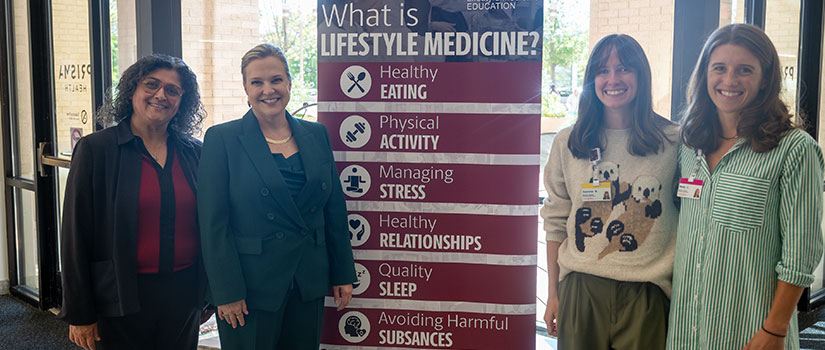
The University of South Carolina School of Medicine Greenville (SOMG) hosted its inaugural Lifestyle Medicine Research Symposium at the SOMG campus.
The conference, held Sept. 25, featured groundbreaking research in the field of lifestyle medicine in healthcare, sparking bold ideas — including both bench to bedside solutions that support clinical advancements in patient outcomes, as well as addressing everyday behaviors that have the biggest impact on health. The symposium brought together physicians, researchers, and community members to focus on preventing illness at the root cause and combating chronic disease.
Seventeen researchers presented research on a range of topics, including: lifestyle medicine in primary care; a pediatric produce prescription program; lifestyle counseling in adolescent primary care mental health visits; and preventing sleep fatigue in medical residents.
To view Fox Carolina News coverage of the symposium see here.
Also at the conference, five panelists discussed the impacts of lifestyle medicine research on real-world outcomes that improve health. The first-of-its-kind symposium here in the Palmetto State concluded with a E. Arthur Dreskin, M.D. Distinguished Endowed Lecture delivered by Jennifer Trilk, PhD, FACSM, DipACLM, Professor of Biomedical Sciences and Director of Lifestyle Medicine Programs at SOMG.
The symposium aimed to address the significant impact of lifestyle behaviors on chronic diseases. Studies indicate that 80% of coronary artery disease, over 90% of type 2 diabetes, and approximately 70% of stroke and colon cancer cases may be preventable through healthy lifestyle choices.
For the full list of research project abstracts and panelists, click here.
“It is awesome to have a place to explore lifestyle medicine — not only in our curriculum, but also here at an event where we can share research,” said Joanna Burgess, a second-year medical student at SOMG. Burgess presented on the project, “Beyond Medication Rechecks: Evaluating Lifestyle Counseling in Adolescent Primary Care Mental Health Visits.” Burgess is also working on a community project, titled “Good Vibes, Healthy Lives: A Community-Based Lifestyle Medicine Curriculum for School-Aged Children” with fellow student Molly Crosswell.
John Manna, DNP, APRN, FNP-C, DipACLM, a family nurse practitioner with Prisma Health in Columbia, SC, came to SOMG to present a poster on his team’s research on positive impacts from shared medical appointments for patients referred for chronic conditions, from prediabetes or hypertension. “We talk about resources, places where they can exercise, and talk about sleep, stress mitigation, how to prepare certain foods at home,” said Manna. “The goal is to empower patients.”
Jennifer Grier, PhD, Associate Professor at the USC School of Medicine Greenville, presented on research that utilizes a smart watch to monitor medical residents and sleep fatigue.
“This symposium is a great opportunity to bring knowledge about lifestyle medicine to the school,” said Grier.
SOMG's mission is to equip clinicians with the knowledge and skills necessary to prevent and treat lifestyle-related chronic diseases, thereby enhancing patient care. Since its establishment in 2012, the School has become a leader in Lifestyle Medicine, developing innovative curricula and expertise focused on addressing the root causes of illness.
Chronic disease now accounts for 90% of the nation’s $5.3 trillion in annual health care expenditures, and lifestyle medicine can help with disease prevention.
“Lifestyle medicine holds the potential to help turn the tide,” said Dr. Jennifer Trilk, the E. Arthur Dreskin, M.D. Distinguished Endowed Lecturer who delivered the keynote address at the Research Symposium.
The six pillars of lifestyle medicine are: a whole-food, plant-predominant eating pattern, regular physical activity, restorative sleep, stress management, positive social connections, and the avoidance of risky substances
Lifestyle medicine research across these six pillars is incredibly important, said Dr. Trilk. Additionally, it is vital to both translate data to help providers and to set up a system in place that helps doctors implement the advances and improve patient outcomes.
The day-long conference concluded with Dr. Trilk’s keynote lecture “Fueling Health and Longevity: The Power of Nutrition and Lifestyle Medicine.”
Lifestyle medicine is a cornerstone of healthy living and thus should play a central role in healthcare. “What if the most powerful tools for improving cardiovascular disease, type 2 diabetes, obesity-related disease conditions, some cancers, and other chronic diseases could be on our plate, and in our daily routines, and across our communities? What if those were our most powerful tools?”
Lifestyle medicine also can positively impact cognitive function.
Associate Professor Kirsten Porter-Stransky, PhD, DipACLM, is an experienced medical science educator and scholar in neuroscience. “More and more research is showing that lifestyle modifications can be helpful in neurological conditions, cognitive decline, and psychiatric conditions,” Porter-Stransky said.
The School plans to host the Lifestyle Medicine Research Symposium annually each fall.