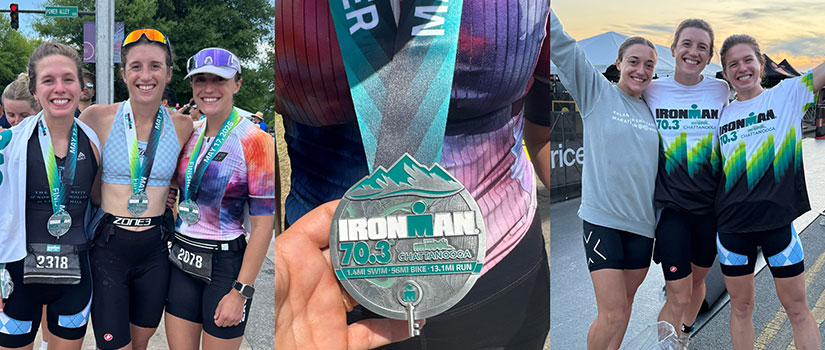
USC School of Medicine Greenville (SOMG) M3 medical students Molly Crosswell and Grace Anderson recently competed in Ironman 70.3s and now qualify to race in the Ironman 70.3 World Championship.
The Ironman 70.3 is an internationally recognized half-distance triathlon series. Competitors swim 1.2 miles, bike 56 miles, and run 13.1 miles in immediate succession. Racing requires months of disciplined training, strategic nutrition, and mental resilience.
For Anderson and Crosswell, racing together and crossing the finish line at Ironman 70.3 Chattanooga meant more than just athletic achievement. It also represented their shared dedication to lifestyle medicine.
“SOMG’s focus on lifestyle medicine was one of the primary reasons why I chose to come to this school, and it has shaped my experience as both a medical student and athlete,” said Crosswell. “The ability to learn about lifestyle medicine practices and incorporate those practices into my own life has helped better shape my understanding of how to support patients and how I want to practice medicine.”
Both future physicians point to the six pillars of lifestyle medicine—optimal nutrition, physical activity, restorative sleep, stress management, social connectedness, and risky substance avoidance—as critical to their success in endurance sports and medical school. Specifically, nutrition and social connectedness serve as cornerstones for Anderson and Crosswell’s approaches to triathlon training and academics. Crosswell has “come to learn that fueling properly is just as important as the training itself." Anderson feels lucky to understand “how important that social connection pillar is for overall health,” especially after a brush with social isolation during her first year of medical school.
Last September, Anderson finished her first Ironman in 12:05:32, placing second for her gender and age group—an incredible feat for anyone, especially a first-time racer. This year, Crosswell and Anderson both competed in Ironman 70.3s. Their placements qualify them to race in the 2026 Ironman 70.3 World Championship in Nice, France, this September.
Before her first Ironman, Anderson never swam laps. She grew up running with her dad, but she had no formal triathlon training. Support from her family, friends, coaches, and fellow medical students (including her husband Logan Cripe, M3 at SOMG) helped Anderson navigate the training learning curves. Seeing her loved ones along the run course were some of Anderson’s most rewarding moments during the race.
“In our M1 year, a group of my friends had the idea to do an Ironman, either a full-distance Ironman or an Ironman 70.3. Molly and I decided to go big and signed up for the full-distance Ironman. Unfortunately, injuries kept us from competing together at first, but ultimately Molly was able to compete and qualify for a spot in the Ironman 70.3 World Championships while I completed a full-distance Ironman,” said Anderson. “From there, Molly challenged me to set a new goal: qualify for the World Championship to join her in France. She told me if I competed in Chattanooga, she would do it with me. So, that’s what we did. It was so much fun to finally race together; and we get to do it again this September in France!”
Balancing demanding academics and athletics can be difficult even for seasoned triathletes. Fortunately, the skills required to succeed in endurance sports and medical education complement each other well.
“Medicine and triathlon training require similar skills, such as consistency, dedication, and the ability to stay focused on long-term goals even when progress isn't immediately visible,” said Crosswell. “Being an athlete has made me a better medical student by providing a healthy outlet and sense of balance during a demanding period of life. Being a medical student has also made me a better athlete. My medical education has deepened my understanding of physiology, nutrition, and recovery, and working with patients has given me a greater appreciation for health and the privilege of being able to compete.”
In addition to bolstering her academic performance, Crosswell’s experience with endurance sports has also changed how she thinks about counseling future patients on physical activity.
“Endurance sports have helped me find grace for my patients and learn the importance of meeting them where they are,” said Crosswell. “There have been days when I wake up and completing a workout seems close to impossible. As a healthy individual with no socioeconomic barriers to physical activity, I can only imagine how hard it is when there are barriers to entry.”
As Crosswell and Anderson prepare to race together again at the Ironman 70.3 World Championship later this year, they are carrying more than race credentials. They are demonstrating the values USC SOMG seeks to instill in every future physician: that health is built through daily choices, community support and a lifelong commitment to wellness.