He was a star quarterback for the Gamecocks more than 50 years ago, and for most of the years since then Tommy Suggs has been the color commentator for radio coverage of USC football games. He recently sat down with Remembering the Days co-hosts Evan Faulkenbury and Chris Horn to look back on his career and look ahead to the fall 2025 football season.
TRANSCRIPT
Evan Faulkenbury: All right, Chris. So the new football season is about to start. Gamecocks are coming up. What's your prediction or hope for this next football season?
Chris Horn: Well, we are currently undefeated because the season hasn't started yet. That's the old line for USC and probably lots of other colleges around the country. You know, hope springs eternal — a lot of really big expectations for this year, huge expectations for our quarterback LaNorris Sellers. It's going to be exciting just to watch and see how they do. I am cautiously optimistic — how about that?
Evan Faulkenbury: That's how I feel too — I can't wait. I feel like this is my second year here, and the first year I was still getting my head screwed on with being in a new place and a new job, and I feel like I didn't quite enjoy the football season enough. So this year I'm here, I'm more rooted, and we even got a new TV. So I'm ready to go for the opening game.
Chris Horn: Well, good. So you'll be watching games, but if you happen to tune in on the radio, you would hear Tommy Suggs, who played football here many, many years ago, had a ton of success on the field, and within a few short years of hanging up his cleats, he became the color commentator for radio broadcasts of Gamecock football.
Evan Faulkenbury: Yeah, over the decades, Tommy's been a staple here at the university and with the football program and radio and in the community here in Columbia, and for decades and decades now, he's done the color commentary and he's one of the more recognizable voices of the Gamecocks that we have. And so it was a pleasure to sit down with him and talk about some of his history and the upcoming season.
Chris Horn: Yeah. So let's get started.
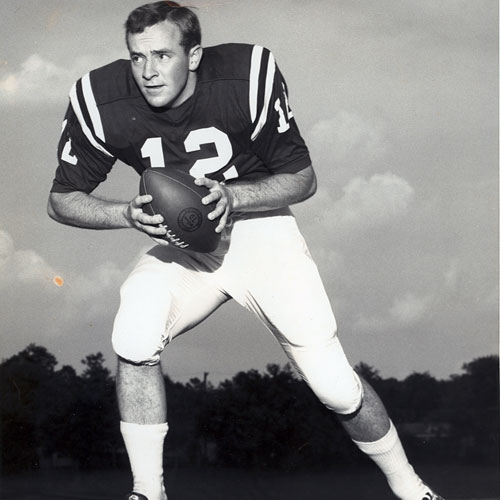
Chris Horn: You played the game more than 50 years ago. And as a commentator, you've had to keep up with how the game has evolved. But as you were saying, in some ways the game really hasn't changed that much. Could you talk about that a little bit, how the game has changed and how it's stayed the same?
Tommy Suggs: It's changed a lot because technology has helped a good bit there. Coaches, players have the ability now to see things in real time to do a lot more analytical stuff, look at trends better, just break down and get more data that they can do their game plans with and create plays. Um, which that has helped a lot. We had some of that when I was playing, but not nearly as much as they have now, obviously.
But on the athlete side, clearly they're bigger, stronger, faster. No question about that, and that's a good thing, I think. But candidly, if you look at it, weight training has improved a lot. Diets have improved a lot. People start earlier now playing. They get coached earlier. I wouldn't say all the early coaching is good necessarily. It worries me sometimes because some of the coaches mean well, but they don't really know what they're doing from a technical standpoint, fundamental standpoint. And I think sometimes that can hurt a kid or maybe just scare them out of being an athlete later.
Overall, the whole I guess environment has changed. From a broadcasting standpoint, you have to keep up with that. Schemes have changed and gotten more complicated because the data is better. And so they can tell when a player is looking to the right, favors their right more than their left. They can just do all that analytical work that we couldn't do back then. So that's helped a lot. But it still gets down to blocking and tackling, who does the fundamental basics of football better. And if you look at the teams sometimes, in my opinion, that really go on and win in the big games and win throughout, they all play good defense. They know how to tackle and they know how to come off the blocks, their fundamentals, they're coached well. So it's changed. No question about it. But still, in my opinion, the team that does the basics the best will endure.
Evan Faulkenbury: Let me rewind a little bit. And I read when I was doing a little bit of research about you that you grew up a Clemson fan but ended up here at Carolina to play football and study business. So why did you grow up a Clemson fan and then what brought you to USC?
Tommy Suggs: Well, I'm going to tell you more than you asked for. I'm not sure what I grew up as. I grew up six miles outside of Lamar, South Carolina, which is about 1,300 people, about 60 miles from here in the Pee Dee area on the way to Myrtle Beach. And I grew up on a farm and I worked hard, had a great work ethic, great family, loving brother to this day. Back in those days, you played baseball, basketball, football. And I ran track, small high school. I was drafted by the Mets to play Major League Baseball. I turned down scholarship offers with Lefty Driesell to go to Davidson. Coach McGuire wanted me to come here, and then it boiled down to football. And I just felt like that my future would was probably better in football than it was in the other two. So my junior and senior year, I kind of concentrated on football more than the others necessarily. And a lot of people, there were Clemson people. Being in the country in those days, farming, and we had some really close family friends that were Clemson. Clemson recruited me hard. And then Carolina changed. And Paul Dietzel came here as a head coach. He was big time. He'd won the national championship at LSU. He came from West Point and Carolina got after me then pretty, pretty hard. They were always recruiting me, but not as hard until he got here. And then he did a great job. He was a phenomenal recruiter. His staff, they were great recruiters as well. And then the people we knew and our family, friends that were Carolina people are people I wanted to emulate. They were people I wanted to be like. And so I ended up here. And that's how it happened. It's just weird sometimes as a young age how you make those decisions now, how much money they offer you, I guess, with NIL but we didn't have that back then. So that's how I got here.
Chris Horn: A lot of success as an athlete and a lot of success here in football and you had previous success in high school sports. Was there ever any possibility of playing professionally? The Mets were trying to recruit you right out of high school.
Tommy Suggs: I got offers to be a free agent in football with the Dallas Cowboys. Gil Brandt with the Cincinnati Bengals. And there may have been one more, but. But I got real lucky in life. My offensive coordinator then was named John Bridgers. And John had coached Joe Namath and, in his early years, Johnny Unitas. I had a really good year my senior year. I learned a lot from him. He changed the offense around and all this stuff. And I went to him and I sat down with him, and I asked him and he said, ‘Tommy, you throw the long ball better than any quarterback I've ever coached in my life, including Unitas and and Namath.’ And he said, ‘You got a lot of things you do well. You get out of trouble, you scramble, those guys couldn't run, blah, blah, blah.’ He said, ‘But if you go in the pros, you're 5'-91/2"and you're going to throw six touchdown passes in a scrimmage, and a 6'-5" quarterback going to throw four interceptions, and they're going to cut you because you're 5'-91/2."
He said, ‘Give it up. Don't do it.’ And I said, ‘That's exactly what I wanted to hear.’ And I did. I didn't want to do it, but I felt like I could make it even at my height. And it's great advice, probably some of the greatest advice I've ever gotten in my life, so I quit. I didn't try it. Bobby Richardson tried to get me to come out for baseball my senior year after my football career ended, and I finally said, ‘OK, coach, I'll come.’ And I took batting practice, and I think they were throwing it about 60 miles an hour, and it looked like a pea coming to me. And I said, ‘Coach, I think I've been away from it too long. I need to quit.’ And so I just kind of relaxed my last year, my last semester here then went into banking.
Chris Horn: So you made a fairly quick transition then over to broadcasting. It was Paul Dietzel's idea, right?
Tommy Suggs: I was a journalism broadcast major or whatever. And what actually happened was I was very active in the Fellowship of Christian Athletes here on campus, and I spoke a lot. And actually one year I spoke at the Super Bowl down in Miami. I spoke in North Carolina some, and I was pretty active in that and Coach Dietzel was as well. So he and I one time ended up at the same event, and both of us were speaking. And I guess he was impressed because about a year or two later, whenever it was, ABC came out with Monday Night Football with Don Meredith, Howard Cosell and Frank Gifford. He liked that format so he called Brent Hill, who was a manager of WIS radio here in town at the time, and they were our network, basically. And he said, ‘I want to go to the ABC format, and I want three people and one I want to have is a former player. And I've been with Tommy Suggs a couple of times and he talks OK and played for me. Let's just put him on there.’ And that's how I got on it. And I've been there 52 years. It's amazing how God leads you through things and how life takes you through things. And it just happens, you know? And that's what happened.
Chris Horn: And I think I remember reading somewhere that you said your first year, you didn't feel like you did all that well and you thought they might —
Tommy Suggs: I didn't feel like I did well last year. That's true. It was learning. It was a real learning process because, you know, you got the headphones on, you got the mic here, and listening to yourself talk and all. And there were three of us, which was always kind of when do I talk? When do I not talk, this kind of stuff? Bob Fulton I worked with him — a legend — for 23 years. And Bob liked me to say about two words and that's it, you know, and I'd get started and talking and all, so. But he ended up being a great mentor of mine and very patient with me. But overall, I think I've gotten a little better. But I had to learn. And then one year our network decided that they would have the engineer and producer and everything in my left ear and the and the broadcast in my right ear, and that didn't go well with someone that only broadcast 12 or 13 times a year. That takes an adjustment. You know, I'm not a professional at all. And so that was really adjusting. And we did that for two years. And they finally cut that out not because of me. It just didn't work.
But it's been an interesting experience. I'll tell you one thing though about it, if I may. That's interesting, is that I had a doctor one time tell me how lucky I was to do it. He's a Carolina guy, and I admitted that and everything. He said no, but you don't know why I mean that. And I said, what do you mean? He said, your work on a weekly basis is insurance man, blah, blah, blah. I said, yeah. He said during football season you turn your brain to participating in a bridge tournament. And he said that is so healthy for your brain. And I went. I never thought about that. He said, your learning changes. You have to be flexible. You have to remember things. And I've thought about that. He told me that about six years ago. And he was so right, so right. Because the learning process, the preparation is so different. And then you get in that booth and you’re on seconds, you know, five, four, three. Get out of here. Cut it. You know this. And it's really — it's an interesting process to go through when you have to flip from one type of learning to another type of learning and be on stage for no better term. So I've been very fortunate, very fortunate.
Evan Faulkenbury: When you're in the broadcast booth, how do you keep a cool head? Because as someone who played, you bring your fanboy-ness to your perspective and your color commentary, but I guess you have to rein it in sometimes, too. How do you find that balance?
Tommy Suggs: I don't. I lose it sometimes. I think there is a discipline you have to have. And you know that when you're going in the booth, you've got to be careful. You're not ESPN or CBS. You're the University of South Carolina network. So you have to remember that. You have to remember that there's a wide group of people listening to you. You can you can say things one way and get the meaning across without saying them another way and just hurting people's feelings and being mean to people. But overall, they have told me over the years that my job is to be analytical, but also be the fan, the Carolina fan, and I probably, sometimes I take the Carolina fan to the extreme. I get wrapped up in it, and I think people want to hear that because I think they're sitting at home or sitting by the pool listening to the game, and all of a sudden we score against Missouri or score against Clemson. They don't want me to be blah. They're probably screaming and hollering or something like that.
So I want to do the same thing. And is it childish? Is it unprofessional? Probably, but I really don't care, because it's Carolina and that's who I am, and that's who I try to be. And I think overall, unlike some professional person, maybe, most people like that and enjoy that. I try to be them for no better term. Also, in my analytical work, I come at it a little bit differently than some. I don't try to get in the weeds too much with coverages, with all this stuff, because I don't think the average fan candidly knows that. And if I said it, they'd get lost in it. So I'm not demeaning the average fan, but I don't think it's my job to be an analytical person on the schemes they're running. You can say, yeah, we're running a soft zone as opposed to a man to man. That's one thing. But you get into some of the stuff, it gets way too technical and I don't want to do that. I don't think that's what the people want. I may be wrong on that one.
Chris Horn: Looking back over the more than 120 years of Carolina football, no one would say we've ever been a perennial powerhouse. We've had some good years, we've had some good runs, we've had some not good runs. And in the 50 years that you've been in the broadcast booth, you've seen the good, the bad and the ugly. Is it difficult not to become cynical or to think, gosh, why can't we have five great years in a row?
Tommy Suggs: I think overall, you're right on that. It's somewhat hard to understand why we've never been able to consistently be a consistently good football program. We have had tremendous games, tremendous years, teams, players. But it's just been kind of up and down a little bit. And I get that, I understand that. I don't think, though, that it ever feels — it doesn't get in my brain when I go in there because I'm such an optimist. I think we're going to beat everybody's butt when we walk in there, more or less.
But I also am a realist, understanding that we can lose because they could have better talent than we do. But this year was different, if I may go to this year, because we had good talent. Some of it matured a little later than others, and it's oddly enough, it's easy to look back because the kids now that are going to the NFL combine, we had 11 I think. The last time we had that number was when Spurrier was here. We were No. 4 in the country. So we need better talent. We need more of it. And when you get that and you've got your good coaching staff in place, then you can perform, I think.
The amount of confidence we all had in that broadcast booth and on that staff and all this year at the end of the year was phenomenal. You could feel it. You could smell it. OK, we're going to still get this game. It was just a sense of camaraderie, team, love, confidence. And we had athletes, you know. So that always helps. I think overall all of us need to get past that because in life and in sports and business or whatever, you have your ups and downs, but all of a sudden you hit a path and you take off. And I think the university, I think athletically here, we're on that path and we need to accept it and go with it.
Evan Faulkenbury: When Carolina is successful in its football program, what does that do for the university, the community, for Gamecock fans, you know, worldwide tuning in?
Tommy Suggs: It’s priceless. I mean, I laugh and tell people when we were No. 4 in the country and winning all the big games with Spurrier, Columbia became a cooler place to live. People always were always asking you about Columbia, the university and this kind of stuff. I just came back from Dallas, Texas. I was on a panel discussion out there in front of about 300 people from all over the country. And there were four of us up there, and it was about insurance and other stuff, and they got to me and they introduced me as a Gamecock. And so people came up to me afterwards. And we have a home in the mountains. We've been fortunate. We have a beautiful place up there with a lot of great friends from all over the country, and they follow Gamecock football. They want to come to games. You know, I got buddies of mine, hedge fund managers in California that a couple of them moved to north of Greenville. And they called and we brought them down to a game a couple of years ago. They wanted to come to a Carolina game because they see it on TV and the flags or towels rather. So you got to win though. You got to win. And if you win, that's what people are looking for now. And when you win and also have that atmosphere and a great place like the university here in the city of Columbia, which is a super big college town. Hard to beat it, guys. Hard to beat it. People want to be around you.

"We love this city. We love this university so much because it's meant so much to our family, and it means so much to other people in this city and state. So I don't know what the next one is or next thing is, but we’re kind of looking around now and just seeing what kind of hits our fancy a little bit. But whatever we can do to help this university, its staff, its faculty, its students continue to be better, our athletes be better and win — we're all in."
Evan Faulkenbury: This past year, a lot of fun to watch. We went on a huge win streak towards the end of the year. Wrapped it up by beating Clemson. Coach Beamer had a really successful year. Like you said, the players grew and got better and better. You could see the team elevating. Do you have a favorite memory or a favorite game or a favorite moment from this past 2024 season?
Tommy Suggs: I don't know of an exact moment, but I felt like mid-year, we could have gone one of two ways. We could have let the Ole Miss/LSU, whatever you want to call that game, really get to us. And we didn't. And I thought that was critical. It wasn't a play necessarily. It was just coming together. And I thought Shane and his staff did a heck of a job of keeping the crowd together, keeping them focused. Nothing better than a win or two to help. But all of a sudden you saw kids at practice, and we fly with the team, and you could feel it. You could see in their eyes that they had more confidence. They knew they could be good and they had a road ahead. I saw Shane Beamer mature as a head football coach. Not that he wasn't a mature guy at all. And I've shared this with him. But, you know, he was a graduate, I mean, an assistant, never been a coordinator and came into this job, and he had a learning curve, as it would be for any of us. And I saw him really, really, really grow into the job this year. And I'm really happy for him, his family. He works hard. He's a great person and the staff, he's put a good staff together. So I feel real good. But again, a lot of great plays at Clemson, Missouri, Oklahoma. I mean, Oklahoma going out there and beating them 36 to 9. And they got the strongest, best home winning record in college football. People forget about that. They forget about it. We had nine sacks out there. But to me it's that mid-year when we could have gone either way. And we went to good way. And I just saw us and I felt it and I'm still nervous, but I saw it.
Chris Horn: It's probably hard to to calculate how much of that is coaching influence, and how much of it is the character of the student-athletes. But would you say maybe it skews a little more toward the coaching staff knowing what to say, how to how to keep those guys motivated?
Tommy Suggs: I would, I really would. I think that's critical. I think it's very, very important in our lives to have those people around us that can, can touch those points within us, that can get us to understand what we've got to do to be better, to go to the next level. And I think a lot of that has to also do with the character of the players on your team. But you can develop character by associating with better people. And I think that that's when it doesn't matter what Shane Beamer or anybody else says. It's what those players say off the field at night to the other players. It's those leaders on the team, that senior leadership. Those guys sometimes can have more influence than Shane Beamer can at practice.
Evan Faulkenbury: Do you have a prediction you'd like to offer, maybe not in wins and losses necessarily, but what are you looking for in the season coming up?
Tommy Suggs: I have no clue. No! I think a general statement would be that last year, as our defense was ahead of our offense and played better and took a while for our offense to catch up. Took a while for LaNorris Sellers to find his footing, for the coaches to find out what he could do best. You know, he only played, what, 9 or 10 plays a year before. We thought he was the second coming. It was unfair to the kid because he wasn't there. But the defense played well. I think this year it may flip. I think the offense may be a little ahead of the defense because we lost so many players over there. But we filled them with some transfer portal kids and we could be good both sides and equally same timing. But I think the offense ought to be, in my opinion, probably ahead of the defense. We got a great core of wideouts coming in. They're young. We got running back situation I think is better although we lost Rocket Sanders. But we ought to be OK there. We got LaNorris Sellers of course. Offensive line. We got some transfers in there. But that's the way I look at it right now.
Chris Horn: What's the next highlight for you? Have you accomplished everything you can or is there still some milestone that you'd like to hit?
Tommy Suggs: When I feel like I've accomplished everything I can, I need to quit, period. And I'm not there at all.
We lost our daughter to cancer at 33 years old. And I'm probably more proud that we named the dance program here in her memory. Did that about a year ago. And we're very pleased and excited about that. That is probably more touching to me than the Tommy Suggs Garnet way or the 2001 tunnel. But we want to do more. We have been very fortunate in our life and we're big into giving back. And we also are a family that we know what this university has meant to us, to our daughter, to our son, our grandkids. And our daughter-in-law is a big Georgia business school graduate, and she's taken some antibiotics — she's over that now. She's one of us. And my wife graduated from Brenau University over in Georgia, and she was on their board for 15 years. So we understand giving back. We understand and we want to do that. We love this city. We love this university so much because it's meant so much to our family, and it means so much to other people in this city and state. So I don't know what the next one is or next thing is, but we’re kind of looking around now and just seeing what kind of hits our fancy a little bit. But whatever we can do to help this university, its staff, its faculty, its students continue to be better, our athletes be better and win — we're all in.
Chris Horn: Tommy, thanks so much for being with us this morning.
Tommy Suggs: Thank you very much I appreciate it.
Chris Horn: Well, that was a fun conversation with Tommy. I didn't realize that he had considered trying out for the NFL. I think he made the right decision. It seems like to him he made the right decision as well. And certainly we've all benefited from him immediately going into radio coverage. Well, Evan, tell us what's next on Remembering the Days.
Evan Faulkenbury: Well, our next episode is going to be on the McBride Quad. These are the residence halls that are on Blossom Street that have been there since 1955. They have a certain reputation on campus. A certain look to them, you might think. And in fact, pretty soon the university is planning to take them down and put up something new. So before that happens, we thought it'd be fun to look back on McBride's history as the fraternity quad and a place where hundreds, really thousands of students grew to maturity in these buildings before they're gone.
Chris Horn: That's next on Remembering the Days.