A multistate, multidisciplinary team of researchers — including project investigators from the University of South Carolina’s Baruch Marine Field Lab — has spent four years collaborating on a study into the impacts of warming coastal ocean waters on shrimp populations. Carefully analyzing decades of existing data, as well as newly collected data, they have determined that shrimp populations across South Carolina and Georgia appear to be changing in subtle ways but have been largely stable over the past two decades.
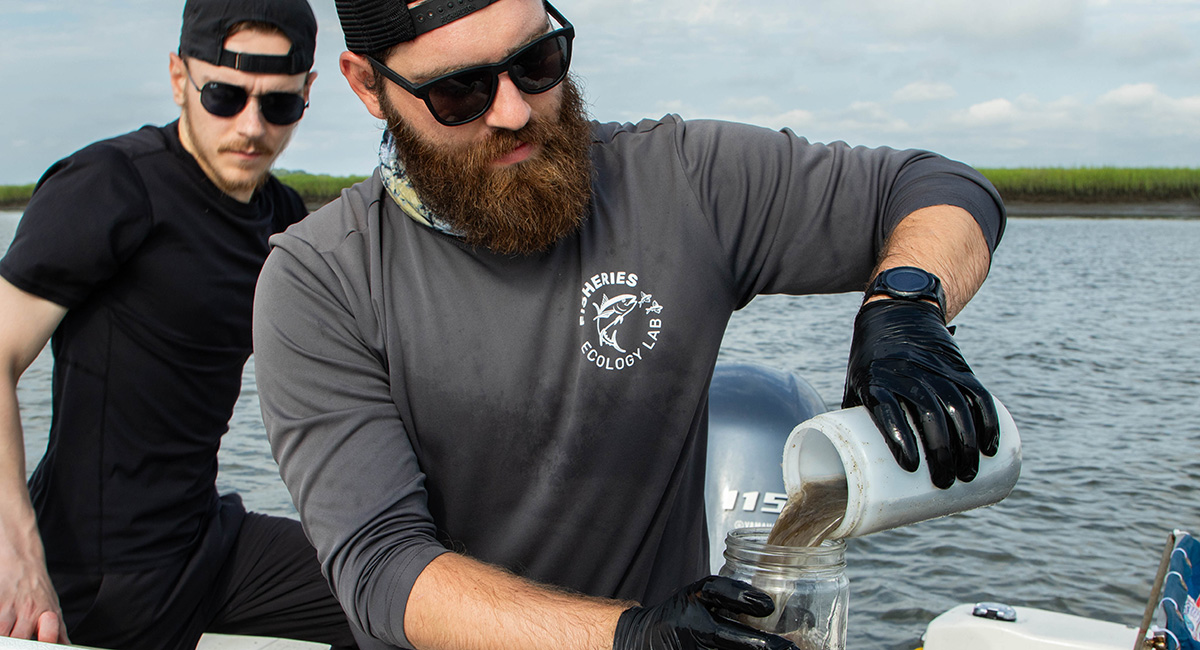
As part of their investigation, USC research affiliate Robert Dunn and Ph.D. candidate Liam Batchelder worked with fisheries extension agents in South Carolina and Georgia to interview commercial shrimpers who navigate trawlers across local waters. These shrimpers see firsthand how environmental conditions can affect their haul, and their efforts support a vital coastal industry that helps draw millions of tourists every year.
In addition to USC, the Lowcountry Shrimp Collaborative project team includes National Estuarine Research Reserves in North Inlet-Winyah Bay, ACE Basin, Sapelo Island, the S.C. Sea Grant Consortium, UGA Marine Extension and Georgia Sea Grant, S.C. Department of Natural Resources, Coastal Carolina University and the South Atlantic Fisheries Management Council.
“We are academic researchers. A lot of our focus is advancing knowledge about these animals and the environment they live in,” Dunn explains. “Some of this information can be applied to enhancing sustainability of this culturally significant fishery resource.”
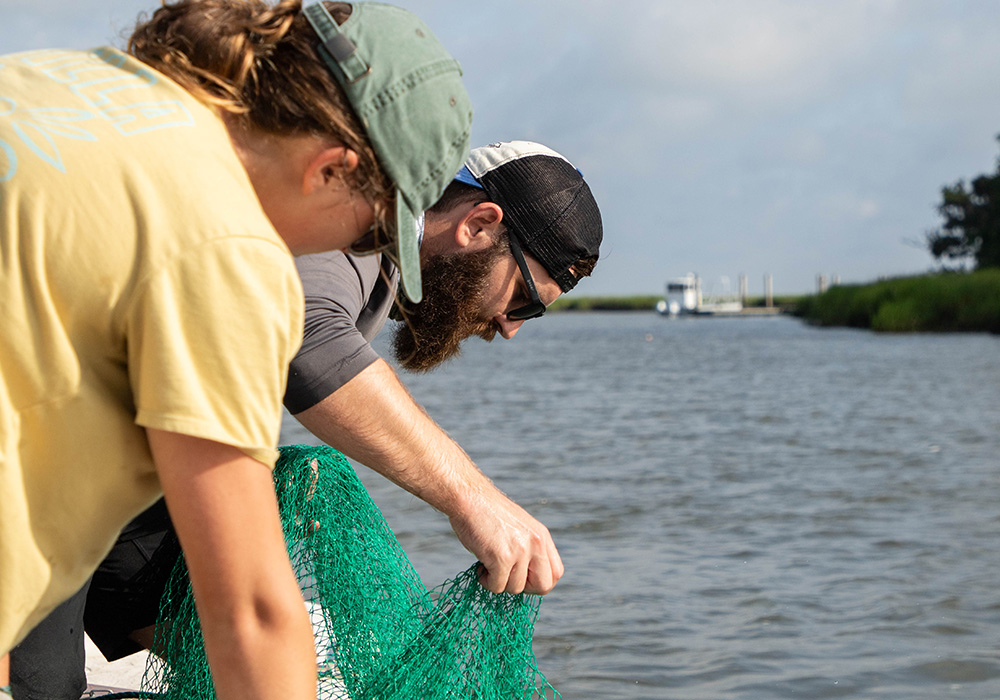
As project investigators, Dunn and Batchelder led their colleagues studying long-term variations in shrimp populations in the coastal estuarine environment. Batchelder, joined by other graduate and undergraduate students as well as colleagues from S.C. DNR, led data collection from sites in the National Estuarine Research Reserves.
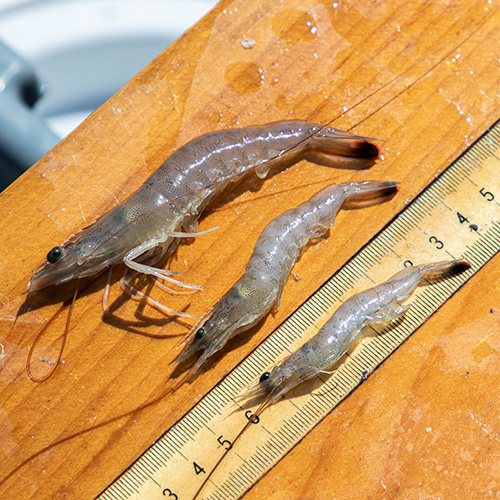
The team simultaneously collected data on multiple shrimp life stages and their prey resource — the small creatures that shrimp feed on. This allows the team to investigate spatial and temporal variation in shrimp early life histories within estuaries.
Shrimp have a relatively short life cycle of about a year, spending multiple life stages in estuaries before moving to open water to spawn as adults. Juvenile brown shrimp appear in estuaries earlier in the year, while juvenile white shrimp arrive later and stay longer. Accordingly, they spawn at different times. Overall, the shrimp spend about six to eight months of the year in the estuary, Batchelder says.
White and brown shrimp comprise the bulk of commercial shrimp in the region, Dunn says, with white shrimp populations historically being the more economically important of the two. Through analyzing long-term data, conducting field sampling and lab experiments at the Baruch Marine Field Laboratory, and interviewing commercial shrimpers from 2021-25, the research team came to several key conclusions, including:
- The most prevalent environmental change over the past three decades was increasing water temperatures throughout the region, especially during the critical winter months.
- Water temperature has a stronger effect on shrimp populations than salinity. As cold-blooded animals, shrimp are especially sensitive to temperature.
- Warmer winters have extended the harvest season, which used to end in December but now often runs through January.
- Post-larval white and brown shrimp are increasing in abundance over time.
- The geographical range of shrimp species studied is shifting northward for the first time.
“The shrimping season usually ends around the end of the calendar year in December. But lately, the shrimp seem to be sticking around later into the winter,” Dunn says.
An interesting additional observation has been the establishment of very small shrimp fisheries as far north as the Chesapeake Bay, suggesting that some species of shrimp are surviving farther to the north.
Ways to coexist
While brown and white juvenile shrimp arrive in the estuary at different times, there is about a six-week period during which they overlap, sharing the same estuarine habitat and, therefore, competing for the same resources. One way they coexist is by divvying up separate nonoverlapping geographical areas or sections of the environment for their species to occupy. This is called spatial partitioning.
We are focused on training the next generation of scientists and are proud of how many students were involved in the project.
Another way the two species of shrimp coexist is alternating time spent in a space, or temporal partitioning. This is naturally facilitated by the different arrival times of juvenile shrimp in the estuary.
The researchers also looked at “density dependence” of the brown and white shrimp — factors such as disease or competition that affect the size of a population in response to the concentration of animals within a single unit of space. In their lab experiments testing for density-dependence, Dunn and Batchelder found that body size was an important indicator of survival, with smaller animals having a higher risk for mortality.
The shrimp were most concentrated together in the same part of the estuary during June and July. These species reduced their risk for density dependence through habitat partitioning.
The Baruch researchers’ shrimp studies will continue, branching next into the tidal creeks.
“We knew we had a goldmine of data to leverage to identify long-term trends in both the estuarine environmental conditions as well as numerous life stages of shrimp,” Dunn says. “This has been a very productive project with a strong collaborative team able to analyze long-term data sets. We are also focused on training the next generation of scientists and are proud of how many students were involved in the project. Their enthusiasm and motivation were key to our productivity.”