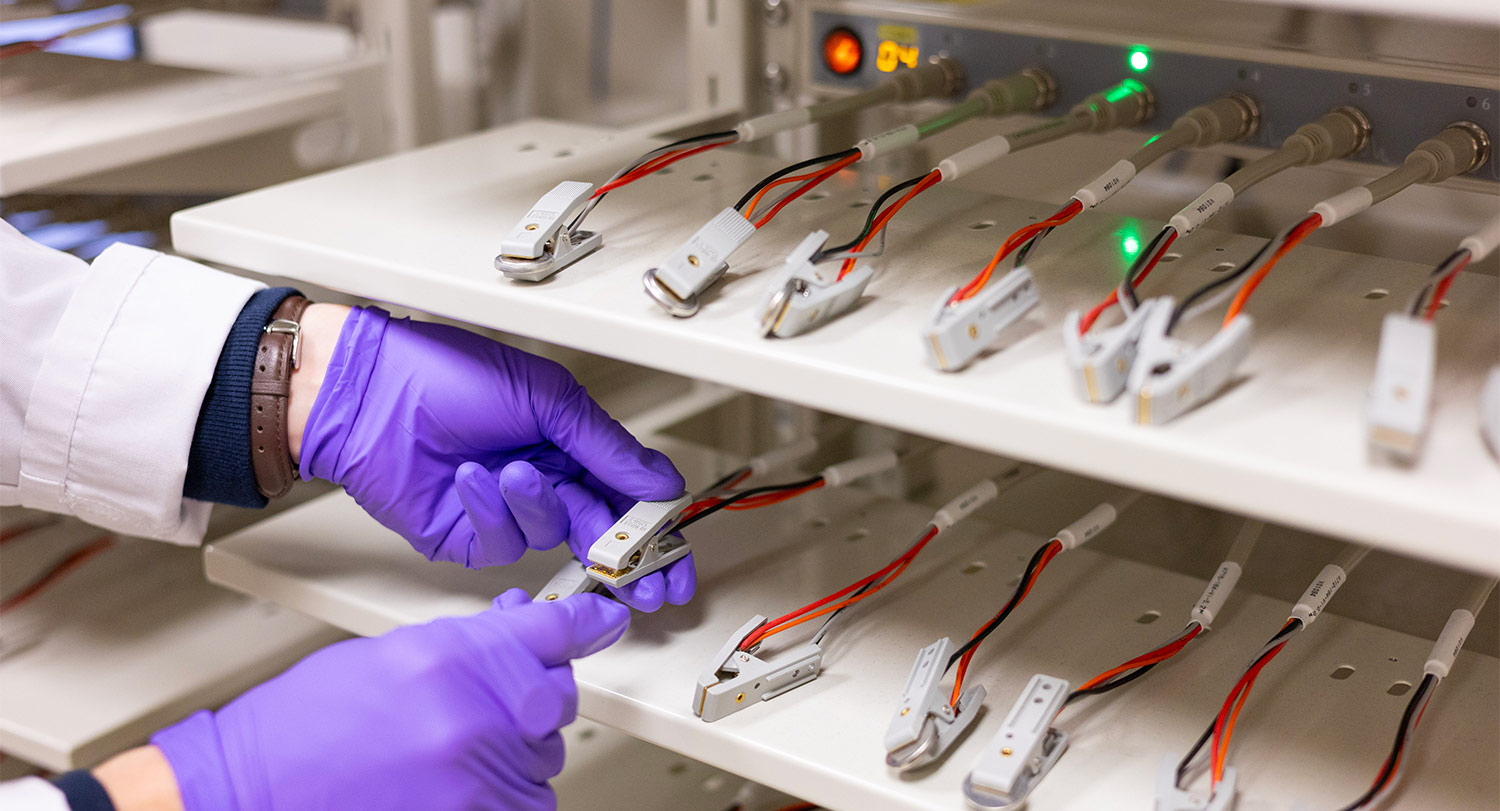
In about 18 months, the Carolina Institute for Battery Innovation at the University of South Carolina plans to open the first phase of its Battery Center, a research, manufacturing and teaching facility in partnership with several commercial battery manufacturers.
The 20,000-square-foot facility will be housed in a section of the university’s former biomass building on Whaley Street near the Swearingen Engineering Center. Funding for renovation, upfitting and equipment has been provided by the U.S. Economic Development Administration, the S.C. legislature, industry partnerships and internal university resources.
“Our vision is to build out more than 100,000 square feet of battery-related research and manufacturing space, but to do all of that at once would take several years,” says William Mustain, director of the Carolina Institute for Battery Innovation and a chemical engineering professor in the Molinaroli College of Engineering and Computing. “The battery industry needs our help now, not years from now, so we’re moving forward with this initial phase, which will have a battery pilot-scale manufacturing, a cell formation and testing lab and office space for about 40 researchers.”
Several battery manufacturers have invested more than $10 billion in manufacturing in South Carolina in the past two-and-a-half years, and USC’s 100-member cadre of faculty, research staff and graduate and undergraduate students involved in battery research is partnering with many of them in research projects.
Most of those researchers are in the Molinaroli College while some hail from the McCausland College of Arts and Sciences. Investment in the first phase of the Battery Center will help cement the university’s role as a regional hub for resilient energy, including grid-scale stationary batteries and electric vehicle innovation.
“It’s not just our research that our battery partners like. It's the fact that they can hire our graduates and advance the careers of their people through certificates like this."
When the first phase of the Battery Center is fully operational, USC and battery industry scientists will focus on three battery cell types with the capacity to produce 1,000 cells per week, Mustain says. Contingent on available funding, the longer-range plan is to demolish the remaining portion of the former biomass building and construct a new facility adjacent to the phase one space, providing more capacity for battery-related research, manufacturing and teaching.
University research administrators have been meeting with industrial partners for months to plan the initial phase of the Battery Center, with Fraunhofer USA, in particular, assisting in equipment and space flow design.
“It’s fully designed to the highest level of detail,” says Hossein Haj-Hariri, dean of the Molinaroli College of Engineering and Computing. “Some of the equipment already has been ordered. We just need to break ground.”
The Molinaroli College is also designing a graduate certificate in battery design and engineering and plans to offer an undergraduate minor in that field.
“It’s not just our research that our battery partners like. It's the fact that they can hire our graduates and advance the careers of their people through certificates like this,” Haj-Hariri says. “These are certificates that people absolutely want to earn.”
Haj-Hariri envisions the Battery Center facility as the first stride toward creating a new engineering district adjacent to the Swearingen Engineering Center, with industry-partnered research focused on artificial intelligence, nuclear energy, advanced combustion and other fields in which Molinaroli College faculty members have particular expertise.
“As we build out that district, more people are going to hear about the areas of expertise and success stories that we have at Carolina,” he says.
