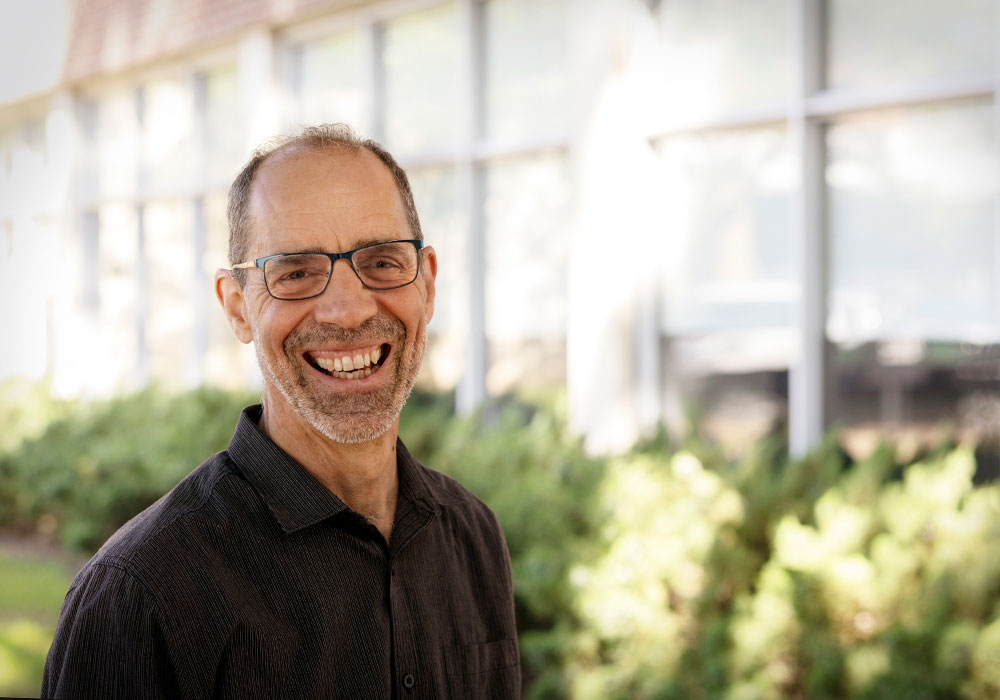
Greg Carbone’s interest in weather comes naturally. As far back as he can remember, the University of South Carolina geography professor has been contemplating storm systems, meteorological phenomena and the earth’s evolving climate. Simply looking up at the clouds can excite his imagination.
“As a kid, I just always noticed those kinds of things — the sky, the earth, what was growing around me,” he says. “Part of my challenge as a teacher is to recognize that not everyone is like that. Everyone has their own thing that they’re intrigued about.”
That awareness helped Carbone win USC’s 2025 Michael J. Mungo Distinguished Professor of the Year award, but lecturing and leading classroom discussions didn’t always come so easy. As an undergraduate at Clark University, even a 10-minute presentation filled him with dread.
“I was pretty introverted, I was pretty shy,” he says with a casual smile that makes you believe him. “We had to give oral presentations in class, and every time it was absolutely frightening to hold those index cards and to actually stand up there and give those talks.”
Forty years later, he counts teaching among his biggest professional pleasures. And his favorite course? Introduction to Weather and Climate, a 200-level course taken by majors and non-majors alike, because it bridges the gap between hard science and daily life.
“I'm really keen on them making the link between the abstract, theoretical stuff about how it works — the dynamics, the radiation budget, the moisture budget — and the processes that underlie everything that they witness,” he says.
Carbone turns toward the window behind his desk. From his third-story perch in the Callcott Social Sciences Building, he looks out through the leafy boughs of a hearty oak at a bright blue sky. There are no clouds this afternoon, but as he considers his classroom approach, he imagines a few wispy white brushstrokes across the heavens.
“If my students look up and see some high cirrus clouds, I want them to think, ‘Hmm, I wonder where that moisture came from. I wonder how it got up that high. I wonder what kind of winds brought it here. I wonder what it means for tomorrow and the rest of the week.’”
Carbone’s curiosity is contagious, but he didn’t originally set out for a career in the classroom. He was more inclined toward fieldwork. Or lab work. Or some integration of the two. Maybe he could land a job with a state agency or the federal government. The National Weather Service was an option. Or he could work for a private consulting firm.
“If my students look up and see some high cirrus clouds, I want them to think, ‘Hmm, I wonder where that moisture came from. I wonder how it got up that high. I wonder what kind of winds brought it here. I wonder what it means for tomorrow and the rest of the week.’”
He wasn’t considering graduate school, though — because, as Carbone understood it, graduate school meant a graduate assistantship, which meant lecturing and leading discussions, which meant confronting those same class presentation jitters on an even bigger stage, and several days a week.
But his adviser saw potential. She convinced him to apply to a few graduate programs, and he got into all of them. Soon, Carbone found himself at the University of Kansas, preparing for his dreaded first day as a graduate teaching assistant in a meteorology lab, expected to introduce the students to the basic principles of earth-sun geometry.
“The sun drives everything else, so you start with that. And I was going to talk for 10 to 15 minutes, introducing the concept of orbital rotation,” he says. “But I was so obsessed about getting it right that I prepared for like a week for this one lecture. I remember it vividly, walking home at 1 a.m., literally reciting my lecture out loud.”
And how did things go when the big day finally arrived? How did his students respond when the orbital rotation began in earnest?
“It was amazing!” he says. “There’s this elation that comes when you’ve prepared really hard for something, and then it starts going well. I could tell by the expressions on my students’ faces and by their reactions — after that, I was fine.”
He reaches for a metaphor to describe the feeling.
“I used to run track and field,” he says. “You’re out on the track, people are watching you, everyone’s jockeying for position — it's so easy to get psyched out. You feel the lactose, the lack of breath and oxygen, and you're thinking, ‘You know what? If I just pretend to trip, I don't have to worry about it anymore.’ But then on the first turn, or the first quarter mile, your competitive juices kick in and you go into autopilot. Teaching that first class felt like that.”
He hadn’t mastered the art of teaching — he doesn’t pretend to have mastered it now — but he had cleared the first hurdle. He started to hit his stride a few weeks later when he caught a glimpse of a fellow graduate student leading another lab section on the same hall.
“His dad was a professor at a small liberal arts college, and he was just very comfortable in the classroom,” Carbone says. “His door wasn't open, but there was a small window where you could look in, and I saw through his body language, in the way he turned his head and his smiles, that you could actually do this with joy.
“Before that, I was still just worried that Kepler and Galileo might be rolling over in their graves!”
That single realization changed the trajectory of Carbone’s career. Instead of simply preparing course activities and materials, he tries to take a moment to remind himself of the classroom dynamic. Now, whether they’re talking about fluctuations in dew point and relative humidity or launching a weather balloon to capture data in real-time, he tries to convey his own excitement and wonder alongside the hard science.
“Everyone likes interacting with someone else who is enjoying what they do,” he says. “If I take just five or ten minutes to let go of everything else and imagine myself in front of the students that I’m hoping to reach, I have an easier time sharing this passion I have for the subject. I can’t do it every time, but almost every time I do, the experience is extraordinary.”