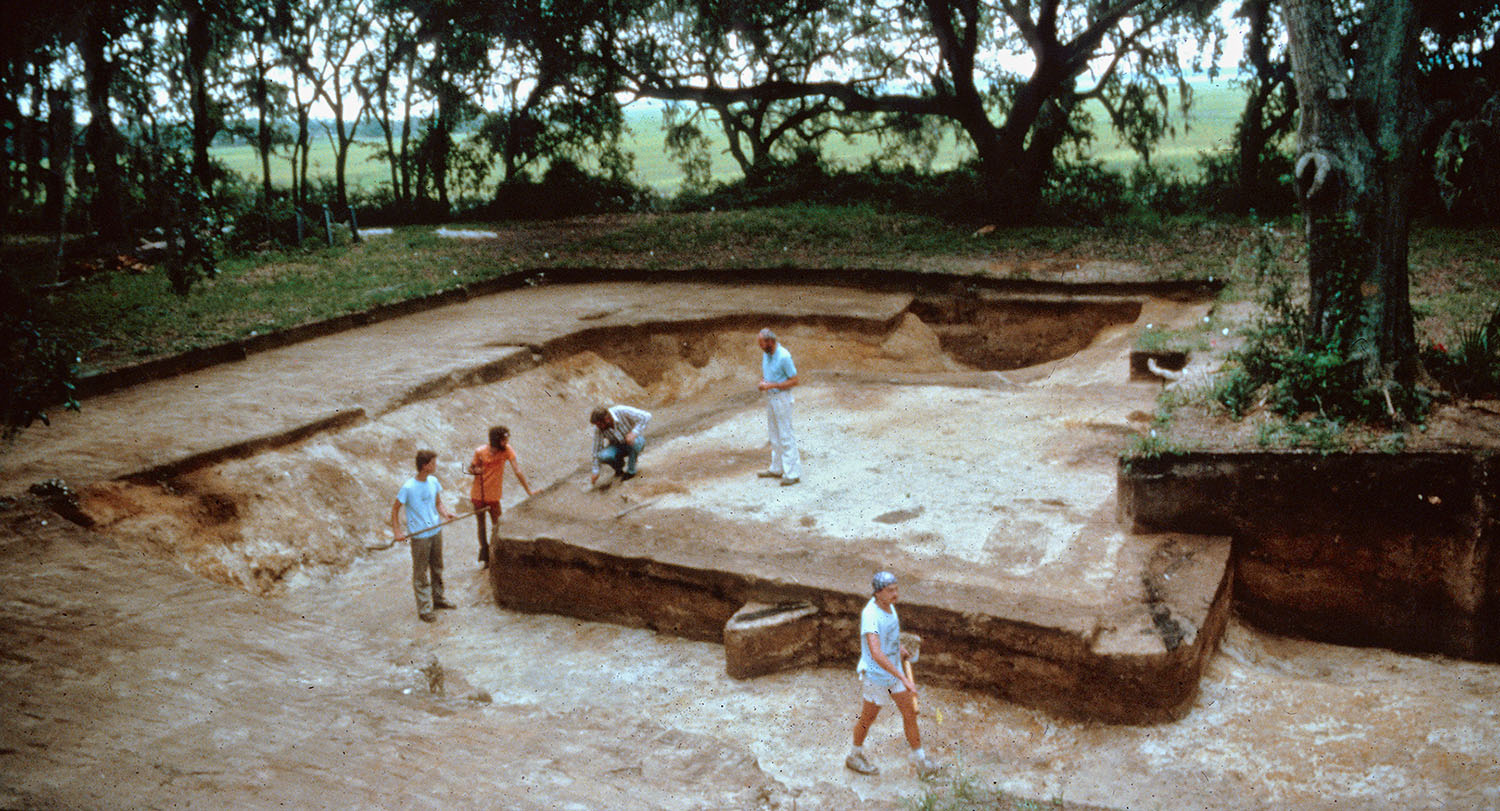
Not unlike a determined forensic detective meticulously going through a suspect’s trash for evidence, Chester DePratter has been sorting through archaeological evidence gathered over nearly three decades of investigation at the 16th century Spanish settlement of Santa Elena on present-day Parris Island.
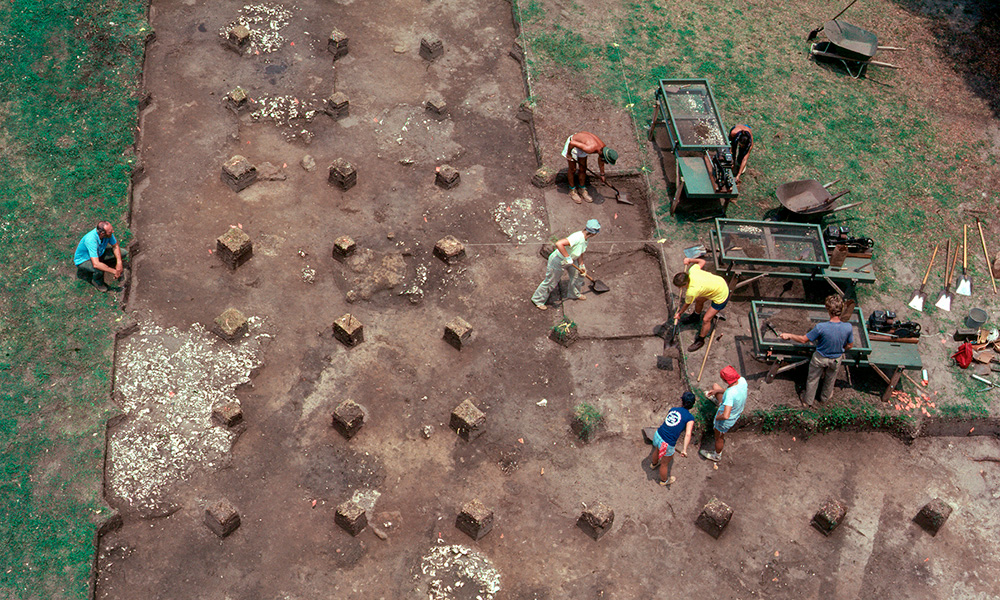
“The archaeological dig is essentially collecting the garbage left by people a long time ago,” said DePratter, a research professor emeritus in the University of South Carolina’s S.C. Institute for Archaeology and Anthropology. “We’re looking at things left behind by residents and soldiers. The predominant items we find are ceramics, tableware and olive jars (shipping containers of that era). We also find military artifacts like gun parts, crossbow parts and tool fragments.”
DePratter is working with institute colleagues James Legg and Heathley Johnson on artifact analysis and report writing.
A nobleman explorer
Intent on claiming portions of the southeastern U.S. coast for Spain, nobleman Pedro Menéndez de Avilés in 1565 established multiple outposts, including the most well-known, St. Augustine in Florida. The following year, Menéndez began building the settlement of Santa Elena in South Carolina. The Spanish occupied Santa Elena from 1566-1587.
The site went through many changes and uses over the ensuing centuries. In the 18th and 19th centuries, the land was occupied by working plantations. During World War I, it provided training grounds for U.S. Marines bound for Europe. Then it became the present-day U.S. Marine Corps Recruit Depot. Fortunately, remains of the Santa Elena site were protected beneath a golf course that was built in 1947. In fact, DePratter suggests Santa Elena is the best-preserved 16th century town in the country.
The archaeological dig is essentially collecting the garbage left by people a long time ago. We’re looking at things left behind by residents and soldiers. The predominant items we find are ceramics, tableware and olive jars. We also find military artifacts like gun parts, crossbow parts and tool fragments.
In 2001, the site was certified a National Historic Landmark. It remains under Marine Corps stewardship and was approved for limited archaeological exploration. The late SCIAA archaeologist Stanley South found the confirmed remains of Santa Elena in 1979. DePratter joined the long-term project in 1989.
“The primary fieldwork on the site took place between 1979 and 2007,” DePratter says. “We haven’t been actively digging since then. We returned in 2014 with Victor Thompson of the University of Georgia and used remote sensing to find a Spanish fort. We went back in 2017 and mapped out 80 percent of the site using a series of remote sensing tools.”
Among remote sensing tools the researchers employed was ground-penetrating radar, in which radio waves are directed into the ground to measure differences in local magnetic fields to assist in mapping the remains of Santa Elena.
Over 21 years, a total of five forts were constructed by the Spanish at Santa Elena, used and abandoned intermittently due to fire, decay and unstable relationships with local American Indians.
Capital of ‘Spanish Florida’
In 1571, Menéndez moved his family to Santa Elena, which became known as the political capital of Spanish Florida (La Florida), a massive region of Spanish-occupied lands from Mexico and Florida and north along the Eastern seaboard to Newfoundland.
At its height, Santa Elena was home to more than 300 settlers and soldiers who erected more than 60 domestic structures. The town bustled with shops, taverns and a church. Missionaries arrived to introduce Catholicism to Native Americans.
“When the Spanish came and settled on Parris Island, they settled on an abandoned Indian town. At first, they immediately established friendly relations with the Indians,” DePratter explains. “The Spanish, for a time, were trading with the Native Americans because supply shipments from Spain were irregular.”
The fragile cross-cultural courtship did not last. In 1576, the Native Americans attacked Santa Elena, resulting in abandonment of the colony and its rebirth after about a year. By 1587, Spain ultimately abandoned Santa Elena due to a threatened attack by English explorer Sir Francis Drake, and the Spanish colonists moved south to St. Augustine.

Among key features the researchers hoped to confirm was the existence of wells at Santa Elena. With 300-plus residents and up to 60 homes identified over 21 years at the site, access to fresh water was essential. The team collected an abundance of information on the location of potential wells near individual house lots. A lack of funding, however, has prevented the researchers from returning to the site to definitively confirm those locations are wells.
Using GPR, the team identified 193 reflection signatures in the GPR data, some of which could represent buried or filled-in wells once constructed of dugout earth and wooden barrels, similar to some wells found at St. Augustine.
The team also found the earliest known evidence of a European-style kiln. Consistent with the Spaniards’ documented reliance on ceramics, they found thousands of fragments of 1-3-gallon olive jars, which are coarse earthenware vessels the Spanish used to ship supplies.
The complexity of findings from the Santa Elena site investigation far transcends the Spanish occupation. “We are looking at multiple uses spanning 4,000 years,” DePratter says. “It’s like putting together a huge puzzle.”
Native Americans first occupied the site 10,000 years ago. Their occupation of the site continued until about 100 years before the Spanish arrived.
Nearly half of the ceramics found at Santa Elena were Native American vessels. Archaeologists also found evidence of the Means Plantation African American cemetery on the site, one of at least four such cemeteries discovered on Parris Island.
A massive collection
DePratter says the Marine Corps has been a responsible steward of the site, installing walking trails and historical monuments across the well-maintained land. In addition, the Parris Island Heritage Foundation operates the Parris Island Museum, which includes exhibits on all parts of Parris Island history, with a special exhibit room focused on Santa Elena.

DePratter and his team in 2014 began a long-term project to reprocess the entire collection of Santa Elena artifacts amassed since 1979. When that work is completed, a series of reports will be published detailing knowledge obtained from the research.
The entire Santa Elena Collection is housed in the State of South Carolina archaeological repository, where it will be housed in perpetuity. Regrettably, the repository is not open to the public. Qualified researchers from across the globe will have access to the collection for study and comparison.
Selected Santa Elena artifacts can be viewed at the South Carolina State Museum and at the Parris Island Museum.