There are only about 384 North Atlantic right whales remaining on Earth. That’s fewer than the number of students living in the Capstone dorm.
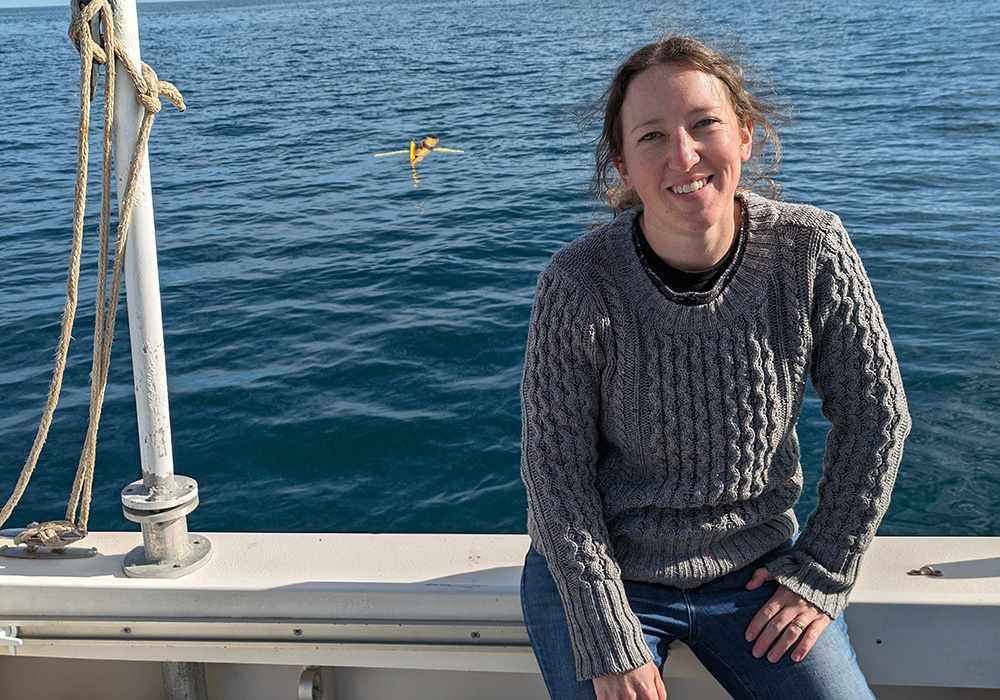
Erin Meyer-Gutbrod, an assistant professor with USC’s School of the Earth, Ocean & Environment, studies North Atlantic right whales and advocates for them in the global halls of leadership, including Congress. In addition to serving on multiple boards, she has been appointed to advise the U.S. government on compliance with the Marine Mammal Protection Act of 1972 and to serve on the National Oceanic and Atmospheric Administration’s Atlantic Scientific Review Group, which advises NOAA fisheries and the U.S. Fish and Wildlife Service on the status of marine mammal populations.
The latest right whale count is cause for alarm, and the whales’ leading killers are entanglement in fishing gear and vessel strikes. The whales have been classified as endangered since 1970 and were declared “Critically Endangered” in 2020. Of the remaining 384 whales, only about 70 are reproductively active females, and the number of new calves born in recent years has been declining.
“The clock is absolutely ticking. We are experiencing an Unusual Mortality Event,” Meyer-Gutbrod says. “Right whales are dying at a faster rate today than a decade ago.”
Rapidly warming ocean temperatures near the New England coast and Gulf of Maine, where right whales migrate seasonally to feed, are another factor in their population challenges. The whales’ main food supply (tiny crustaceans that Meyer-Gutbrod affectionately refers to as “bugs”) needs colder waters to survive, so about 40 percent of the whales now swim farther north to forage for food in the colder waters of the Gulf of St. Lawrence.
“It’s important to recognize that we do have power. I can still ask the hard questions. Those answers can help inform future management of ocean ecosystems. It’s still possible to persuade people at each level to do the right thing.”
“I research why their food is declining and how whales move to new waters to find more food,” she says. “Females get so skinny that they don’t reproduce. Biologically, they can give birth every three years. But we are seeing them give birth every seven years or longer.”
Meyer-Gutbrod is the lead investigator on a National Science Foundation project to better understand how right whales are responding to climate change, and to determine whether their movement to new habitats and potentially eating new types of food demonstrates resilience. The first step of this project has been led by USC Marine Science Ph.D. student Abigail Kreuser, building a model that shows how individual right whales move within and between habitats. In addition to answering fundamental questions about right whale ecology, this model can be used to guide management in both the U.S. and Canada by predicting where whales are when we don’t see them.
The primary U.S. agency developing right whale policy is NOAA, which writes and passes rules governing how fishermen and vessels use the ocean where these vulnerable animals live. When needed, NOAA can initiate temporary fishery closures or limit how fast ocean vessels can travel. Meyer-Gutbrod collaborates with researchers at Woods Hole Oceanographic Institute and Skidaway Institute of Oceanography to acoustically monitor the waters of the southeastern U.S. to inform temporary vessel speed recommendations.
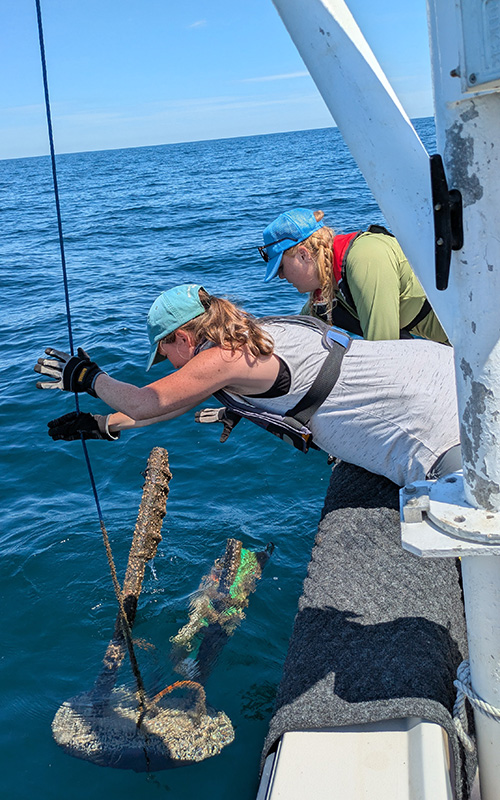
“We have buoys off the coast of Norfolk, Charleston and Savannah that listen for whales year-round, and we add an underwater glider that roams the coastline between South Carolina and Florida during the winter calving season.”
If Meyer-Gutbrod and her team of graduate students detect a right whale vocalization, called an “up-call,” they use a system of websites and cell phone apps to alert mariners and NOAA.
Since right whale conservation requires governments to regulate activities and mariners to change their behaviors, Meyer-Gutbrod has become increasingly interested in the human side of the problem.
USC Marine Science Ph.D. student Amadi Afua Sefah-Twerefour has undertaken an analysis of news content to determine how frequently and what type of information the general public receives about right whales. After working on Amadi’s analyst team, USC Honors College graduate Laura Doughton led a project analyzing right whale legislation at the state and federal level. These social and political science projects have provided tremendous insight into how the states cover right whale news differently and take different approaches to regulation.
Both projects have benefitted immensely from the guidance of Josh Meyer-Gutbrod, in USC’s political science department, to guide the methods and interpretation of the findings. These projects were presented at the annual North Atlantic Right Whale Consortium meeting in October to guide future conservation efforts.
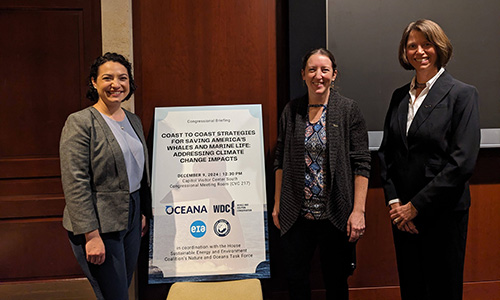
Last December, Erin Meyer-Gutbrod addressed lawmakers at a Congressional Briefing in Washington, D.C., on how climate change impacts right whales. Her key message is that the oceans are changing so rapidly that it’s difficult, if not impossible, to predict seasonal whale habitats. Management efforts can’t rely on historical whale patterns, so we need to expand monitoring, and perhaps the scope of regulated waters, to keep this species from going extinct. It’s not a popular message, because it means that there is even more work for scientists and managers to do. However, Meyer-Gutbrod says, “Studying right whale response to climate change will undoubtedly help us to better understand how other highly mobile animals are changing their distribution and behavior, even if they aren’t monitored as carefully as right whales.”
Meyer-Gutbrod recently returned from a meeting of the Marine Mammal Commission, where she serves as a scientific advisor.
“We are supposed to come up with plans to mitigate human-caused injuries and mortalities in baleen whales,” she says. “Sometimes we only know an entanglement has happened because we see a scar. We can’t tell how long they have been entangled. We especially don’t want to see any wrap around-the-mouth cases. The longer they are dragging this gear, the harder it is to swim and feed.”
With concrete policy changes unlikely in the current political climate, Meyer-Gutbrod says she is focusing on improving awareness of and compliance with existing policies. That requires expanding outreach and education programs. Meyer-Gutbrod remains hopeful that North Atlantic right whale populations can recover in our lifetime.
“It’s important to recognize that we do have power,” she insists. “I can still ask the hard questions. Those answers can help inform future management of ocean ecosystems. It’s still possible to persuade people at each level to do the right thing.”