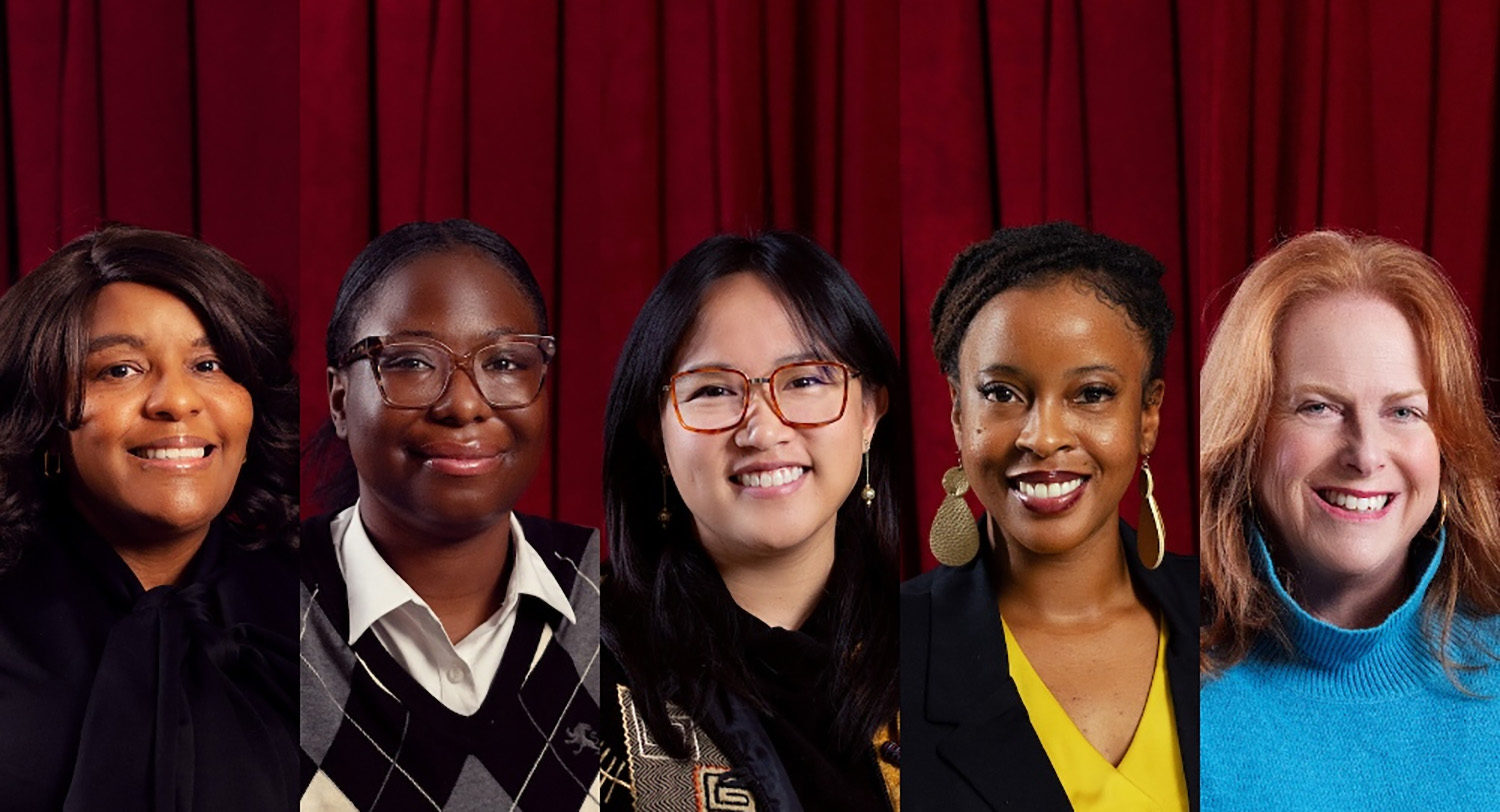
The University of South Carolina has recognized five students, faculty and staff members for their work on campus and in the larger community with 2026 Social Justice Awards.
The awards recognize individuals who have exemplified the philosophies of the Rev. Martin Luther King Jr. through acts of community service, social justice or racial reconciliation.
The award recipients will be honored at the university's annual MLK Commemorative Breakfast on Friday (Jan. 16) in the Russell House Ballroom.
The value of listening is key in hard conversations
Betty Wilson, assistant professor of social work at USC, has a silent mantra for difficult conversations — “Listen first.” Empathy across the cultural spectrum, she says, is paramount. Meaningful connection comes through thoughtful listening without judgment or agenda.
“We all have a history,” she says. “How we show up every day is important.”
Wilson’s research examines how police interactions affect mental health and what kinds of culturally responsive interventions might be employed to find common ground, foster healing and reduce disparities in people’s encounters with police.
We all have a history. How we show up every day is important.
Being the 2026 faculty recipient of USC’s Martin Luther King Social Justice Award has buoyed Wilson’s determination to make a difference.
“This award means a lot to me,” Wilson says. “Dr. King famously said, ‘Injustice anywhere is a threat to justice everywhere.’ I am grateful to have an impact.”
Though she was interested in possibly pursuing a career in criminal justice, Wilson was inspired instead to choose the field of social work in large part because of the example left by her paternal grandmother, Queen Wilson, who worked in the field for 32 years. Social work professor Terry Wolfer, who nominated Wilson for the recognition, is confident it was the right career choice for her.
“I have come to know Betty as a brilliant and disciplined scholar, creative and dedicated educator, and committed community leader,” he wrote in his nomination letter, “whose work exemplifies the philosophies of Dr. Martin Luther King Jr. through sustained, impactful efforts to promote justice and community well-being.”
Wilson has worked tirelessly, through dialogue, collaboration and workshops, to engage productively with law enforcement and criminal justice professionals and even served as a roundtable discussant at USC’s Law of the Police Conference last year.
“We must come together and brainstorm effective, long-term strategies,” she says. “These issues can be rectified.”
Ensuring the homeless are seen — and supported
Lila Anna Sauls understands that any one of us may be just one devastating life event away from homelessness. The mother of five boys, she naturally hopes they always will have a roof over their head and food in their pantry. Sadly, she knows many people (and children) do not.
As president and CEO of Homeless No More — and the 2026 community partner recipient of USC’s Martin Luther King Social Justice Award — Sauls is laser-focused on addressing every detail that might impede a family’s journey out of homelessness. Her organization has built a network of resources to help people seek employment, find affordable housing and start their journey toward long-term, sustainable success.
“We are still doing the work, but it has gone far beyond our original mission,” Sauls says. “We work with every member of the family.”
If we don’t change the systems in place, the most vulnerable in our community will never break the cycle of poverty.
From emergency services and crisis support to temporary placement in St. Lawrence Place (the organization’s transitional shelter), families then receive help obtaining affordable permanent housing. Over the years, Homeless No More has begun multiple initiatives to actually build affordable housing with one project resulting in more than 200 affordable housing units.
“We have to have a strategy,” Sauls asserts. “We are more than shelters. I spend time at local, state and national levels working with policymakers on housing issues. If we don’t change the systems in place, the most vulnerable in our community will never break the cycle of poverty.”
Homeless No More provides access to a spectrum of partner organizations and support services designed to help transition families toward independent living.
“Many of us have experienced hardship and discomfort,” she says, “but no one has suffered like the King family has suffered. As Dr. King famously noted, ‘The time is always right to do what is right.’”
Xavery Hopkins: ‘We are all called to serve’
Because there generally is no user manual for first-generation college students, many must navigate their seemingly mountainous journey alone, without a “sherpa” to guide them. Enter Xavery Hopkins, equipped with a metaphorical climbing axe to break the ice, empowering first-gens to bloom and prosper socially, academically and economically.
The staff recipient of the university’s 2026 Martin Luther King Social Justice Award, Hopkins is a servant leader who builds relationships that honor the worth of every individual.
“I am very honored and touched by this award,” she says. “It means a lot because MLK is an everlasting figure in our world. His impact motivates me to do more things to improve where I live and the people I have touched.”
As the senior director of access, opportunity and community engagement at the USC Darla Moore School of Business, Hopkins leads programs aimed at expanding access and opportunities for students.
MLK is an everlasting figure in our world. His impact motivates me to do more things to improve where I live and the people I have touched.
Hopkins works to introduce high school students to academic and career pathways and provide mentorship, leadership development and early exposure to higher education, particularly for first-generation students and those with limited access to higher education.
Hopkins’ commitment to supporting students is exemplified by the 2023 launch of the annual First-Generation Symposium — an initiative she developed during her time at the Center for Teaching Excellence — to celebrate perseverance and connect students with important resources.
Hopkins’ service far transcends the USC campus. She is involved in efforts to enrich her community, most of which occur quietly and without public recognition, driven not by visibility but by a deep commitment to service and impact.
“If I see a need, I am going to do it. I believe we should act to have an impact,” she says. “We just have to open our eyes and hearts and say, ‘What can I do?’ … We are all called to serve.”
First-gen students have a friend in servant-leader Shalaia Myers
When trying to navigate campus, there are some things that can’t be explained, even by a well-placed sign: how to handle financial aid, where to find a job, how to manage finances, where to connect with likeminded students.
It can be overwhelming, especially for a first-generation student transferring from a small 4,000-student college to this university with a total enrollment of nearly 10 times that. Shalaia Myers can relate.
“Arriving at USC, I was terrified,” Myers says. “I actually texted my mom to come and get me.”
Myers, a senior in African American Studies and psychology, is very close to both her mother and her grandmother. All the things they do to support her journey are not lost on her.
She credits them with her emergence as the person she is today and her recognition as the undergraduate student recipient of the 2026 Martin Luther King Social Justice Award.
“As a kid, I was shy. All throughout elementary and middle school, my mom got me into extracurricular activities like the art club, dance club and drama club,” Myers says. “I played in the school orchestra for a while. I played softball.”
When I got here, my first thought was, ‘where is my community?'
Those experiences burst Myers out of her shell and strengthened her resolve to help others. While still in high school, she became a mental health volunteer.
“What I found was that mental health was not talked about enough,” she says.
Once she got her bearings, Myers became a mental health ambassador — earning her suicide prevention certification because she “was raised to always give back.” She’s a CommUNITY shop volunteer, the co-founder of Book Fair Fund, a member of the Zeta Theta Chapter of Sigma Gamma Rho, Sorority, Inc. and founded the university’s First-Generation Student Advisory Board.
“Her ability to bridge organizations and build meaningful partnerships demonstrates the collaborative leadership Dr. King modeled,” wrote Nikki Buie, associate director of mental health education and training, nominating Myers, “which is one that unites rather than divides.”
Today, the once-quiet Myers is virtually unstoppable.
“When I got here, my first thought was ‘Where is my community?'” she says. “But I knew if I didn’t find my community, I was going to make it.”
Working to ensure that every student is seen and empowered
Kim Tena, a third-year doctoral student in psychology at USC, believes a gap between the diverse needs of students with disabilities and the systems designed to support them needs to be addressed with a critical examination of how institutions collect, structure and interpret data.
By critically examining how data are contextualized, the 2026 graduate student recipient of USC’s Martin Luther King Social Justice Award is focused on ensuring that research findings accurately reflect a range of lived experiences.
Tena explains that data collection systems often oversimplify diverse experiences, leaving the needs of marginalized students invisible in decision-making processes. Tena’s work focuses on data architecture as a foundation for achieving equity in education and clinical research.
As the child of Filipino immigrants, Tena’s commitment to equity stems from firsthand experiences with challenges in understanding and navigating the education system, first as a student seeking support and later as a clinician providing it.
Equity is a shared goal. Solidarity can only strengthen that cause.
Through community-based and disability-affirming research, Tena has demonstrated how inclusive data practices can uncover often-overlooked patterns and have far-reaching impacts that can inform better policymaking, fairer resource distribution and more effective support systems.
“Kim Tena is unlike any student I have met,” wrote Jessica Bradshaw, Tena’s nominator and associate professor for psychology. “She approaches advocacy with tenacity and grace, centering collective improvement over individual recognition.”
Tena says that these awards are helping Dr. Martin Luther King’s legacy move forward. Guided by the Filipino concept of “kapwa,” or togetherness, Tena promotes collaboration and collective care in her work.
“When I received this award, it gave me a reason to pause,” Tena says. “I thought about my work, my colleagues, my friends and family, and the education system. Equity is a shared goal. Solidarity can only strengthen that cause.”