The skills that made Connor Shaw one of South Carolina’s greatest quarterbacks — his competitive spirit, leadership skills and ability to improve those around him — have translated well to his life after the gridiron.
Shaw now works for Arthur J. Gallagher & Co., an insurance brokerage and risk management services company, “specifically, the health and well-being side of things, so I partner with companies to improve their employees’ health outcomes,” he says.
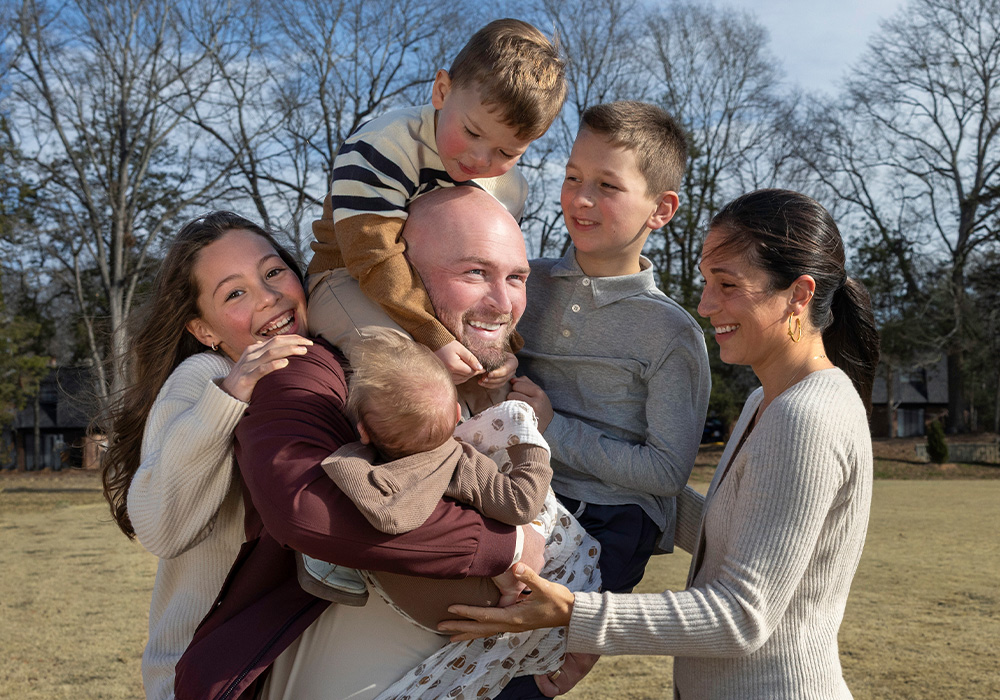
He’s also a family man. He and his wife, high school sweetheart Molly, have been married since 2014 and just celebrated the birth of their fourth child, son Shepherd Tate, in November.
Shaw, who turned 34 on Sept. 19, has his hands full and is loving life. But his story was almost very different. Two days before his birthday, he was part of a familiar scene at a rec field in Simpsonville, South Carolina. Shaw, a coach and the quarterback for his son’s flag football team, felt a little dizzy and nauseated as they broke the huddle, but he didn’t think much of it. He kept calm and threw a touchdown to one of the kids. Then something changed.
“I was walking toward our sideline,” he says, “and that’s when I collapsed in a sudden cardiac arrest.”
Luckily, two coaches on the next field were first responders. Within seconds, the coaches — one an off -duty police officer, the other an off-duty firefighter — were taking turns performing CPR on Shaw. Even more fortunately, the fields were next to a fire department, so in about five minutes, an automated external defibrillator, or AED, arrived. Quick thinking, the presence of first responders and an AED saved Shaw’s life.
“My wife and kids were there,” Shaw says. “I was in and out of consciousness, but my wife was holding my head while they were doing CPR. So it was just a movie-scene type of traumatic event. Credit those kids for being resilient. Kids are so tough.”
So is Shaw, but toughness only goes so far. Ninety-three percent of the time, people don’t make it, he explains. It’s a staggering statistic, but it’s true: When it happens outside of a hospital, the survival rate for sudden cardiac arrest drops below 10 percent.
And there’s no playbook on how you respond to that kind of event. “So for my family,” Shaw says, “we just kind of sat in it for a week or two and tried to process ‘here’s what happened, and here’s what it means.’” He had no prior condition that could’ve led to this, no genetic trait, no abnormality, and even though physically he bounced back quickly, mentally, it has been life changing.
Lots of people reached out to Shaw afterward, he says, “and it became obvious that everyone has a story about sudden cardiac arrest — sometimes stories of survival, but more often stories of heartbreak. I had no idea it was this prevalent.”
Shaw saw an opportunity to help others. Just weeks after he got out of the hospital, he created HRTHUDL (pronounced “Heart Huddle”), a nonprofit, to increase CPR training and bring AEDs to athletic fields statewide and beyond.
I wanted to embrace my story and leverage it to create more survival stories.”
“I wanted to embrace my story and leverage it to create more survival stories,” he says. “If I was on a different field that day — where I know for certain they don’t have an AED — or the timing of the first responders would’ve been different, things would’ve gone differently.”
With the help of Caleb Carter, the lieutenant at the Simpsonville Fire Department who helped save his life, Shaw is connecting with other first responders around the state to identify areas of need.
“HRTHUDL’s number one mission is to host as many CPR events as we can,” he says. “I think it should just be a basic life skill for people so that they’re prepared in those moments. And then we want to get AEDs at all middle school fields, rec fields, city parks and even in all police cars.”
The nonprofit is partnering with several AED companies — CoroMed, Avive, ZOLL and Stryker — for the devices. Prisma Health is also involved and will help with awareness and education. To mix sports metaphors, this former quarterback is covering all his bases.
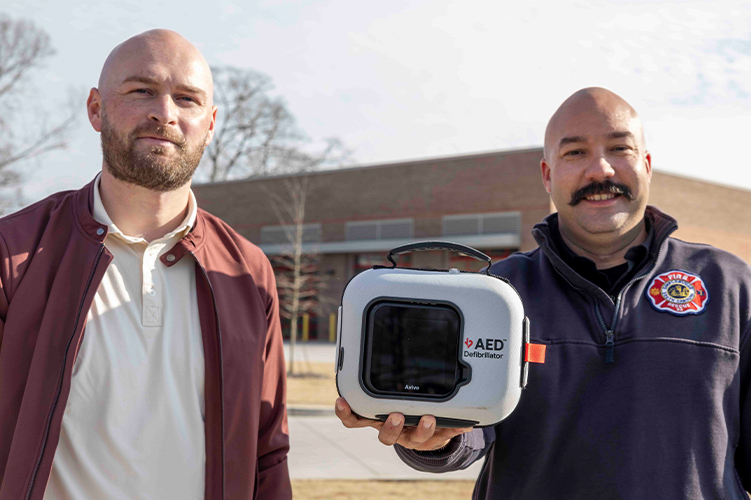
Shaw is already working with the Simpsonville Parks and Recreation Department to place five AEDs and teach CPR to all youth league coaches. And that's just the start.
HRTHUDL’s official kickoff was, appropriately, hosted by Shaw in the shadow of Williams-Brice Stadium before the USC-Clemson football game on Nov. 29. While Shaw is no stranger to Columbia — his job with Gallagher brings him to town weekly — this trip was special.
“This is as neutral a cause as you can get, whether you’re a Tiger or a Gamecock, and I think people recognize that,” Shaw says. “To be able to host the opening when there is so much emotion and a lot of passionate people coming together is special because this is something they can be passionate about as well.”
But even at a celebration, Shaw was working. Attendees could apply to get an AED for their local field or to host a CPR event. Molina Healthcare, which has backed Shaw’s youth football camps for the last six years, also took part in the tailgate. “They’re going to be instrumental in two ways,” he says, “because they are matching our fundraising efforts and they already work in underserved areas.”
Shaw hopes HRTHUDL grows beyond South Carolina’s borders to lend help wherever it is needed. He even wants others to start their own HRTHUDL off shoots, and he and his team are ready to help.
“I have a vision for people to start their own. It could be school campaigns or fundraising in memory of someone or an athletic initiative where they know of a venue or venues that don’t have AEDs,” he says. “We’re going to welcome them and give them the resources and contacts to do it, and we’ll just be behind the curtains lifting them up and sourcing the AEDs for them. You know, they can be a heart hero in their own town.”