The University of South Carolina Board of Trustees met Thursday (March 19) and approved a number of new construction and renovation projects, including a neurological hospital and rehabilitation center, and received updates on the university’s master plan, including redeveloping the student union and developments on South Main Street.
Trustees also adopted a resolution in recognition of the 250th anniversary of the signing of the Declaration of Independence and the 225th anniversary of the founding of USC.
USC Next update
The board received an update on construction and renovation tied to USC Next, the university’s master plan. Trustees received summaries of work planned through 2030 with the goals of revitalizing areas around historic Horseshoe and improving student life:
- Activating the campus’ historic core: Renovating McKissick (classrooms), Woodrow (student housing), Thornwell College (student housing), Wardlaw College (College of Education) and Barnwell College (Department of Psychology).
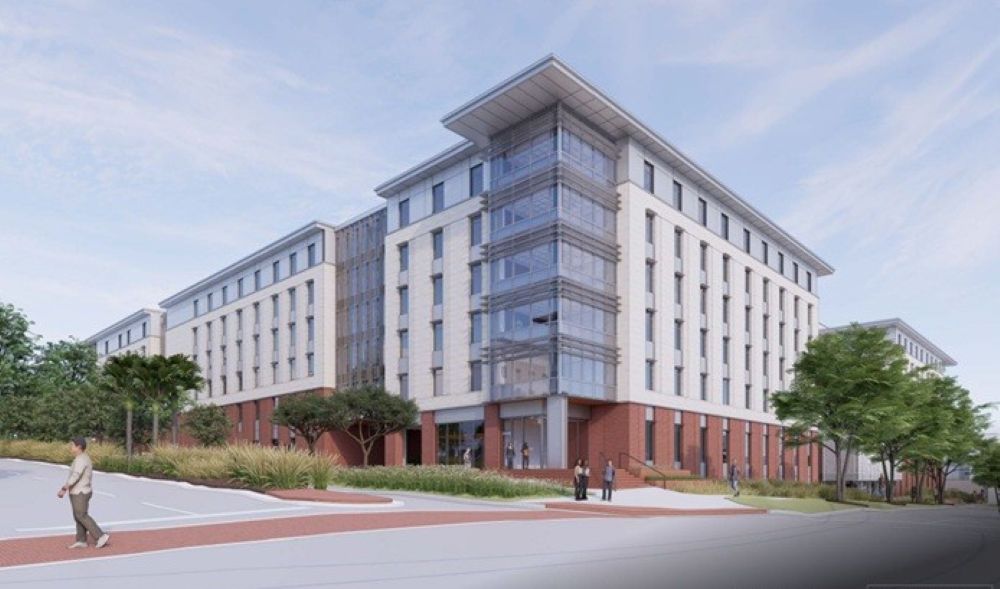
- Enhancing the student experience: Building new housing on Sumter Street and a pedestrian bridge over Wheat Street; renovating the Thomas Cooper Library and Longstreet Annex; and expanding the Honors College residence.
South Main Street redevelopment planning update
USC has worked with the state of South Carolina and city of Columbia on redeveloping the blocks on Main Street just south of the S.C. State House. Planning is ongoing for developing two six-story buildings each with street-level student-oriented retail.
One building could go on the 800 block of South Main Street and include market-rate housing with a second building possible on the Byrnes site along College Street that would include student housing. No decision has been announced on the timing and scope of these buildings.
The South Main Street corridor also will include a new STEM building under design at the corner of Greene Street. The new building will open next to the former School of Law building that has become the Science and Technology Building.
Project approvals: hospital, wellness center, Capstone, parking
The board authorized work on a number of projects, including:
- Neurological hospital and rehabilitation center construction: The board gave formal approval to the state’s first standalone medical facility fully dedicated to care of the brain and nervous system is part of USC’s Health Sciences Campus that includes the recently opened Brain Health Center and the new School of Medicine building. While no opening date for the hospital has been announced, work is one-third complete on the new home for USC’s medical school with a scheduled opening in fall 2027.
- Wellness and Fitness Center renovation: The main campus recreation center will undergo remodeling and add 55 percent more floor area.
- Parking repairs: A multi-year effort will repair campus parking garages and lots.
- Capstone renovations: Planned work includes modernizing student rooms and replacing infrastructure that would extend the life of the residential tower known for the top that glows garnet.
- Gonzales monument and time capsule relocation: USC will accept the monument and time capsule from the site of The State newspaper, which is becoming private housing. USC will install them near the College of Information and Communications building.
- USC Aiken Quadrangle renovations: The popular campus outdoor space will undergo a renovation that will add new sidewalks, amphitheater and covered seating patios.
- USC Salkehatchie Student Commons and Conference Center upfit: Work will renovate the student and community hub.
Sumter Street residential project update
The board received an update on two student housing projects on Sumter Street. McBryde demolition is scheduled to start in April. Work also will begin expanding the Honors College residence. Occupancy of the new residences is planned for fall 2028. Sumter Street between Greene and Blossom streets will close this summer to accommodate a tower crane.
Renovation project approvals
Trustees approved a number of repair projects that will enhance the Columbia and system campuses for students, faculty and staff:
- Landscaping the area behind the 300 Main Street Building of the Molinaroli College of Engineering and Computing for beautification and recreation. This project is a first step in the Engineering District master plan.
- Repairing HVAC systems at 1600 Hampton Street, Earth and Water Sciences, College of Nursing, Close Hipp, Coker Life Sciences and the Graduate Science Research Center.
- Repairing and updating elevators at the McCutchen House, Calcott and 1244 Blossom Street.
- Replacing roofs at the East Energy Plant, School of Music and Sumwalt College.
- Improving USC Salkehatchie’s softball field and dugouts and building a locker room and support space.
- Demolishing USC Aiken’s old softball field to make way for a planned cyber center.
“We have committed to transformational projects, vital enhancements and critical expansions that will improve academics, research and student life on our campuses and further share our health care and scientific expertise with the state,” said USC President Michael D. Amiridis. “These investments will pay off with students even more prepared to enter an evolving workforce, researchers unearthing latest new discoveries with cutting-edge technology, and South Carolina communities that are healthier and more economically vibrant.”
Trustees celebrate America 250 and USC 225th anniversary
The USC Board unanimously adopted a resolution in recognition of the 250th anniversary of the signing of the Declaration of Independence and the 225th anniversary of the founding of USC. Trustees expressed gratitude to national, state and university leaders who work to preserve democratic principles. The board committed to fostering education opportunities focused on civic responsibility.
“USC’s board is the first in the country to publicly acknowledge and celebrate the 250th anniversary of the Declaration of Independence and the nation’s founding with a unanimous board resolution,” said USC Board Chairman Thad H. Westbrook. “Our country’s successful struggle against tyranny was solidified and enhanced by the creation of public institutions of higher learning, like the establishment of South Carolina College in 1801 by our state’s leaders.”