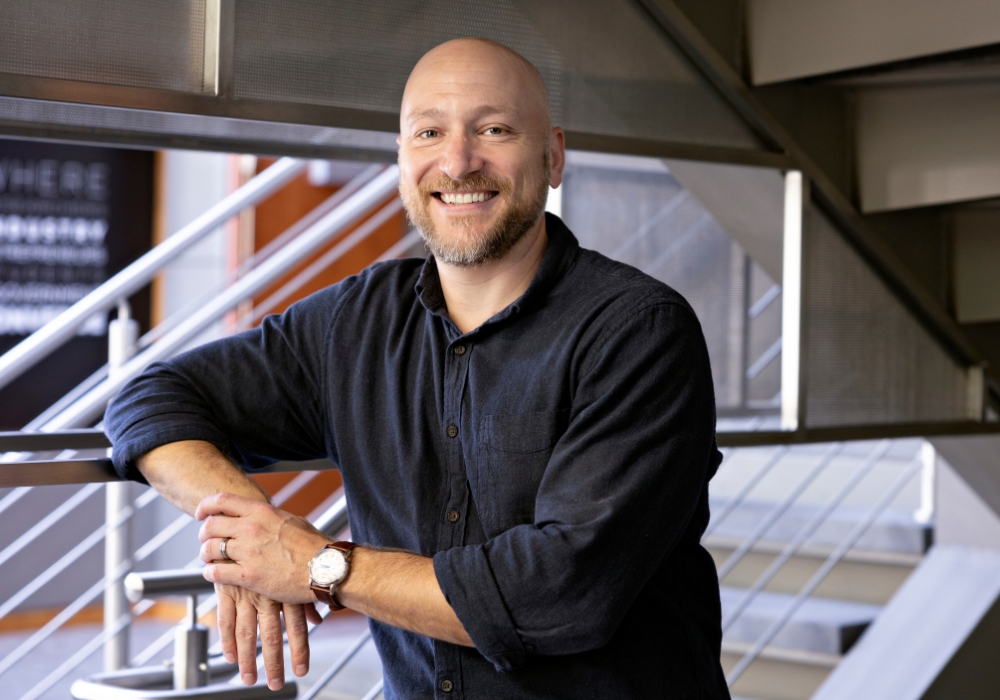
Aaron Vannucci doesn’t have a sophisticated teaching philosophy to explain his award-winning teaching style. He merely points back to his own high school chemistry teacher, Mr. Ballauer.
“Every day he was so excited to teach and clearly interested in the topic,” says Vannucci, a 2026 recipient of the University of South Carolina’s Michael J. Mungo Undergraduate Teaching Award. “That made me interested in the topic. So now I show up every day prepared and enthused about what I’m going to talk about and try to get the students on board.”
Vannucci joined the Department of Chemistry and Biochemistry faculty in 2012. He teaches a 500-level course in inorganic chemistry and a general chemistry course for non-chemistry majors. He says the culture of the department is steeped in a commitment to quality instruction.
“We have a history of teaching awards in the chemistry department and really taking teaching seriously,” says Vannucci, who also received the university’s Ada B. Thomas Outstanding Advisor Award in 2020 and was named a 2021 Breakthrough Star by the Office of the Vice President for Research. “I got into academia not just to be a researcher but also a professor, so I was very happy to discover that teaching is embedded in the culture here.”
Vannucci admits there is a little more to his approach to teaching than mere enthusiasm. The section of Chemistry 112 that he instructs usually has no chemistry majors, and most of the students are taking it only because it’s required.
I tell people I can give a talk at a research conference and my heart rate doesn’t change much. But on day one of every semester, my heart is racing.
“So, everything I teach I try to relate to everyday life. When we’re learning about intermolecular forces, we talk about why you put salt in pasta water. It’s actually not to make the pasta taste salty but to change the boiling point of the water so it cooks more uniformly,” he says. “A lot of them are going to be pre-health, so anything that can be related to drug discovery is helpful, like, ‘If you go into pharmaceutical research, you’re going to be doing these types of titrations.'”
Vannucci says he also tries to think back to his own learning experience with different chemistry topics and sometimes talks with other professors to see how they explain a particular concept. That gives him multiple approaches to get through to students who might be struggling with a particular idea.
While he’s already taught both courses plenty of times in the past dozen years, Vannucci says he doesn’t tire of explaining the same material over and over.
“It is sort of like putting on a show, like a touring band that plays the same song for 30 years,” he says. “It may not be new to me, but it’s new to every class that comes through, and I have the same jokes in my back pocket for every semester.
“It’s exciting to talk in a classroom," he continues. "I tell people I can give a talk at a research conference and my heart rate doesn’t change much. But on day one of every semester, my heart is racing.”