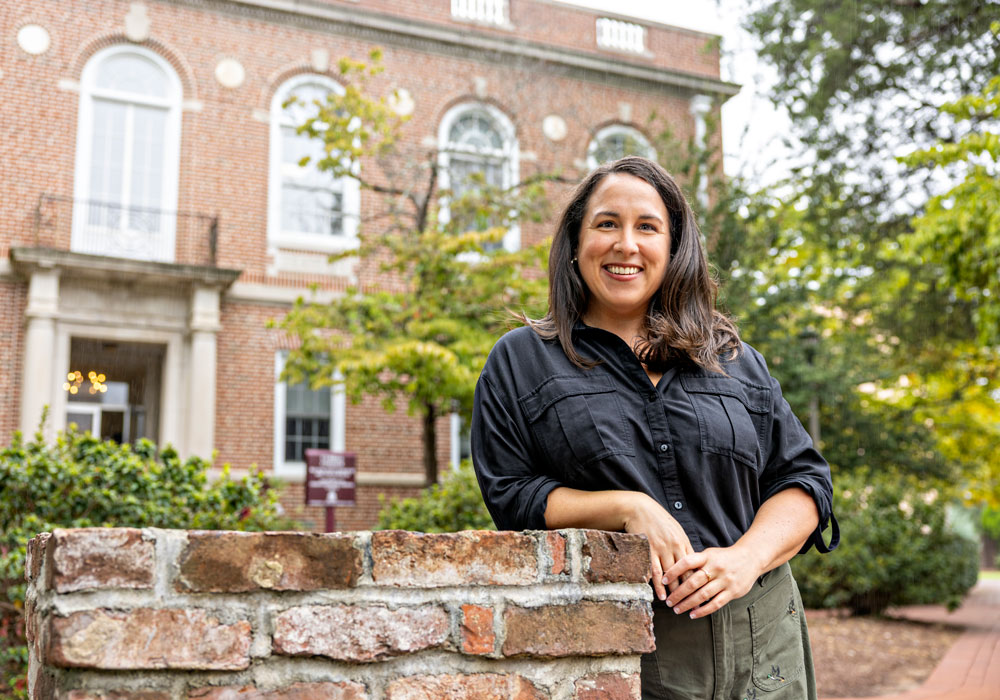
Sarah Rogers is aware how challenging it can be to navigate higher education. As a first-generation college student, it took her nine years to complete her bachelor’s degree. Now, as a senior instructor in the Department of Criminology and Criminal Justice, that experience has shaped her teaching philosophy to prioritize empathy and center students.
Fostering a comfortable environment for students to participate in discussions and engage with the sensitive topics like hate crimes and sexual violence is paramount to her teaching philosophy. Her student-centered approach is informed by the concept of intersectionality, an analytical framework that considers identity and structural barriers individuals face, and a feminist pedagogy, which emphasizes the value of different perspectives.
“It is very important to me to start every single class by giving students a broad scope of my positionality in the world,” she says. “I talk about being from and living all over the South, but also other things that make me up as an individual like my race, gender identity, socioeconomic status and being a parent. It helps set the tone for the semester and gets students to think about who they are and what they bring into the classroom.”
In addition to utilizing things like documentaries, podcasts and in-class discussions, she integrates innovative approaches to classroom instruction like collaborative syllabi and student-driven final projects.
Here, the 2026 Garnet Apple Award for Teaching Innovation recipient elaborates on her approach to teaching sensitive topics in criminology.
Localizing broad topics
I teach very niche courses like Women, Gender, and Crime; Victimization; and Criminal Justice and Mental Health. It's all very heavy stuff, but my students really like those topics. I start out by showing them that context matters, and I try to approach these difficult conversations with an intersectional framework. Like, ‘Let's talk about this through our perspectives on the world, where we live and how it affects us on a day-to-day basis.’ For example, when I cover hate crimes in my victimization class, I focus on policies, and I like to tie in local things as much as I can so students can see that these things affect them.
South Carolina and Wyoming are the only two states who don't have hate crime legislation statewide. But last year, Richland County implemented a hate crimes ordinance that has a monetary fine in addition to the charge for whatever crime they were committing if it is enhanced by prejudice like race or sexuality. We look at the news of the very first guy last year who was charged with this ordinance, but we also look at the federal hate crimes statute, which was named after James Byrd Jr., a Black man in Texas who was murdered, and Matthew Shepard, a gay, white man murdered in Wyoming. We watch documentaries on those two men — two very different stories that happened around the same time in 1998. And to students that seems so long ago, which I understand, but it's not — it was 28 years ago. So, I try to frame it in a context they’ll understand — pop culture. We'll look up popular images from 1998, so they can see we aren’t so far removed from the brutal and horrible things that were also happening.
If [students are] turning in quality work, getting value out of the class and showing up — maybe not physically, but intellectually — then that's all I can ask for.
Encouraging creativity
At the end of the semester students give presentations on a topic of their choosing. It can be a topic that we've already covered, but it can't be how we've covered it. For example, if we've covered sexual assault in the general terms, but that was the most interesting topic to them, then they have to come up with a creative way to teach us something new about it. A lot of students make PowerPoints, Prezis or Google Slides, but I've also had people write and perform plays. I've had people make original artwork and write a narrative for each piece of art. I've had people do podcasts. One semester, a student designed, printed out and put pamphlets around campus with statistics and resources for students who have experienced sexual assault. And that was her project. Whatever they can think of, they can do. Sky's the limit.
Shifting perspectives
The pandemic taught me a lot. It really changed my entire teaching philosophy, because I had to acknowledge that students exist outside of their role in the classroom. My father-in-law died of Covid, and that completely upended my personal life. I thought about how that was happening to so many people — maybe not death, but serious illness. And that could lead to needing to miss a significant amount of class. Who am I to say that's not more important than schoolwork, right? My previous attendance policy accounted for a maximum of 10 percent of the course grade, and students had to be there, no excuses. Then Covid happened and we were all online. It really did click in that moment that they’re all these multifaceted people. If they’re turning in quality work, getting value out of the class and showing up — maybe not physically, but intellectually — then that's all I can ask for.