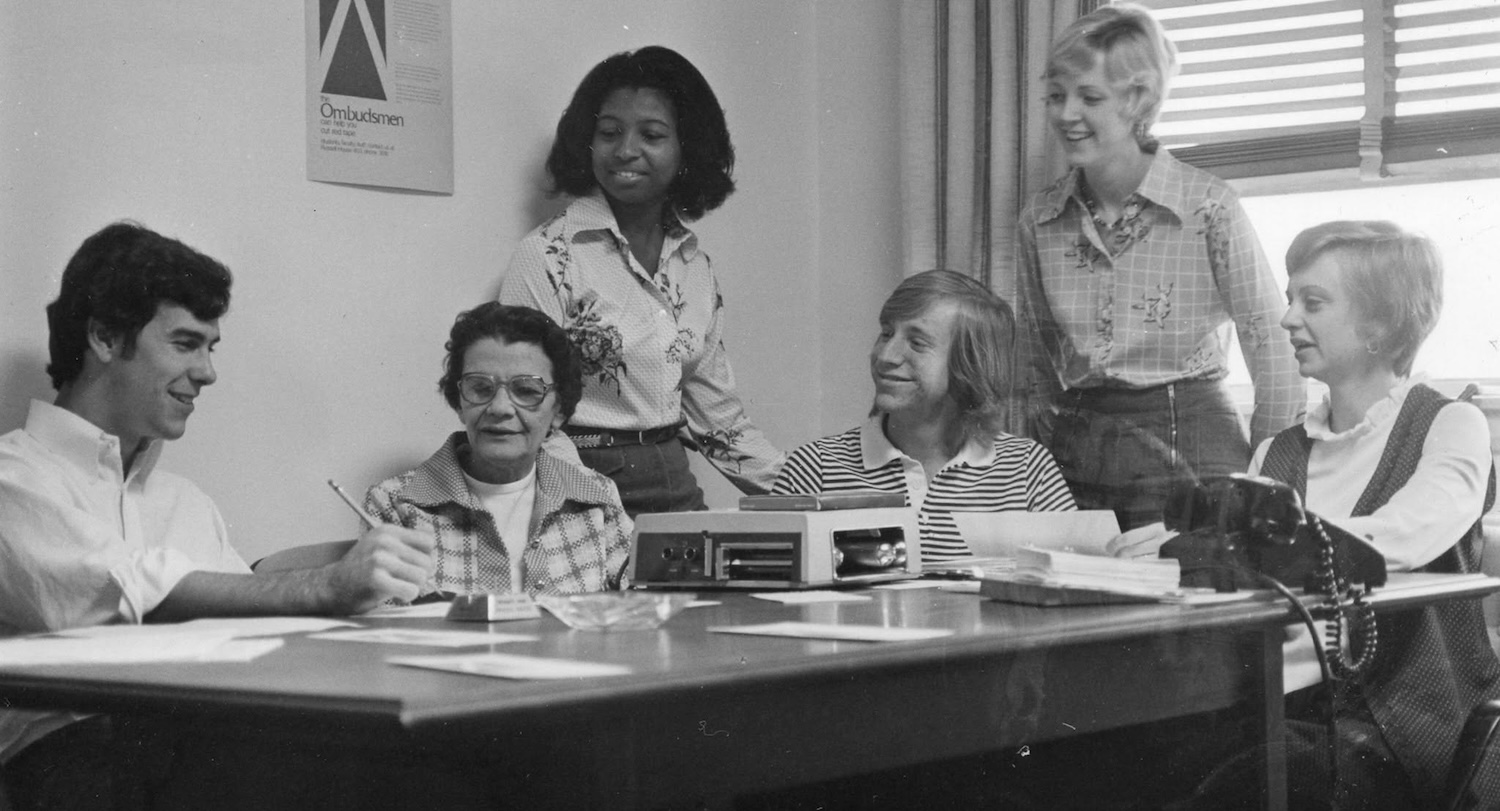
She was a person of small physical stature who made a very large impact over five decades at the University of South Carolina. Plain and simple, Ada B. Thomas was someone who got things done and helped myriad students along the way.
I’m Chris Horn, and today on Remembering the Days, we’re spotlighting a woman who was loved and revered by thousands of USC alumni. Ada B. Thomas had a fancy title — assistant dean of the School of Business — but she was perhaps better known informally as the school’s Mother Superior. A lot of students called her Mrs. T and appreciated the way she advocated for them.
Don West: “I was a horrible student and never would have graduated without Ada.”
Sarah Korab: “She always had students around her. You always felt comfortable walking up there to go see her. It was kind of a warm and enveloping atmosphere. She was kind of like our mother away from home.”
Chris Horn: Ada B. Thomas wore several hats at the business school, including professor of management, but she spent much of her time focused on one thing: advising students on how to navigate their way through USC and make something of themselves. Many alumni swear they wouldn’t have made it without her guidance and cheering them on from the sidelines.
My career at USC overlapped with Ada Thomas’ time at the university by about 10 years, but our paths never crossed. After seeing a picture of her grandmotherly face not long before she fully retired, I assumed she was a meek and mild person who went around dispensing kindness like Mother Teresa.
People who knew Ada well assure me that she was very kind and caring. But Ada Thomas was not at all averse to warning students in no uncertain terms of the consequences of continuing on their merry ways — if those ways did not lead to graduation. If your chain needed to be yanked, Mrs. T would not hesitate to yank it into a knot and steer you in the right direction.
But if your class schedule was messed up, if you needed a particular course to graduate but the course was full, if you were running out of tuition money and down on your luck, or you needed someone who would listen to your woes and help you to solve them, Ada B. Thomas was probably your best hope — maybe your only hope. And she could and would move mountains on your behalf.
Her granddaughter, Lisa Bashara, remembers her grandmother’s fierce independence and unmovable resolve.
Lisa Bashara: “She was truly just a very strong individual and not afraid to fight for what she thought. And she would go to bat for the students, even calling up the professors and saying, ‘Look, you know, you gave them an F, they really need a D. What can they do to make it? Because this is, they’re going to run out of money. They’re not going to be able to finish school unless you can help them. Please, please.’ You know, she would push. I wouldn’t say she begged, she didn’t beg, but she’d say, ‘Come on, work with us here.’ But yeah, she was definitely a very strong-headed person.”
Chris Horn: Lisa shared a story that illustrates her grandmother’s feisty nature at an early age. As the story goes, Ada Thomas was a little girl, perhaps 5 years old or so, living in Rock Hill, S.C., when her parents reprimanded her for acting up at the dinner table. Sent to her room, Ada apparently did not agree with her punishment and somehow shimmied down from her second-story bedroom, entered the house through the front door and sat back down at the dinner table as if nothing had happened. I’d love to know what her parents thought about that!
Over the years, lots of USC alumni have reminisced about Mrs. T’s resolve that sometimes manifested itself through tough love.
“Sometimes, I think I would never have graduated if that lady hadn’t kicked, consoled, prodded and helped me.”
“She told you the way it was, and she was there to help you, but she wasn’t going to hold any punches — not sugarcoating anything. I think it taught a lot of us that you kind of have to make your own way, and yeah, you can have fun in college, but you gotta work, you gotta work to get ahead. And I think she instilled that in a lot of us.”
“Business students would line up for the opportunity to be advised by Ada B. Thomas. Even when other advisors were available, many of us chose to wait — no matter how long it took. Ms. Thomas was knowledgeable, thorough and deeply committed to her students. With her, you felt confident that you were receiving the guidance you truly needed. She left a lasting impression on me, both academically and personally.”
Dan Bundy transferred to USC Columbia from the Lancaster campus around 1981 and was given a class schedule that would have been impossible to fulfill. Someone in the business school told him to go see Ada Thomas.
Dan Bundy: “I came to Columbia as a complete fool and naive college boy. I had no idea what I was doing, how to sign up for classes, where to go or what steps to take. I was smart enough to know that I wasn’t that smart. I was there to eke out a degree and find a job. I had no pull, I wasn’t ‘somebody.’ I went in to plead my case as to why the school should adjust their schedule to fit mine, with the appropriate classes flowing properly over the next few years. She dropped what she was doing and, realizing I didn't know a left shoe from a right, sat me down and reviewed the situation. She made notes, made a call or two and, in that short time, moved heaven and earth to get me on the right path. She made me feel special. For whatever reason she stopped for me, I’ll never know. But I beamed with pride every time we ran into each other around campus, and I hoped she knew I was trying to keep my end of the bargain. She was an angel then and is now. And I know I’m one of thousands who received this kindness.”
Chris Horn: Ada once said of herself, “If a lot of people hadn’t helped me when I was young, I would never have made it. I can’t do anything to repay them, so I guess subconsciously I’m trying to pass on what other people did for me.”
She had enrolled at USC in 1937 in the then-brand-new secretarial science department in what was then called the School of Commerce. Ada earned an associate degree and became the first person in South Carolina to pass the Certified Professional Secretary examination in one sitting. While working full time as a secretary in the private sector, she began taking business courses part time at USC and earned a bachelor’s degree in 1948.
In 1957, the secretarial science department hired her as an instructor, and that began her 40-plus-year career at the university. She later earned a master’s in educational guidance, and that launched her role as the business school’s chief student advisor.
“She never stayed in her office,” remembered one student. “She was always in the outer office, at a long table, surrounded by students. If you wanted to see her, you just had to stand in line. Her door was open 24 hours a day.”
Ada Thomas was famous for giving out her home and work phone numbers during freshman orientation and urging students to call her if they had any problems. Her granddaughter remembers that students — and their parents — were not hesitant to call.
Lisa Bashara: “I remember it was a Saturday night when I was there with her and one of the parents called and said, ‘I can’t locate my child.’ She went into action and helped locate their child, whatever it was. I don’t remember where the child was. You know, nothing was bad wrong.”
Chris Horn: Sometimes a student’s situation was dire. One who was dealing with an unplanned pregnancy turned to Mrs. T, who let the student stay at her house to sort things out. Another student had a physically abusive boyfriend and turned to Ada Thomas for immediate help and a shoulder to cry on in the weeks after.
Don West was a business student who started at USC in 1968. He says he had never studied much in high school and didn’t change his ways at first when he came to USC, despite Mrs. T’s urgings to the contrary.
Don West: “You know, she tried as hard as she could to help me. Sometimes I listened, sometimes I didn’t. And then they kicked me out after four years, and she helped me get back in after just one semester. Oh yeah, she yelled at me for four years, five years. I pissed her off. But, you know, she always hung in there and got me to do the right thing eventually. She had an edge, but she was just, she was the friendliest person. Even if she’s yelling at you, you still don’t mind because you know that she cares.”
Chris Horn: After finally graduating from Carolina, Don West began a successful career and often returned to campus to take his favorite advisor to lunch. One day, about 10 years after he’d graduated, he and Ada went to lunch in her dilapidated car. Don was so chagrined at the sad state of the vehicle that he made a beeline for the office of the business school dean as soon as they returned. He asked for the school’s alumni mailing list, and he and his wife wrote a letter asking graduates to donate toward the purchase of a new car for Ada Thomas.
Don West: “For weeks and weeks and weeks, we just went by the post office and picked them up. It was so much fun because everybody wrote a nice note and everything.”
Chris Horn: Donations poured in — enough to buy a brand-new Toyota sedan, which Don West and his compatriots wrapped in a giant bow before presenting it to her.
Alumna Sarah Korab put it simply: “She took care of us all that time. We decided to take care of her.”
Lisa Bishara says her grandmother was thrilled to receive the car because she’d never owned a new automobile in her life. Ada Thomas was a single parent who had always pinched and scraped to put her daughter through college (USC, of course) and, later, her granddaughter Lisa through USC and the USC School of Medicine.
Lisa Bishara: “Her favorite color was firetruck red. So this was close when they gave her the Garnet one, but she was absolutely tickled to have a brand new car. So she rode her dog around in it when she could.”
Chris Horn: It was about this time — 1989 — that Ada Thomas retired from the business school, 32 years after she began her career there. But retirement wasn’t really something she wanted. After three weeks of it, she came back to work as a part-time student advisor in the College of Humanities and Social Sciences, which later became part of today’s College of Arts and Sciences.
In 1991, while she was working three days a week in her second go-round at USC, the university established the Ada B. Thomas Advisor Award, which is given every year to one faculty member and one staff member who best exemplify the extraordinary example of the award’s namesake.
Jeff Turner, a senior instructor in the Department of Philosophy, received the award in 2024 and now serves on a committee that evaluates nominees for the honor.
Jeff Turner: “Do you make yourself available? Are you willing to jump in and help a student with something if it is a difficult or time-consuming task, or maybe a task that involves bringing in some other folks from various other departments? So we would not think very highly of an advisor who would say something like, ‘That’s not my job’ or ‘That’s not my area’ or ‘I just pass them on to someone else,’ — right? — without really investigating to see what the problem is, what the need is.”
Chris Horn: A lot has changed with student advising at USC in the past decade or so. There’s now a central University Advising Center staffed by professional advisors whose sole purpose is to help students stay on track. Hopefully, they do their job with heart and compassion and love, just like Ada Thomas did for more than 40 years.
A final postscript to the story: A few years after Ada Thomas retired for the second time from USC, she asked university officials if they would grant her a special request.
Not long after that, in 2003, she passed away at the age of 83.
On the day of her memorial service, the wrought-iron gates of the Horseshoe were opened to allow a hearse to slowly make its way around the brick-lined loop. It was Ada B. Thomas’ last ride through the campus where she had served students for so much of her life.
That’s all for this episode. On the next Remembering the Days, university historian and podcast partner Evan Faulkenbury and I will have a conversation about the university’s quasquibicentennial — a fancy word for a 225th anniversary. We’re going to consider specifically what’s happened at the university since its bicentennial 25 years ago. That’s next on Remembering the Days.