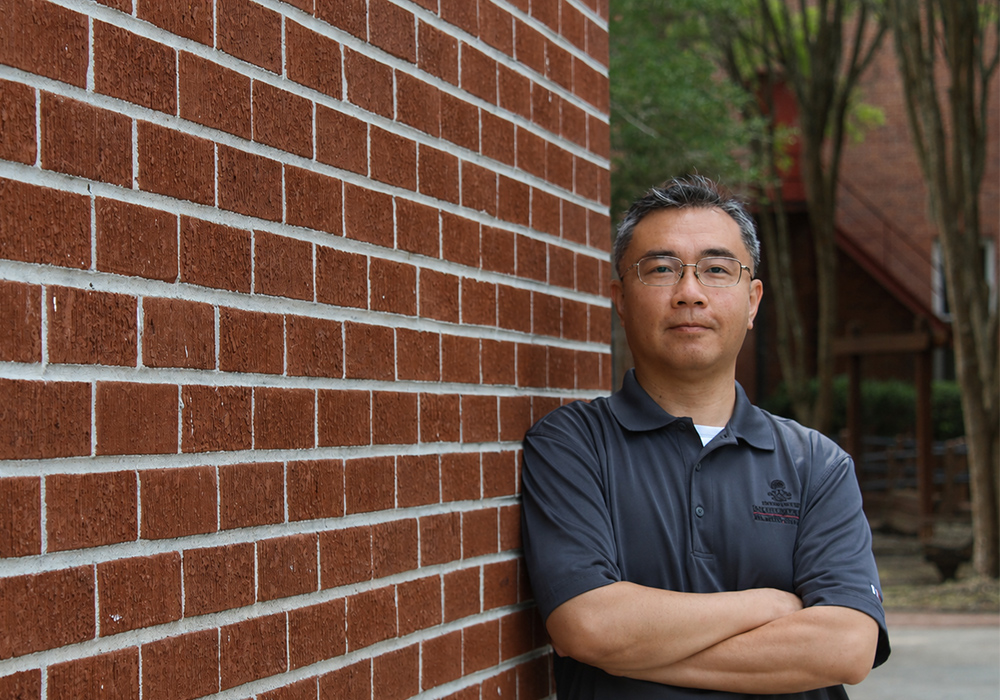
After completing his doctorate in mathematics in 2008 in Mississippi, Wei-Kai Lai started applying for jobs. Location didn't matter that much to him — he’d already traveled from Taiwan to the United States for school, and he wanted to be a college professor no matter where that led him.
“Just like other international students,” Lai says, “when we were about to graduate, we were thinking if we can at least stay in the United States to get a little bit of work experience, it will be easier for us to find a job no matter where we end up — I could stay here or go back to Taiwan.”
What did matter to him was finding a position at a school where he could make an impact and where he could develop his teaching skills. USC Salkehatchie was the first school to give Lai an offer, and he liked what he saw.
He jumped at the opportunity. The camaraderie among USC Salkehatchie’s faculty stood out to Lai early and often and helped him get adjusted to the teaching side of college life. And even having two campuses for USC Salkehatchie — one in Allendale and one in Walterboro — turned into an opportunity for him.
“All the faculty, we carpool together from one campus to the other to teach,” he says. “That’s almost an hour of driving. A lot of people think that’s a waste of time, but I found it to be an advantage because we share our teaching strategies and ask each other for opinions. Especially the first two years, when I was carpooling with an English professor, history professor and biology professor, I learned about their classroom management strategies and a lot of other things. We are all very friendly and very close.”
Roughly 18 years later, Lai is still at USC Salkehatchie. The environment, people, atmosphere and opportunities have all worked out swimmingly for him. If there’s any doubt, a string of awards attests to the fact: This year’s is at least his seventh, beginning with 2012’s USC Salkehatchie Professor of the Year. Lai has been recognized for his teaching, research and service efforts.
Personal attention adds up
Lai loves the small classroom environment at Salkehatchie. “I can deal with my students better, remember my students better, and I can also help them better.” The amount of attention he can give each student plays directly into his ability to teach them.
“In my experience,” he says, “no matter your teaching style or how excited you feel in the classroom, most students don’t feel it because when they take math courses, it’s usually because they have to take them. So in the class, I try to show my excitement. But I noticed it’s easier to help them in smaller groups.”
Building relationships with students who don’t really want to take your class — or are even afraid of it — can be difficult, so Lai breaks down those walls individually. “When I see from that first test, or even a quiz or homework, that students are not doing well, I force them to come see me after class. Then in our conversation, I can show them that I do care about their studies, and I really want to help them, and that bridges the gap. Then students are willing to communicate with me.”
The amount of attention he can give each student has another positive offshoot: Lai can identify students with potential in mathematics even if they feel out of their element. And once he finds those students with the ability to do more, he jumps in to help them.
“If they have potential, I try to talk to them, give them an opportunity. I say, ‘Next semester, do you want to work with me one-on-one to do a little bit more math and do an interesting project?’”
With these projects, Lai meets the students where they are. It’s all about the potential he sees, not how much they already know.
“If the student wants to go into computer science or math, for example, I usually start with number theory, graph theory. Or — I got this idea from math journals — mathematical inequalities. This area can be very hard, very deep, but there are still a lot of parts of it that students can do.”
And if a student is bright but very inexperienced in mathematics, he can start with something else. “Sometimes we start from math puzzles and games and then move to logic, some basic proof technique and some combinatorics knowledge,” he says. “The good thing with math puzzles and games is that even if they don’t know the math, they can play with it. And once they play with it, they get more interested, and we can talk about the math principles behind it.”
Conferences multiply successes
Lai also gives his students opportunities to go to mathematics conferences around the Southeast. “I go to a conference for faculty, but I can bring them to the student-friendly conferences, too. They can present there — either poster or oral presentations,” he says. “And I’ve brought two students to international conferences. The biggest one is at least 6,000 people. And we got very good results. With one of the students, we even published the results afterward in a math journal.”
The proof that these strategies work can be seen in the paths some of Lai’s former students have taken. One went on to USC Columbia for bachelor’s and master’s degrees and is working to become an actuary — a professional who measures and manages risk and uncertainty using mathematics. Another went into the military after getting his bachelor’s but wants to return for a master’s degree in a mathematics field once he’s finished serving. A third is a computational mathematics major at an aerospace school in Florida.
Students years removed from USC Salkehatchie still keep in touch with their former math professor. “Once we start this independent study,” he says, “we have a lot more one-on-one time. And after we finish class, after they graduate, we kind of become friends. So that’s why I keep in contact.”
Continuing the strategy he began years ago, Lai worked with a student this summer and is working with a different student this fall. And he sees no reason to change his approach: His theory has been proven.