Thank you for calling the Patterson Cafeteria Dial-a-Menu. Today is Thursday, Sept. 21, 1989. For dinner tonight we’re having — fried chicken…
If you’re a University of South Carolina alumnus of a certain age, you might remember the outgoing message, which GenX undergrads circa 1989 relied on the way today’s born-digitals rely on Instagram and Emily Mariko’s TikTok.
And if “for dinner tonight, Thursday, Sept. 21,” they were having fried chicken? It was all but guaranteed: You and your hallmates were punching the Honeycomb elevator buttons before the lady reading the menu got to chocolate pudding.
Yeah, a lot has changed over the last 37 years. The modern undergrad now enjoys a full range of dining options, from falafel grain bowls to Callie’s Hot Little Biscuit, and they don’t need a landline to know what’s for dinner.
But if you want to hear about real changes in campus dining — hark! The last 40 years can’t hold a cannoli to the 19th century …
Thank you for calling the Timothy Rives Tavern Dial-A-Menu. Today is Thursday, Jan. 10, 1805. For dinner tonight we’re having — a traditional family recipe for pottage much beloved by the esteemed Oxford dons…
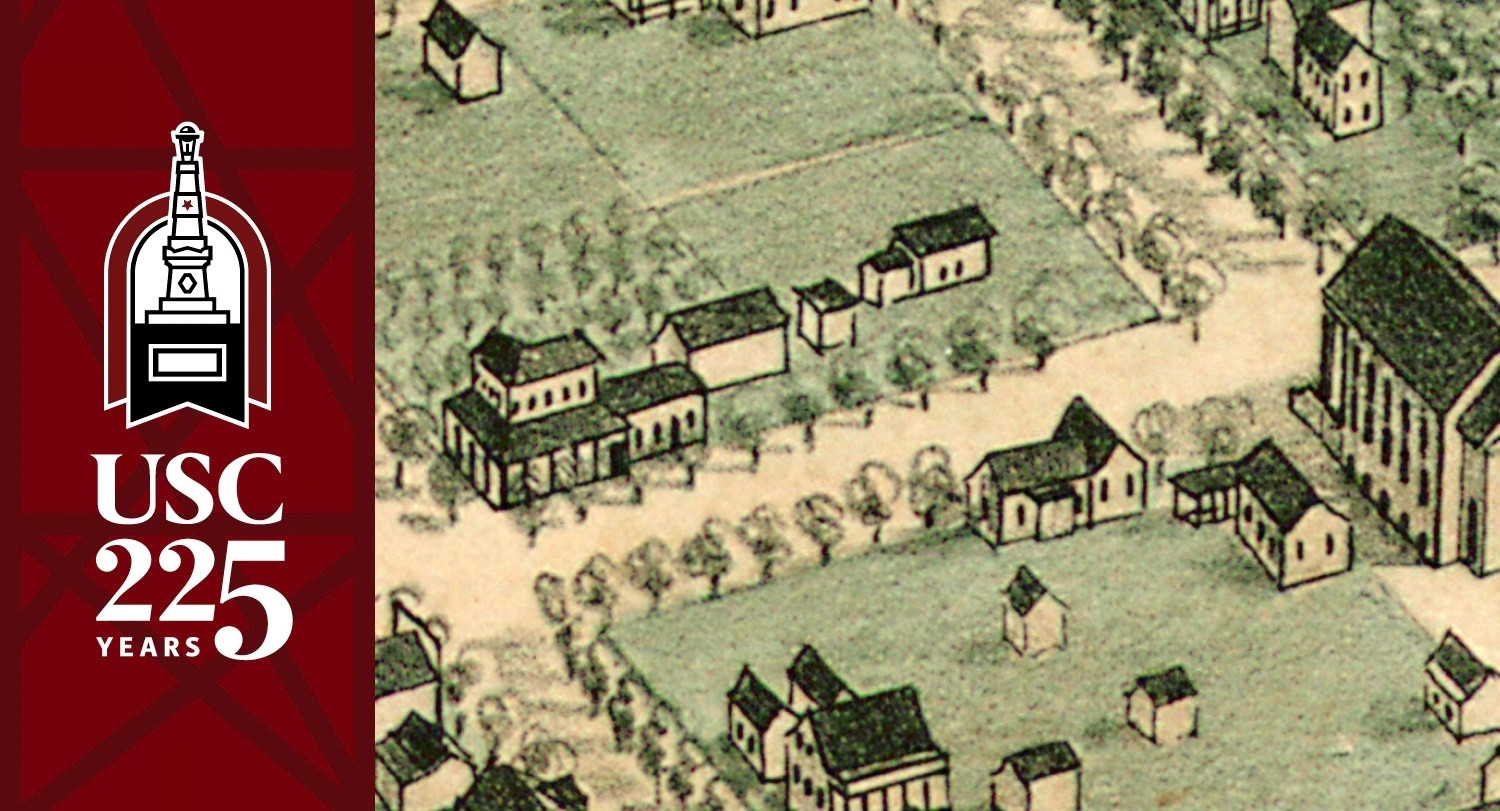
In 1804, the newly established South Carolina College hired a fellow named George Wade to be the campus steward, but Wade quit before he slung his first hash — possibly because, in 1804, there was still no Steward’s Hall for the steward to steward.
As a result, when the inaugural class arrived in 1805, they took their meals at the tavern.
According to historian Daniel Walker Hollis, the tavern run by Timothy Reeves [sic?] appears to have been the most popular haunt. Rives (as his name was perhaps spelled) owned Rives’ Tavern, which according to a 1926 article in The State newspaper “must have stood somewhere near the Hampton monument on the State House grounds.”
And Rives knew his way around a stew stove. Gravy was in his blood. When the college subsequently contracted him to board students for $2.50/week while they constructed the first Steward’s Hall, he was (again, according to The State) “following thus in the footsteps of his ancestor six generations removed, Timothy Ryves, Gent., steward of the University of Oxford in 1612.”
But with a resume like that, contract negotiations boiled over. In 1806, when the first Steward’s Hall opened on the northeast corner of Greene and Richardson (now Main) Streets, the trustees asked Rives to keep the hearth fires burning as an on-campus steward — but at the reduced rate of $2/week. The proud tavern keeper agreed but, per Hollis, “announced he would accept this contract for only one quarter of the year.”
After that, the trustees hired local hotelier Dr. Samuel Green, who lasted about a year. After that — and after the college “ordered in 1808 that the steward should henceforth reside in the steward’s hall and should not be the keeper of any tavern or boarding house” (Hollis) — the position was held by a long string of uninspired stewards, caterers and cooks, and the food, by multiple accounts, became, well…
Thank you for calling the Steward’s Hall Dial-A-Menu. Today is Tuesday, March 7, 1815. For dinner tonight we’re having — disagreeable hominy, raw meat, unpalatable coffee, salt meat and greens with worms…
Maybe you’ve heard of the Biscuit Rebellion of 1852, maybe you haven’t. For campus dining history newbies, here’s the skinny: Outraged by the poor quality of the food at Steward’s Hall, and by the “compulsory system” requiring them to pay for it, 108 students threw down their forks. (No, literally: They stole the silverware and threw it down the campus well on the Horseshoe, per Hollis.)
If the trustees didn’t ditch the compulsory system and move to a licensed boarding house arrangement, they’d quit school. And when the trustees didn’t budge, the Outraged 108 followed through. Enrollment fell from 199 to 122, and only 11 seniors graduated in 1853.
That may sound dramatic but remember: The complaints had simmered for years. As early as 1814, Hollis explains, students were protesting “unpalatable” coffee and tea, “not enough butter” and too much salt pork. In 1817, they took their beef a step further when they submitted a formal complaint to the faculty, which was summarized in the faculty minutes, later reprinted by Hollis:
“That for a week past the Hominy had been disagreeable, which they suppose to be owing to the badness of the Corn and of the Cooking — that in general the meat is so raw as to be unfit for eating … and that worms have been seen in their salt meat — that they never have Steaks for breakfast and poultry but very rarely for dinner. No vegetables but Greens and these frequently having worms in them.”
Thank you for calling the Steward’s Hall Dial-A-Menu. Today is Wednesday, Jan. 23, 1889. For dinner tonight we’re having — salt pork, cornbread, collard greens and for dessert, “Pindars roasted.”
Don’t know what pindars are? (Or who Pindar was?) You’re not alone. The word/name was used in a satirical piece that appeared in an 1889 edition of University Carolinian (not to be confused with today’s Carolinian magazine). The piece’s cheeky author accused the Steward’s Hall caterer, Dover Davis, of serving “the latest Parisian dessert — Pindars roasted,” but when we encountered the quip in Hollis, we had to Google it.
Turns out, Pindar was a famous lyrical poet in ancient Greece. But “pindar” was also, apparently, a regional Southern term for peanut, a common and cheap source of sustenance that failed to rise to the heights of a tarte Tatin, even when roasted.
So which was it, the peanut or the poet? Considering the paucity of quality ingredients in the late 1880s, we’re leaning toward roasted goobers, though that capital ‘P’ in Pindar does leave us wondering, especially considering the 19th-century appetite for the classical education.
Less debatable is the overall improvement in campus dining, or at least the students’ attitude toward it.
Rather than bust up the Steward’s Hall furniture or throw the silverware down the well, the late-century undergrads were more inclined toward satire.
They had also won their case, such as it was. “The primary reason for improved relations was the wise refusal of the authorities to restore compulsory attendance in the dining hall,” Hollis writes.
Which is not to say all the people were happy all the time. For a time, the move away from compulsory attendance created a real and literal stink when students were permitted to set up their own “cooperative messes” in the dormitories. Nobody microwaved any leftover fish, but they might as well have.
“In 1882-1883 there were three such messes, located in Elliott and Legare and boarding a total of a hundred students,” Hollis writes. “President McBryde quickly became dissatisfied with this arrangement, which consumed eighteen dormitory rooms and impregnated the campus with the odor of collard greens.”
Editor's Note: All names, dates and quotations herein are drawn from Daniel Walker Hollis’s University of South Carolina Vol. II: College to University (University of South Carolina Press, 1956); The Gamecock; and The State newspaper. Special thanks to the Walker Local and Family History Center at Richland Library.