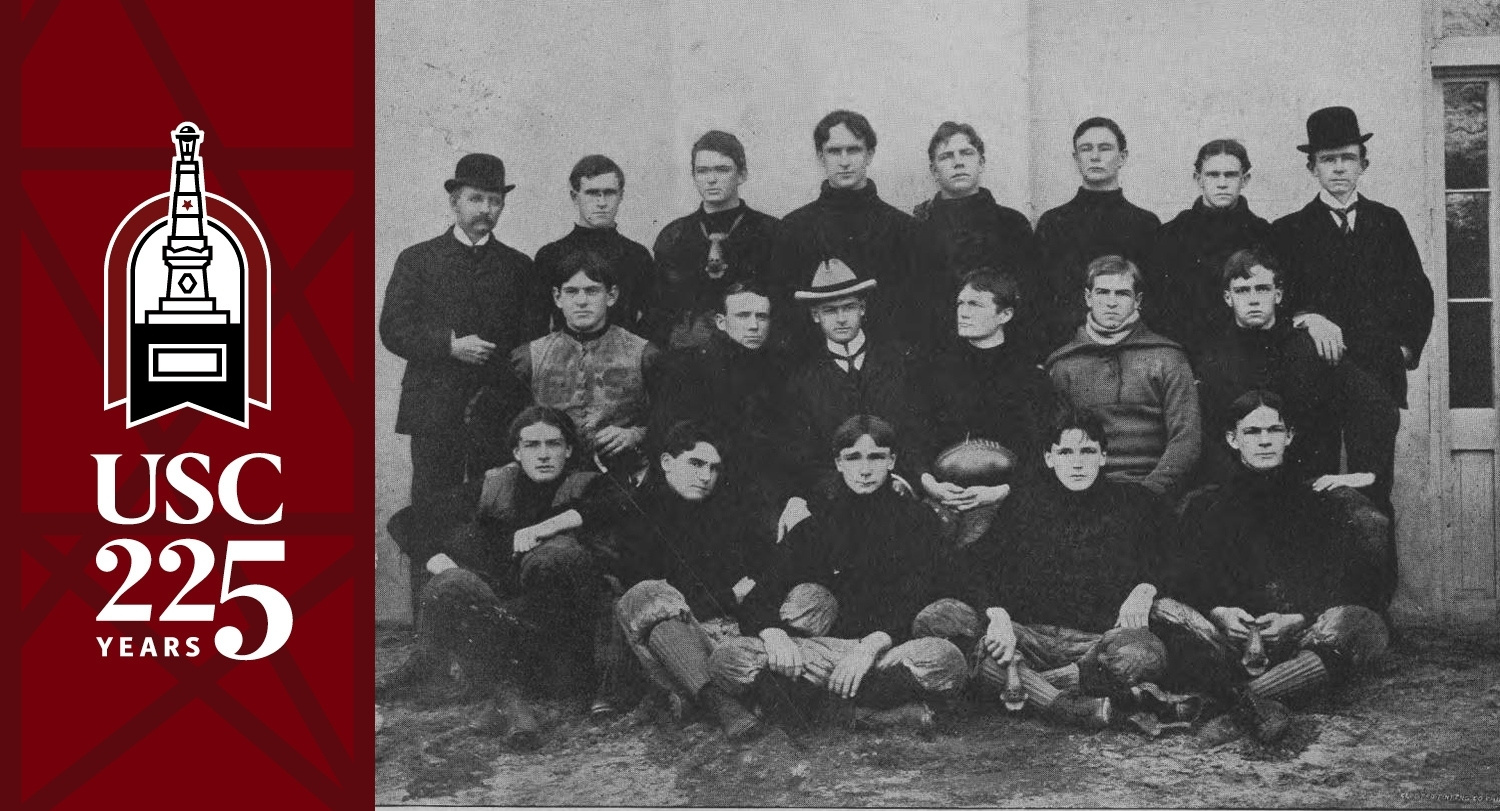
So you call yourself a Gamecock fan. Your doorbell plays Sandstorm, and your entire closet is garnet and black. You’ve had the same tailgate spot since George Rogers won the Heisman. You named your firstborn son Cocky. You named your second son Cocky, too.
But are you as big a Gamecock football fan as you think? Are you really? Are you sure?
OK. Let’s put your Gamecock football knowledge to the test, with a little help from historian Daniel Walker Hollis and his 1956 treatise, The University of South Carolina, Volume II: College to University (University of South Carolina Press). Hollis’ history may be 70 years old this year, but it contains more garnet yarns than a Carolina letterman sweater, and as far as anyone knows, they’re true.
Not My Father’s Football Team
You don’t have to be a history buff to know the Gamecock football team didn’t always play at Williams-Brice Stadium. The earliest version of Willy B was constructed in 1934 with funding from the federal Works Project Administration and originally called Columbia Municipal Stadium. Carolina’s earliest intercollegiate football game, according to Hollis, happened 42 years earlier, on Christmas Eve, at a baseball park — in Charleston.
And no, they weren’t playing the Citadel. The College Boys (as the News and Courier dubbed Carolina’s nameless, coachless and seemingly hapless squad) paid their own train fare to the Holy City, where they gave up 44 unanswered points to the Mountain Boys (as the same paper dubbed the better-practiced Furman team) before a few hundred spectators, many of them decked out in garnet and black, despite the odds.
Win, lose or fumble, football was gaining in popularity.
But not everyone was on board with the ascendent sport. Or with college sports, period. Carolinian, the university’s magazine, was gung-ho for the gridiron and promoted the unsanctioned 1892 matchup in its pages, but as one writer complained, “It is doubtful if there is a college in the state that takes as little interest in athletics as we do.”
No, really. The College Boys had to recruit two nonstudents to field a full team, and one student-athlete was afraid to see his name in the paper lest his dad find out. “Singleton Green played under an assumed name,” Hollis writes, “because his father was opposed to football.”
Furman, meanwhile, was coached by a professor, H.P. Young, who doubled as his own quarterback and was therefore highly unlikely to get his signals crossed. No wonder the College Boys took such a drubbing.
Intramural vs. NIL
It would be two years before South Carolina College (as USC was then known) played another intercollegiate football game.
On Nov. 3, 1894, the still essentially nameless “S.C.C. Boys” (so dubbed by The State newspaper) hosted the University of Georgia at the state fairgrounds, then located on Elmwood Avenue. Carolina got skunked in this game, too — by a hard-to-swallow score of 40-0 — but at least it was a home game.
And that was one of the leading causes of Carolina’s early misadventures in intercollegiate athletics. Before 1895, the trustees refused to sanction any sporting events played outside of Columbia, and official sports-related travel was a no-go. The concern, apparently, was that select student-athletes might use the opportunity for self-enrichment.
You see, President James Woodrow was of an egalitarian mind where sports were concerned, and he was apparently partial to intramurals, which is noble enough. Fame and fortune were anathema, it seems, at least on the playing field. Had anyone broached the topic of NIL, the university’s eleventh president might have suffered an aneurysm.
As Woodrow told the trustees in 1892, according to the minutes of a Nov. 16 meeting, college athletics were meant for “all of the students, and not the training of picked groups — ‘crews’ or ‘nines’ — who shall wander over the country seeking to gain laurels or gate money.”
A Gaudy Spectacle?
It was only at the behest of vocal faculty members that university trustees finally consented, in 1895, to let student-athletes travel, though it was baseball, not football, that made the first real road trip, beating Furman in Greenville in the spring of 1896. Yeah, they dropped the next game — to Wofford in Spartanburg — but even on the road, the Carolina Nine were fan favorites.
According to a Carolinian article cited by Hollis, “a fine looking set of girls” from nearby Converse College showed up to the contest sporting garnet and black. (The Carolinian writer also accused the Wofford team of foul play.)
Meanwhile, the football team didn’t even have a coach — and wouldn’t until that fall, when W.H. “Dixie” Whaley arrived on the scene. A former University of Virginia football star, Whaley was calling plays from the sidelines in the inaugural matchup of what would ultimately become, in Hollis’ words (not ours), “the gaudiest spectacle in South Carolina”: the Carolina-Clemson game.
Two thousand fans forked over 25 cents apiece on a cool November morning to watch Whaley’s much-improved squad take down Walter Riggs’ newly formed Clemson team by a score of 12-6 at the Elmwood fairgrounds. And with that, a tradition was born. A rivalry, too. And better football.