Stephen Criswell, director of the University of South Carolina Lancaster's Native American Studies Center, likes to put history into context — especially when it comes to the center’s collection of Catawba pottery, the largest in the world.
"As our late archivist Brent Burgin once said, 'When the Egyptians were building the pyramids, the Catawba were making pottery,'" Criswell remarks.
Catawba pottery is a sacred, handcrafted pottery tradition that dates back more than 6,000 years. It's the hallmark artform for the Catawba, South Carolina's only federally recognized tribe. The center holds more than 3,000 pieces of pottery, beadwork, ceremonial tools and other Indigenous works. The mission is to preserve, study and educate the broader public on the culture and tradition of Native Americans in the state.
But the center does more than preserve the past — it spotlights the living, breathing culture of S.C.'s recognized tribes and groups.
The center was formed in 2005 after the system campus received a large donation of Catawba Pottery. Criswell, a folklorist, was teaching at Benedict College in Columbia at the time and was courted to Lancaster to establish a Catawba Studies department. But once he spoke with tribal leaders across South Carolina, he realized a broader need.
As one tribal elder put it, "it's like we disappear from history" after students learn about colonial-era America and the Trail of Tears.
For Criswell and his team, the center operates to reacknowledge Indigenous history — and ongoing presence — into the story of South Carolina.
Catawba pottery, for example, is one of the most recognizable artforms from the Palmetto State. There's even a Catawba pot in the White House.
"That's the Catawba tradition, but it's also South Carolina tradition," Criswell explains.
Telling the whole truth
Since moving into their Main Street space in 2012, the center has widened its work, employing Criswell, a gallery curator, archivist and archaeologist, among other staff members like Beckee Garris, one of the longest-serving employees at the center and a Catawba artist in her own right.
Garris leads workshops, gives tours and hosts groups. In addition to the Catawba, there are 10 state-recognized tribes in South Carolina. Garris says the center has helped educate the public on the differences between each group — and dispel stereotypes some might have about Indigenous peoples.
"There’s a whole lot of myths and legends and truths and untruths and half-truths," she says. "And I tell people, even a half-truth is a whole lie."
But how do you tell the truth — the whole truth and nothing but the truth?
The center approaches it in a myriad of ways. It hosts field trips and USC Lancaster classes. It connects area public schools with tribal groups who can educate students. It hosts free "lunch and learns" with guest speakers. It keeps the doors open several days a week for people to peruse the gallery space, which includes a permanent exhibit of federal- and state-recognized tribal artwork, a spotlight on the center's rotating artist-in-residency, a children's nook featuring a horned serpent made of kudzu, and, on view now, a Smithsonian exhibit honoring Indigenous veterans.
That's not all.
An archaeology lab features arrowheads and other found objects that help students get tactile with history. A meeting space welcomes in Lancaster community groups, who can use the conference room for free.
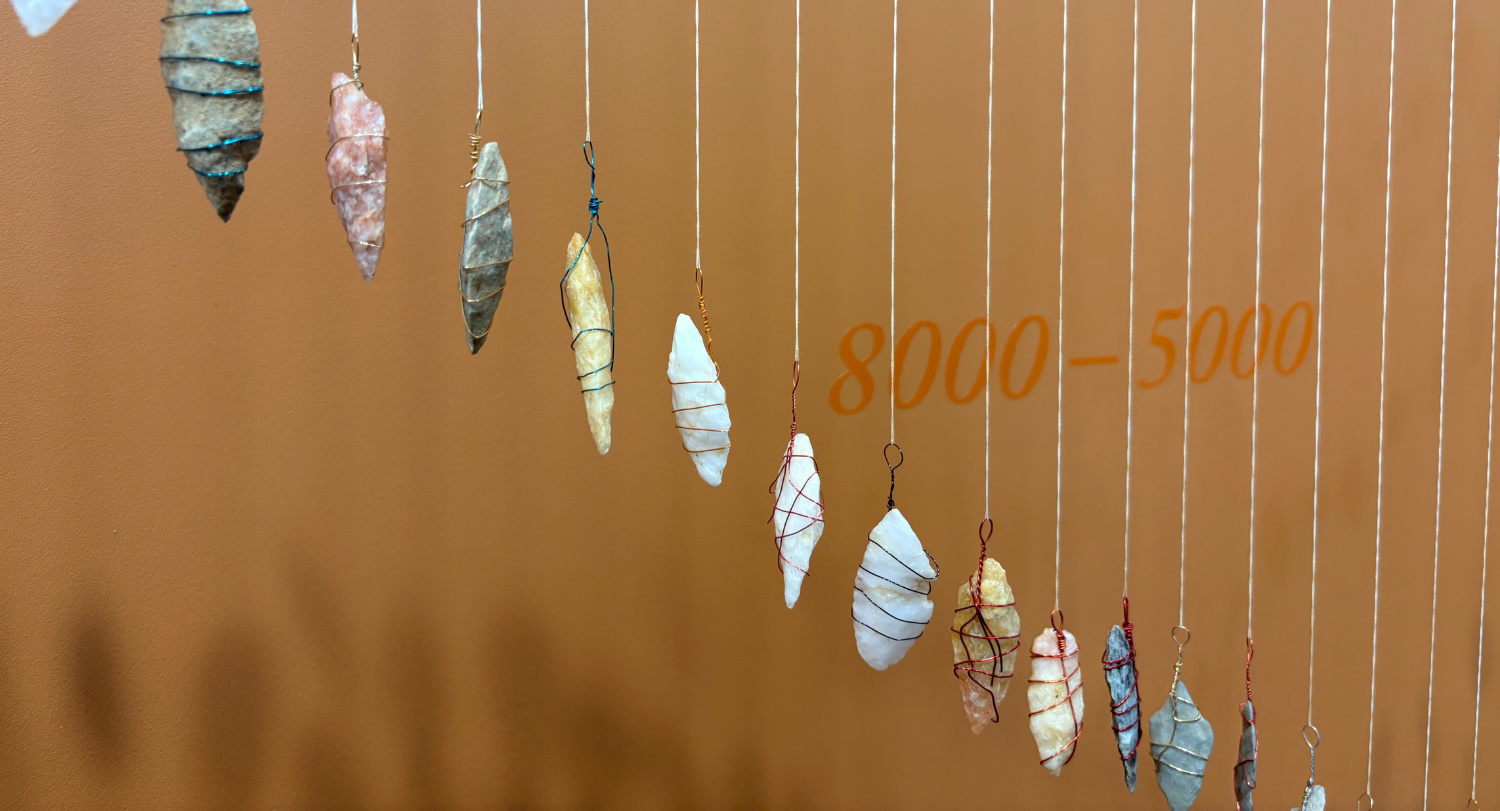
And in the lobby, curving along a partition, is an art installation showcasing 10,000 years of Indigenous presence in South Carolina. The piece is made up of dozens of projectile points hanging from the wall in a pattern. As the painted numbers on the wall behind tick up from 10,000 toward today, the arrowheads evolve. What starts as a blunt weapon grows to a spear point before whittling down into the sophisticated arrowheads most know today.
Not only is it a show-stopping work of art; it's utilitarian. Criswell said people often bring in arrowheads or points they've found in their yards or out on a hike. The installation offers a handy tool to approximate how old the artifact is.
Family tradition
Take a right into the permanent collection gallery and you'll notice repeating themes, like the King Haigler heads and the black snakes typical of Catawba pottery. You'll also notice repeating names.
Indigenous artistic tradition is typically family business. Garris' aunts and uncles have works displayed alongside her own creations. Generations of artwork help visitors trace how tradition can evolve, showcasing the individual styles and market demands for pottery throughout the decades.
"There was a potter, Caroleen Sanders, who would take her stone and rub it on her face, the oils off her face," Criswell offers as an example. "Literally putting herself into her art."
To explore the center and the work it fosters, head up Interstate-77 from Columbia and follow signs to Lancaster. The center hosts a variety of in-person and virtual events, including the Dec. 5 Winter Native American Art & Craft Festival.
Just don't call it a museum. The culture and history inside the center are still very much alive today throughout South Carolina.
"It’s a continued saga," Garris says. "We're still here."