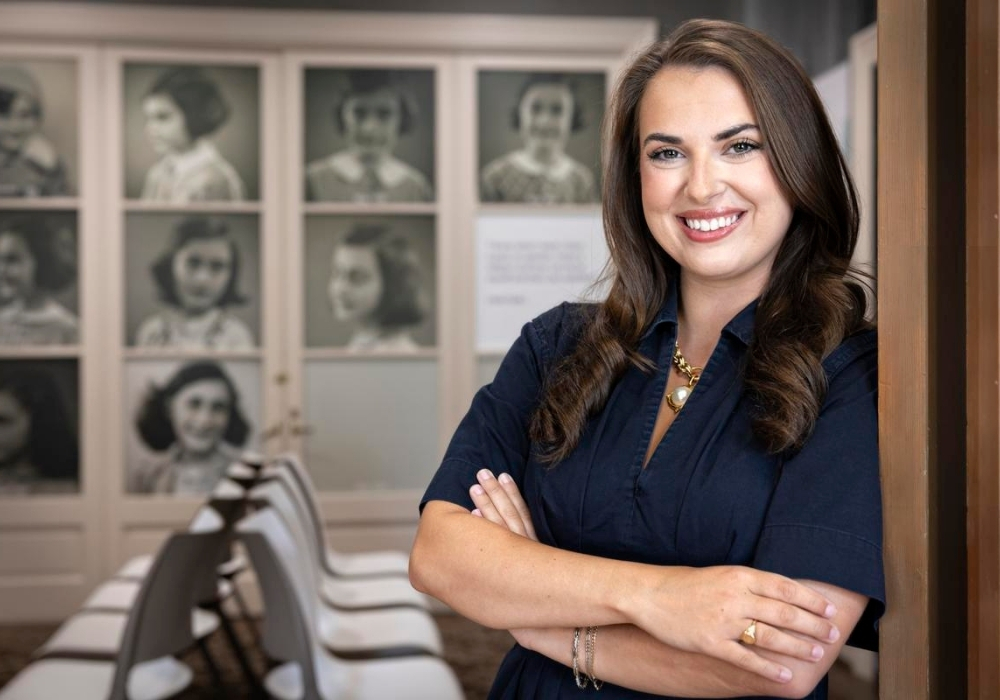
When staff from Amsterdam’s Anne Frank House came to Columbia in 2013 to launch an exhibition about the Holocaust at Dent Middle School, then-eighth grader Sam Livoti was recruited to be a tour guide.
She and her fellow docents guided more than 1,000 students through an exhibit about the life and legacy of Anne Frank, a young Jewish girl whose journal documenting her family’s years hiding from Nazis during World War II was published by her father.
Livoti’s experience helping to tell that story set the South Carolinian on a path she’s still on today.
“As a young person, this was one of the first experiences that I had where I felt like my voice mattered,” she says. “I felt empowered because I got to take the lead in front of my peers.”
Livoti now works at the University of South Carolina’s on-campus Anne Frank Center, which is tasked with expanding Holocaust education nationwide — all with the goal of building stronger, more tight-knit communities.
Becoming an Anne Frank educator
While Livoti was as an undergraduate English major at USC, she got an email: The Anne Frank House — created from the dreams of Anne’s father, Otto, to inspire the world to be better — was opening a center on USC’s campus. Would she be interested in volunteering?
“They had found in The State newspaper that I had done this exhibition years ago, and they did the math,” the 2023 USC alumna says, “and the young people from my middle school class should have been in college by then.”
Livoti came on board as a volunteer even before the center opened in 2021.
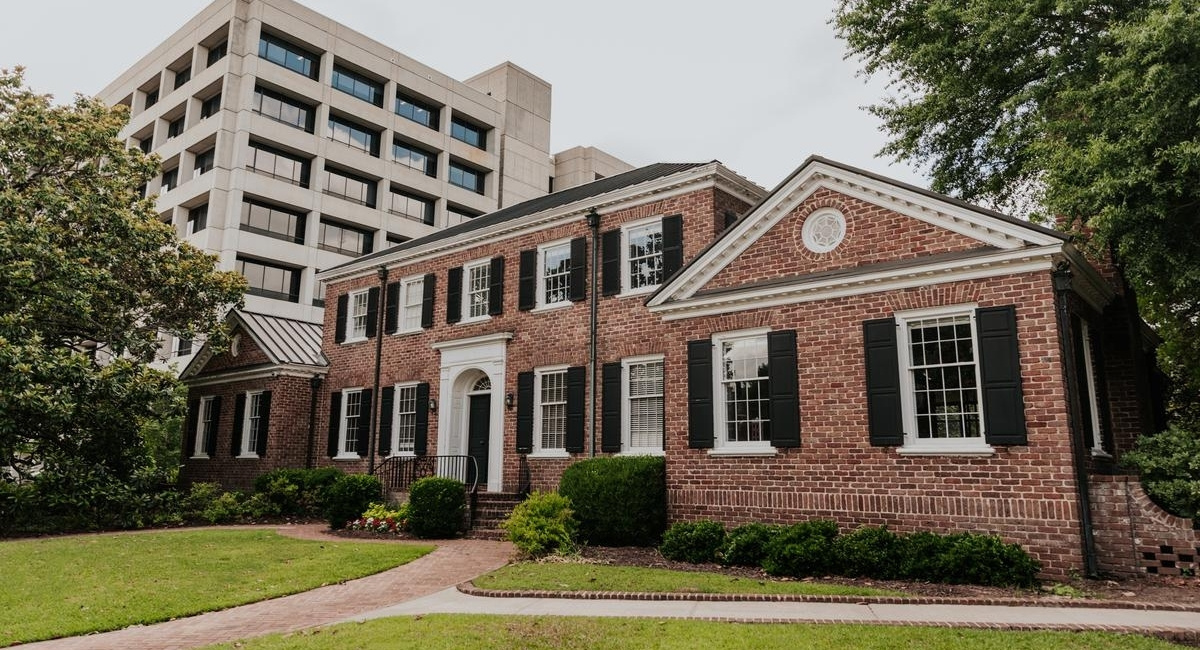
When she graduated two years later, she took a full-time staff position at the center, which is the only affiliated operation in North America to the Amsterdam-based Anne Frank House.
“I had plans to go to law school, but the work here has had such an impact on me,” Livoti explains. “And now I get the opportunity to give other young people the same empowerment, confidence and leadership skills that were given to me.”
As the center’s education specialist, Livoti manages the on-site museum, but her passion lies in her other role: leading the fast-growing Anne Frank Youth Network, a volunteer organization for people age 16 to 26 to prepare them to lead civic programming in their community — all inspired by Anne Frank’s story.
Taking Holocaust education beyond USC’s campus
The network is just one way the center has extended its influence beyond campus. In addition to hosting historians and educational scholars, training K-12 educators and serving thousands of students through tours each year, the center has done programming in 44 states. And more on- and off-campus exhibits are in the pipeline, including an unveiling of the center’s renovated gardens.
It’s all building to 2029. Anne Frank’s 100th birthday.
The Anne Frank House has charged USC’s center with having a presence in all 50 states by the time the centennial rolls around, according to Doyle Stevick, center director.
And while the charge is ambitious, so, too, are the goals of the organization: Through meaningful, peer-led conversations, Anne Frank’s story can help develop tight-knit communities filled with people more willing to stand up for one another and for what is right.
“This history is so powerful and important, we believe it’s a powerful means to achieve those elusive goals, which is, ‘How do we build community?’” Stevick explains. “‘How do we create relationships and understanding between people?’”
Growing a network of young community leaders
As North American coordinator for the Youth Network, Livoti has helped grow the Anne Frank House’s presence in communities across the U.S. She works with young people who — just like she did back in middle school — have worked as student docents for the center’s travelling exhibitions.
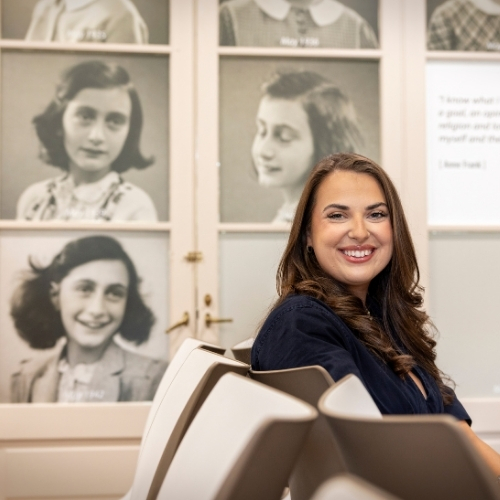
The network mirrors the Anne Frank Center’s mission of generating peer-led, civic discussion about hard topics, namely antisemitism and discrimination.
“We bring young people together across the United States where we are collaborating on projects that have a positive impact on the community,” Livoti says. “We are committed to fostering a world that is rooted in tolerance, inclusivity and human rights.”
The youth network exists in 22 countries. Livoti was first exposed to the international community in 2024, when she attended a conference for the group in Amsterdam. That experience was enhanced by a two-month staff exchange the Anne Frank House sponsored, which laid the groundwork to expand the network’s impact across the U.S.
She gathered 20 youths in Chicago this summer — where a replica of the Franks’ hiding place is on display — to discuss the community projects each student conducted, as well as facilitate trainings. The goal is for the students to go back home and train future tour guides and youth network members, creating a ripple effect of civic action.
The projects are aimed at community betterment, as well as encouraging conversations between students — with or without a teacher present. Stevick calls it the “positive side of peer pressure.”
For example, one student organized an assembly at her school for Holocaust Remembrance Day. Another project involved students facilitating a workshop about refugee protections through the lens of Aristotle’s Golden Mean.
“We help students recognize that they can help bring the best out in one another,” Stevick says.
Having students lead these projects — just like they lead the center’s tours across the country — takes a lot of training and a lot of staff support, Stevick explains. The center partners with museums and freelancers nationwide to activate students, who then go on to educate their peers.
“It’s a deeper commitment,” he says, “but that’s where the deep learning happens.”