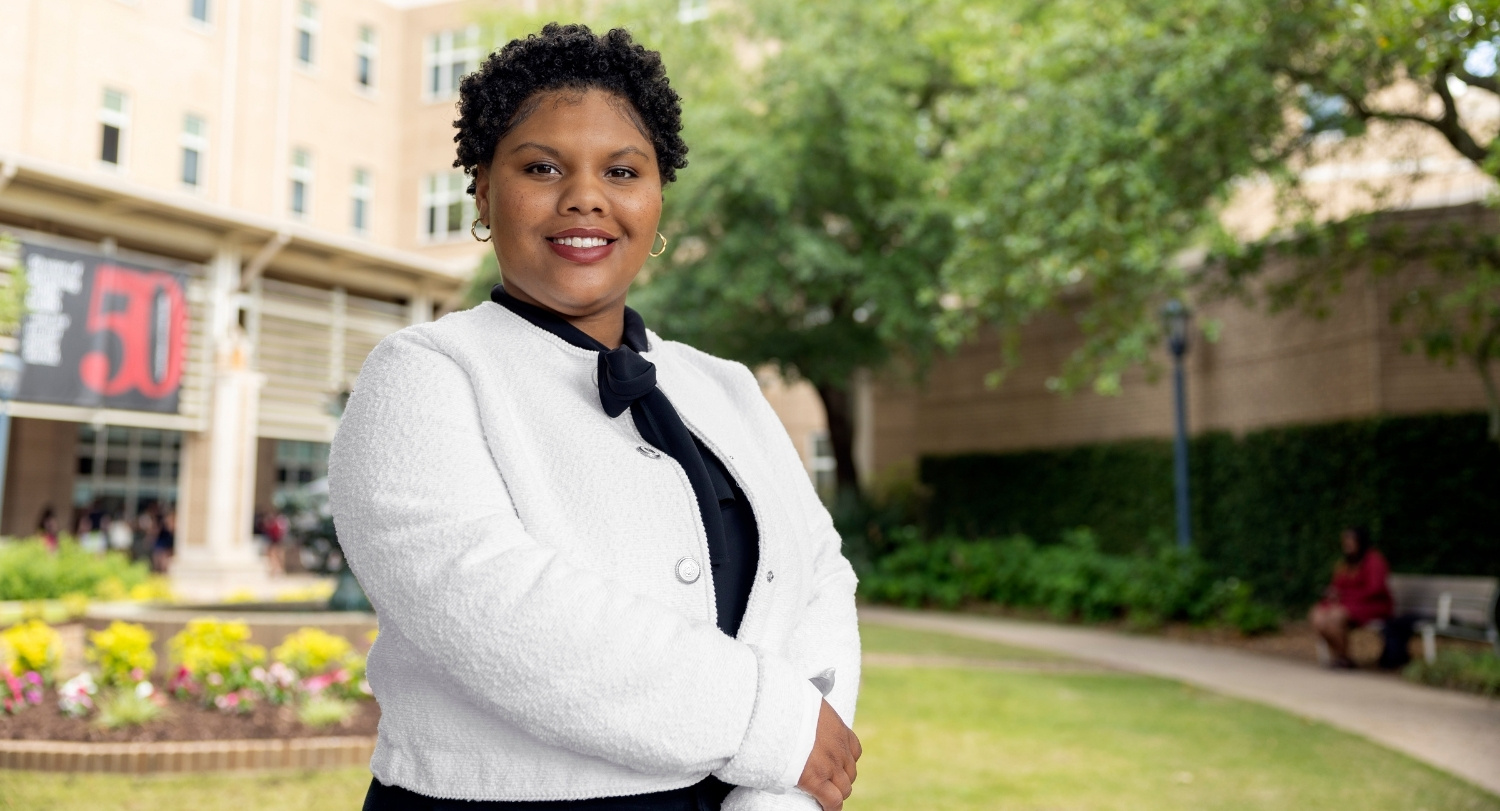
When Ebony Christie discovered the career path to which she would dedicate her life, there was no “eureka!” moment. It wasn’t something the first-generation college student planned on as a child — though faith has guided her from day one. There was no bulb dinging to life over her head. No vision by way of dream.
No, Christie found her passion for maternal health — particularly in lowering the higher-than-average mortality rates for Black pregnant women in South Carolina, according to the S.C. Department of Public Health — because of hard work, scholarship and volunteering while an undergraduate student at the University of South Carolina.
Now at Emory University earning her master’s in public health before going to medical school, Christie credits mentors at USC for nurturing her curiosity and heart for service. It’s all paving the way for her to become a doctor of Obstetrics and Gynecology (OB-GYN) and an Epidemiologist.
“Even though there were so many times where I wasn't sure I was doing the right thing or wasn't doing the right major, I still gave it my best,” the South Carolina native says. “And things worked out the way that they were supposed to.”
Finding her path at USC
Christie was born in Charleston and raised in Columbia by her grandparents. She came to USC as a journalism major — she’d written for her high school newspaper and wanted to “give voice to the voiceless.”
It wasn’t the right fit, so Christie started to look for a new path. “I went from biology to English back to biology,” the 2026 graduate recalls.
Christie ultimately landed on pre-med and started volunteering at The Free Health Clinic in Columbia. It was there, in conversation with her peers, Christie first considered public health.
“I ended up trying out public health and it felt like a really good fit,” she says.
During her junior year, Christie took “Intro to Health Promotion and Behavior.” One of the projects was to create a plan to address a public health concern in South Carolina.
Call it divine guidance, call it kismet, but what Christie discovered in her research changed her life.
“For some reason — I really don't even know — I just did a quick search about Black maternal health,” she recalls.
She found an article from The Post and Courier, a Charleston-based daily newspaper that’s published several articles on the state’s higher-than-average mortality rates for Black mothers and their babies, particularly in the low-income stretch of the state along Interstate 95, often called the “Corridor of Shame.”
“I read it and I was just completely hooked,” Christie says of the reporting. “That's kind of what started everything.”
A passion for research
Once Christie found her path, she charged forward. Full steam ahead.
Her final three semesters were filled with community projects, including helping the city of Columbia mark its first-ever Black maternal health week and platforming the issue while competing in the Miss Gamecock pageant.
Raising awareness soon evolved into research.
The summer before her senior year, Christie was paired with Daniel Cooper, assistant professor of psychology, and researched “Perceived Discrimination in Expectant Black Mothers” as part of the Dr. Ronald E. McNair Program Post-Baccalaureate program. The undergraduate initiative connects first-generation students in the TRIO program with a faculty mentor so the student can conduct research. The program is designed to support first-gen students who wish to pursue doctoral studies.
Christie worked with Tegia Coleman-Rochester during her undergraduate career to develop her research and presentation abilities. Coleman-Rochester, assistant director of TRIO and director of the McNair Scholar Program, witnessed Christie’s growth from an exceptional student into a skilled researcher and presenter.
“One of the biggest things that I saw her develop was her academic confidence,” Coleman-Rochester says. "She already had great grades, but her research and presentation skills continued to excel. Her hard work and dedication earned her the opportunity to present her research at Brown University and Yale University.”
Not only was Christie’s recognized as a top undergraduate researcher, but her presentation of the findings snagged the attention of Prisma Health OB-GYNs, who happened to be in the audience when Christie was honored for her work.
That meeting led to a two-week shadow program for Christie, who got to see firsthand how OB-GYNs care for expectant mothers in a hospital setting.
“I was still pre-med, still thinking I wanted to be an OB-GYN, but I think that experience really solidified that for me,” Christie says.
The drive to give back
Experience, research and awareness (Christie was also a member of the Arnold School’s Maternal and Child Health Student Association) helped solidify her path to becoming an OB-GYN, but what about the systemic public health issues regarding Black maternal health that started it all?
That’s where graduate school comes in.
Christie is in the second year of a master’s in public health at Emory University. Ultimately, she hopes to earn both an M.D. and a Ph.D. in Epidemiology, combining her interests in medicine and research to address public health issues.
“The way we go about communicating information to different channels, you have to be super creative about it. Simply writing a research paper and getting published into a journal won't reach a person in your neighborhood or a community down the street that's getting neglected.”
What she’s learning in graduate school will help translate the needs she finds in medical school to the audiences who need to hear it most.
“The way we go about communicating information to different channels, you have to be super creative about it,” she says. “Simply writing a research paper and getting published into a journal won't reach a person in your neighborhood or a community down the street that's getting neglected.”
For Coleman-Rochester, Christie represents the type of USC student who will change the world — not because of her grades or her research findings, but because of the drive, the grit and the adaptability it took to obtain those things.
“For many first-generation college students, it comes down to drive and determination. You may not have access to the same resources or background as some of your peers, so you have to be adaptable. You have to want more and be willing to do more to create opportunities for yourself,” Coleman-Rochester says. “Ebony is definitely that kind of person.”