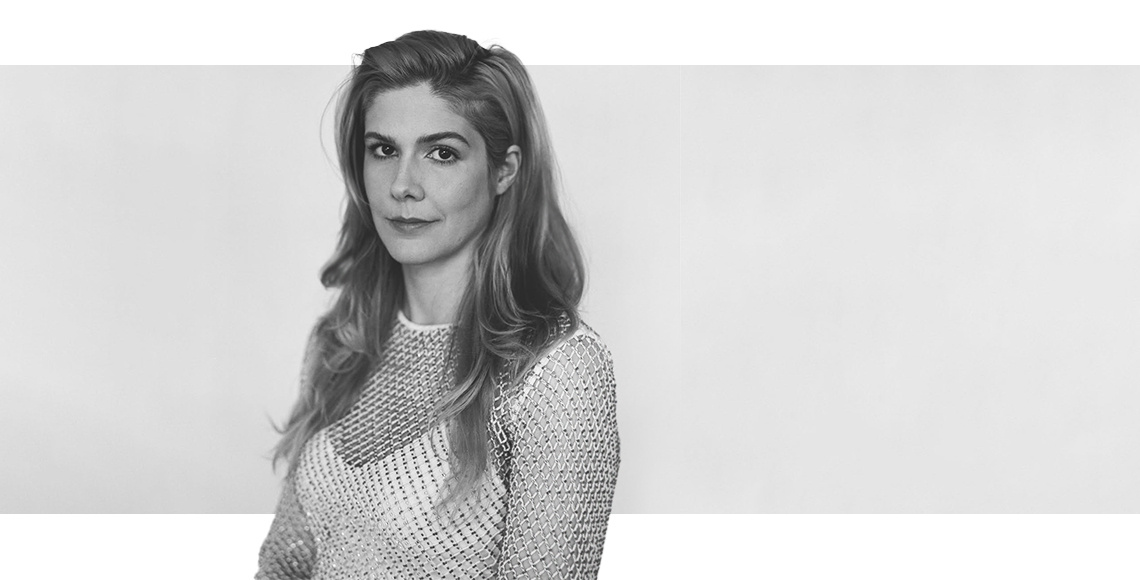
Most professionals don’t have “bloodcurdling scream” in the skills section of their resumes, but Bryarly Bishop does. In fact, you’ve probably heard her: The 2012 South Carolina Honors College graduate and McNair scholar has lent her voice to nationwide campaigns for Toyota, Hello Fresh and Chipotle, just to name a few. She’s also the voice of Connie Taylor in The Texas Chainsaw Massacre video game (cue the bloodcurdling scream).
Bishop’s voice has crisscrossed the nation, reaching audiences through headphones and television speakers and radios. But the first time Bishop heard her voiceover work in public, her reaction wasn’t excitement.
“I heard myself on the radio for the first time when I was in line at Starbucks alone,” she says. It was the “fajitas, fajitas, fajitas” campaign from around 2020. “And through my car speakers, I didn’t recognize myself, so at first I got angry — I thought they had re-cast it and re-recorded it.”
That’s the contradiction of being a voice actor: the ability to be both everywhere and invisible, famous and anonymous. “To me, it felt very superhero,” Bishop reflects. “Seeing it on TV, hearing it on the radio... because nobody knows that it’s me, but it’s a very public thing.”

Bishop’s pursuits are a testament to the capabilities of the human voice. During her time at the University of South Carolina, and in her professional career in Los Angeles, she’s explored voice acting, singing, drama and film. She also believes in the power of a single voice to create community and connections. To have a voice, in Bishop’s view, is to have a particular responsibility.
“I think musicians — at least, for me — singers, songwriters, the ancient onus on us is to tell stories, and to be a record keeper, and also be a voice.”
The story of Bishop’s journey into voice acting began in the United Kingdom. As a European studies major, Bishop spent a semester studying abroad at Swansea University in Wales. She began vlogging about her experience, developing comedy sketches and trying out various accents. The videos gained a following amongst her fellow students, and at a gathering, she was asked how many different accents she could mimic.
“I think I was doing an English accent for fun — I wanted to see how well I could do it — and one of the people in the room was like, ‘Yo, that’s not bad. And actually, I’m shooting a commercial for Burberry, and we need someone to do the voice.’”
The commercial would be Bishop’s first paid gig, and it was a defining moment for the junior from Atlanta, Georgia. Upon returning to the United States, she resumed her voice lessons at USC and began auditioning for audiobooks and other gigs. She moved to Los Angeles in 2013 to star in a web series, and while she was filming, she continued auditioning for voice acting work.

“I was recording and editing and sending in, on average, 20 auditions per day,” she recalls. All the while, Bishop was honing the skills she’d developed in the media arts and music business classes she’d taken as an undergraduate. She also pursued her love of singing and songwriting; in 2014, she released a studio album entitled Bryarly.
Success in the arts and entertainment industry rarely occurs overnight, but after a while, the long hours and thousands of auditions began to pay off. Little by little, Bishop recalls, the voice acting gigs increased, and by around 2015, she was doing voiceover full time for projects ranging from Google instructional videos to clucking like a chicken.
Though the national ad campaigns might have reached the most people, her favorite projects are video games and cartoons. Having been trained to act on stage and screen, Bishop enjoys embodying characters and having the creative flexibility to bring them to life. “You can step outside yourself,” she says. In those moments, the recording booth is her stage.
But there’s more to her success than artistry alone: Bishop has developed her business savvy, as well.
She recommends that anyone pursuing a career in the arts or entertainment industry take the time to learn these skills as early as possible, “not because creative things are never going to work...but because the business side is the non-intuitive side, the side that most artistic people are confused about.”
“I don't think I had a very intelligent or clear idea of what the actual nuts and bolts were, so I have found now that a lot of what I do to manage my own career is stuff that I’ve had to learn over time or figure out or ask people about,” she says. “And it would have been potentially much easier to have done some kind of business management class or internship or kind of like an administrative assistant job, something that is all dotting the I’s and crossing the T's.”
These days, when she isn’t recording, she’s using her voice to explore other creative outlets and to be intentional about making connections with people in her community. There’s a lot to appreciate about Los Angeles, but Bishop admits that it isn’t quite as friendly as what she experienced in the Southeast.
“I really missed getting into a random conversation with the cashier or knowing the names of people around me,” she says. “So I started, everywhere that was walking distance of me, I started getting the names of cashiers, the names of the security guards, and I would remember them by name.” Before long, Bishop was bringing snacks and holiday gifts to her new neighborhood friends.
She’s also directing and starring in her newest short film about a song that, literally and physically, gets stuck in someone’s head. It's amazing the emotions that a voice, that sound, can evoke — which is exactly what keeps Bishop motivated.
“In the short, my character starts pulling the Q-tip from her ear, and around the Q-tip is this cassette tape, magnetic tape. As I'm unwinding, you see it pull out of my ears,” she explains. “When I’ve shown people the still image, a few people have reached up to touch their ears and go like, ‘Ugh!’ and that’s exactly what I want.”

Grounding all of her artistic outlets is her first love: singing and songwriting. She’s excited to be recording new music for the first time in several years, working with “The British Country Music Producer” Tyler Spicer. Though it’s been a little while since she’s recorded songs, Bishop can tell that her voice is stronger and fuller than ever. One of the most important lessons that she learned from her voice teacher at USC, Janet Hawkins, is that most voices don’t reach maturity until a singer’s mid-to-late-thirties.
“I almost think about it like if you if you were to drop water onto a piece of paper and it slowly spreads,” Bishop explains. “That’s how it feels to me — that over time, my voice is slowly beginning to spread out into that fullness and richness that I didn’t have as a teenager.”
That’s another wonder of the human voice: Its ability to reassure us that some things just take time — that this part of us, invisible yet ever-present, is always growing.