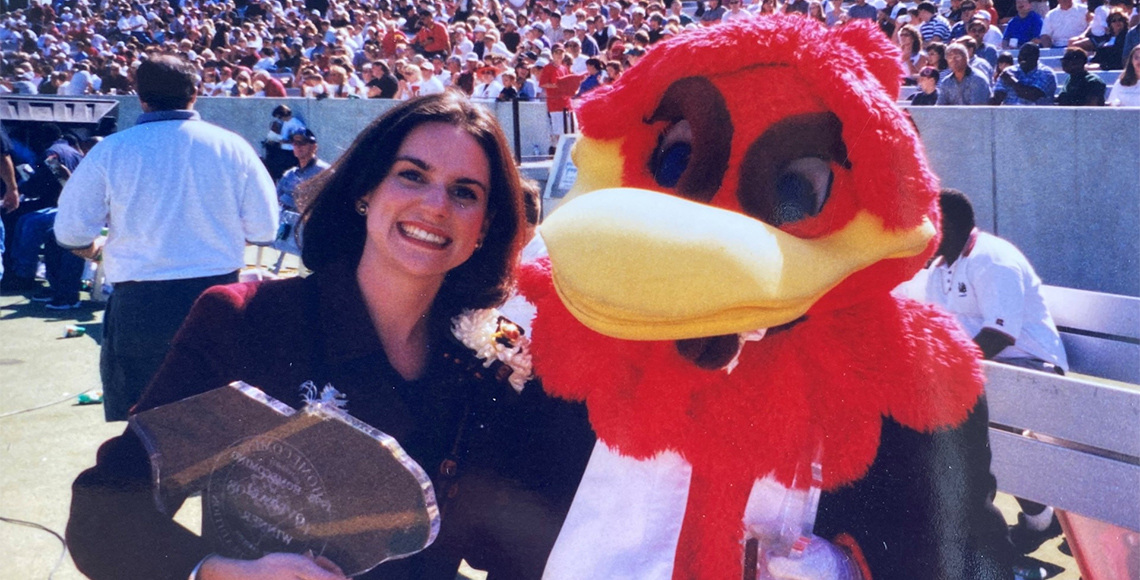
The assistant dean of administration for the South Carolina Honors College begins her interview by asking the questions.
“Have you run any of them through AI yet?” Chappell Wilson asks about the feature stories I’ve written. “I’d be curious — like, how good it would be... You have my permission if you want to try it!”
Intellectual curiosity, piqued. So, what kind of story would artificial intelligence tell about Wilson? Maybe it would start with some facts about her: 1999 SCHC graduate, Carolina scholar, marketing and management major.
Which raises another question: What kind of prompt would coax AI into writing Wilson’s story? Well, here it goes:
“Write an 800-word feature story about Chappell Wilson, 1999 South Carolina Honors College graduate and Carolina scholar. Make sure to include that she was a marketing and management major, and that she worked in development offices in the McCausland College of Arts and Sciences and the SCHC before becoming an assistant dean. Tell that story, but don’t leave out the cast of characters she met in college: the professors, the mentors, the friends and the co-chairs. Oh, and be sure to work the big twist into the end: Though she’s a two-time business grad (she earned her MBA from USC in 2007), Wilson is also a liberal arts major at heart.”
On second thought, maybe that isn’t the kind of prompt that AI could handle. Looks like Wilson’s story will have to be told the old-fashioned way — because, like many SCHC students, Wilson’s intellectual curiosities and Honors experiences blur academic lines and defy predictive technology.
Ties to Carolina
Wilson’s upbringing spanned the United States, with regular moves necessitated by her father’s United States Air Force career. She attended high school in South Carolina, however, which made her eligible for the Carolina Scholarship, the University of South Carolina’s most prestigious award for in-state students.
“We always grew up coming here,” she recalls. “Matter of fact, I remember visiting when we were little, and they actually didn't have the gates closed. You could drive through the Horseshoe. It was one way; you would come in there and drive around... So it felt familiar, even though we didn't ever live in Columbia.”
When Wilson arrived at USC as a student, she would discover that the university held possibilities far greater than just being able to cruise around the historic Horseshoe. She wasted no time enrolling in classes that, even though they weren't business courses, enriched her undergraduate experiences.
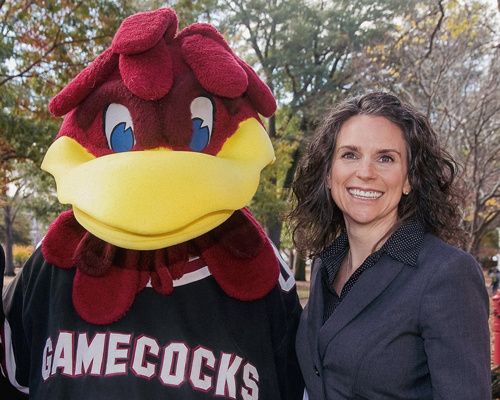
She admits that her course-related reminiscences surprise her — that it’s the arts and humanities classes that ring the first bell of memory. Wilson set out to be a business major because she enjoyed solving problems and wanted to utilize those skills amongst teams of people. And, by her own admission, she wasn’t confident about humanities classes. As she started taking more humanities courses, however, she found that she loved exploring subjects outside of her major.
“I had a history professor who used to dress up to teach us about the historical characters that he would talk about,” she remembers about professor Edward Beardsley.
She would try her hand at acting in professor Ann Dreher’s theater productions, intrigued by the sample class that Dreher taught during her Top Scholar recruitment weekend. “I never got any good roles in the theater,” she says. “I was the person in the back of the line, but I loved it.”
Wilson also practiced the visual and plastic arts, taking a course that traveled to New York City with professor Phillip Mullen; his artwork can be found in both DeSaussure and Harper Colleges, as well as the Koger Center for the Arts. Even though Mullen was tough on his students, the class was still one of her favorites.
“We learned painting. We did wheel throwing. We learned how to blacksmith. We learned all sorts of stuff. He told us that we were terrible at all of it, which was pretty much true,” she laughs. “But it was still such a great class!”
Dreams of deanship
When Wilson wasn’t dabbling in the arts and humanities, she was involved in the USC community. From working in the Honors College, to being an RA in the Maxcy Residence Hall, to managing student body president campaigns, to being the homecoming commissioner, Wilson found opportunities to engage with the university. Along the way, she learned a great deal about leadership.
“I was always so impressed with the dean (Peter Sederberg) that if we (SCHC student employees) were ever stuffing a whole bunch of letters, he would come out and sit there and help us for a few hours,” she remembers about her time as a student worker on the second floor of Harper College. “That really spoke a lot about leadership and how to be a good leader.”
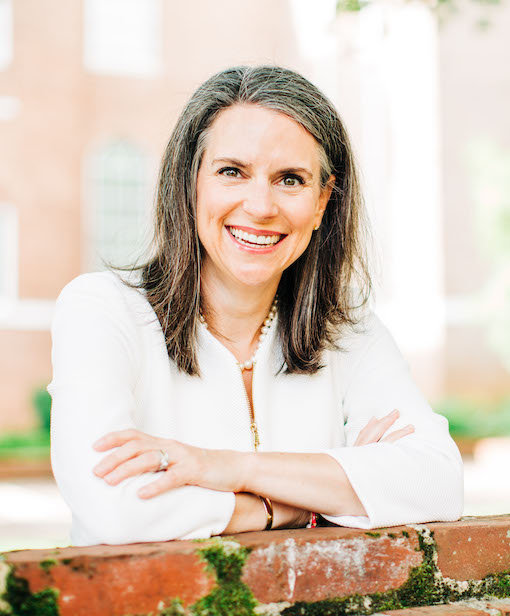
She was so inspired by her work at the university that she would joke that, one day, she would be the dean of the Honors College. When she started working at USC in 2001, she vowed that, if an opportunity ever arose to work in the SCHC, she would take it. In 2006, Wilson joined the Honors staff as its first director of development.
In 2016, she achieved her college-age dream by becoming the Honors College’s assistant dean of administration. The role combines her interests in business, academia and problem-solving, as well as her dedication to building professional relationships.
These days, Wilson’s intellectual curiosities stem from floral arranging to pondering AI to investigating every museum she can find; her favorite one in town, unsurprisingly, is the Columbia Museum of Art. She’s also engaged in a new pursuit that requires both business and humanities skillsets: Wilson is writing a chapter of a book about how to build an honors college. Her contribution will focus on the business needs of an honors college, such as staffing and budgeting.
“You could be a business major like I was and still end up working at the university because, at the end of the day, this is still a business, and we still have finances to think about and strategic planning to do, and HR, and people to hire and jobs to fill,” she attests. “There are still things that you can do at this university, even if you didn't start out to be an academician.”
As an assistant dean, Wilson draws upon the lessons she learned in her business and humanities classes, as well as the skills she gained as a student leader and development officer in the MCAS and SCHC. Though her role is mostly behind-the-scenes, she’s motivated by Honors students’ energy and eagerness to learn. She’s also proud of, and amazed by, the Honors College’s growth. And she still loves the Horseshoe; you can find her working from a bench along the brick pathways on sunny days.
“I love to look back and see how much the Honors College has grown, but the core of who we are and what we do hasn't changed, and that feels really good,” she says. “We’re still here for the exact same reason that we always have been, even though some parts of it have changed over time.”