Let’s start by giving away the surprise: Christopher Carter is an artist.
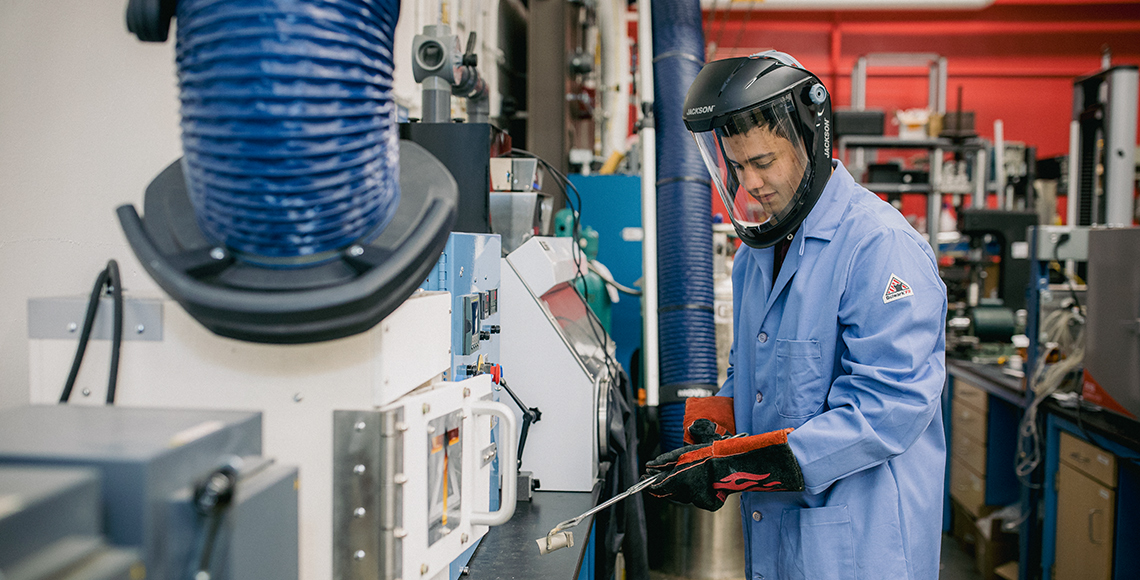
Most of the time, he’s a doctoral student at the Massachusetts Institute of Technology, where he studies mechanical engineering while working with aerospace groups to research materials science. He’s earned a slate of prestigious fellowships, including the National Science Foundation Graduate Research Fellowship and the GEM National Consortium to conduct metal manufacturing research. Not to mention that, in his first year at MIT, he and his fellow researchers developed a specialized treatment for printed metals that was patented.
But when asked if there’s anything else that he would like to discuss about himself, Carter doesn’t elaborate on these achievements. Instead, he reaches for a mixed media sculpture on his windowsill.
“I still have some souvenirs and stuff around me left over from that period,” he says, holding up a wood and metal tree structure. Then, he shows off a piece of metal jewelry he made that was inspired by M.C. Escher’s “Dragon.”
The period that he’s referencing is his undergraduate years: As an Honors student at the University of South Carolina, Carter graduated in 2021 with a mechanical engineering degree and a minor in 3-D studio art.
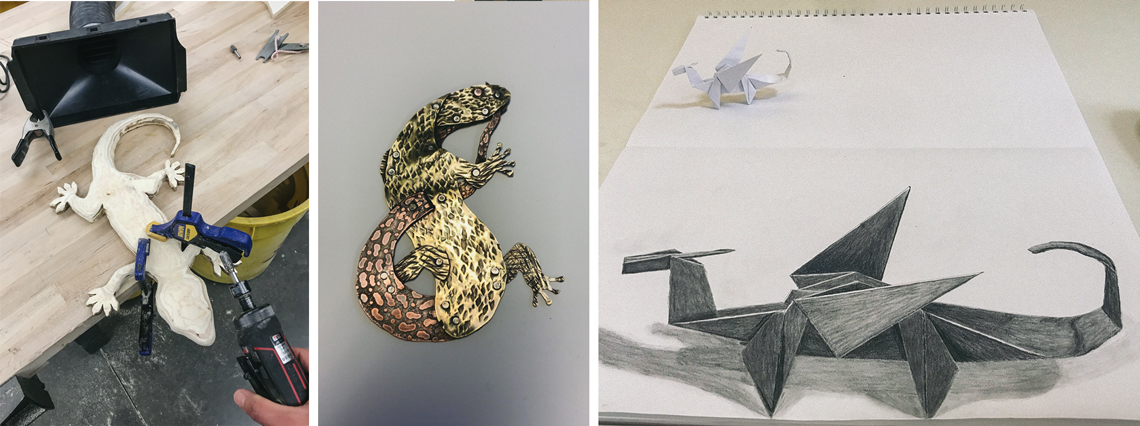
“I’m not sure if anyone else I knew ... who was an engineering major did an art minor or anything like that,” he reflects. “Would highly recommend. It is on the complete opposite side of campus — you need to go all the way up that hill from Swearingen and all the way to the art college. But it is a lot of fun to go from a class on mechanical vibrations to a class where I can work directly with my hands.”
And creating is where Carter excels. He creates community, an encouraging atmosphere, an air of enthusiasm for what he’s researching and those who have guided him along the way. Listening to Carter describe his passion for manufacturing research is a reminder of the importance of the human beings behind the machines, as well as the voices engaged in scientific dialogues.
Originally from Hillsborough, North Carolina, Carter felt drawn to USC after noting the hospitable nature of the Honors College. When he arrived on campus, Carter lost no time involving himself in research. He started working with professor Lang Yuan at the McNAIR Aerospace Center’s 3-D printing lab on metal-added manufacturing, initially in controlling the surface roughness of printed parts. Despite COVID-19 interrupting in-person research, Carter still appreciated the experience and the mentorship.
“Great professor, great person to work with,” Carter reflects. “He’s also the advisor for the club I led, the Society of Manufacturing Engineers (SME). ... We went on a lot of factory tours, got to see a whole lot of cool places where manufacturing is being done in South Carolina, which is a lot of fun and an awesome opportunity.”
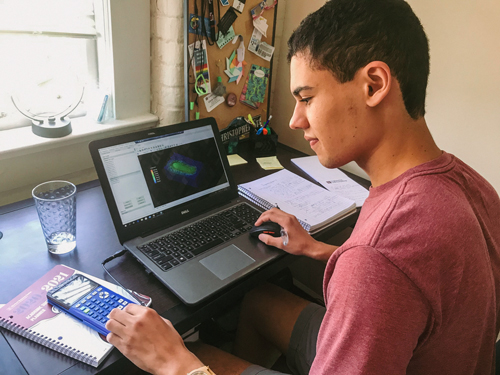
When he wasn’t in the lab or the art studio, Carter was finding ways to advocate for his fellow engineers. He built on a foundation laid by the SME’s previous president and worked to acquire free licenses to SolidWorks, a computer-aided design software, for about 100 students. He also collaborated with a SolidWorks representative to provide comprehensive training for USC engineers.
According to Carter, the program “is super useful for designing products, anything from cars to planes to boats to gears or anything mechanical engineering related.”
Throughout his undergraduate career, Carter’s research was supported by the McNair Fellows program, as well as the South Carolina Space Consortium fellowship. The S.C. Space Grant gave Carter the opportunity to explore how his metal-related research could impact aerospace engineering — and propelled his research career to new heights.
“From there, it also opened the door, I think, to future fellowships,” he says.
In 2021, Carter earned the GEM fellowship, an award that provides summer industry experience for engineering graduate students. As a GEM fellow, Carter spent two summers working for the Argonne National Laboratory in Illinois. Carter was able to build on his research at USC and test the heat-resistance capabilities of metals under high loads, mimicking the conditions that a spacecraft would experience upon reentry into Earth’s atmosphere.
In his graduate studies at MIT, Carter’s initial research focused on superalloys, including a mixture of pure elements such as nickel, cobalt, chromium and iron that form some of the strongest metals at high temperatures.
“One of the big things for printed metals now is aerospace applications,” says Carter, “where you want to really test the limits of these manufacturing technologies — sort of like making internal channels that can air-cool these very high-temperature components a lot more effectively and really change the design from the ground level so that you no longer have to work with simple shapes.”
The ability to 3-D print complex shapes made of heat-resistant metals makes this work indispensable for aerospace companies such as SpaceX and Blue Origin. According to Carter, most of the companies’ engines are constructed from printed metals. And early in Carter’s graduate career, he worked on oxide dispersion-strengthened alloys, a “reemerging technology” that NASA is pushing to be developed into spacecraft materials.
Outside of the lab, Carter continues to build community. “That’s been a huge part of my research journey,” he reflects. He serves as one of two leaders of the queer aero astro club at MIT, QuASAR, which advocates for queer researchers in the aerospace discipline. Carter also collaborates with Boston’s startup community, working with entrepreneurs from MIT, Boston University and Harvard University.
He’s committed to mentoring the next generation of researchers, as well. “I’ve had seven or eight undergrads who worked with me in research positions. They’ve come from multiple universities ... from myriad backgrounds,” he says. “They’ve helped with so many projects, and they’ve done some truly great work. A lot of women, minorities in aerospace, who traditionally are underrepresented in the field are leading these awesome projects and helping push forward really cool technologies that can hopefully lead to better materials in space.”
Though he isn’t making art as much as he did in undergrad, Carter hopes to continue making connections and building community throughout his career. He plans to take a leave from graduate school to be the cofounder of a startup focused on a novel metal 3-D printer.
The trek from the University of South Carolina Molinaroli College of Engineering and Computing to the School of Visual Art and Design might have been steep, but the opportunity to blend his passions for art and engineering was worthwhile, Carter attests. He encourages other Honors students to explore outside of their discipline — there’s an art to engineering.
“The tools that allow engineers to use computer-aided design are very similar to software used to design anything for Pixar, those type of movies,” says Carter. “It’s a very transferable skill, even on the new stuff we’re making with 3-D metal printing. All that stuff has to be designed by someone — and just having that design skill is a great thing to develop further.”