Imagine this: 500 miles above Earth’s surface, a satellite about the size of a microwave orbits. Suddenly, it hums to life, activated by a command sent from thousands of miles below in Columbia, South Carolina, and begins 3D printing a spare part needed to repair a lunar rover.
Or how about this: Along another orbit, a satellite smaller than the Maxcy Monument surveys the South Carolina coast, analyzing the damage caused by a recent tropical storm. It relays the information to disaster response agencies, alerting them to the areas that need the most attention.
These are the possibilities that Jacob Boutin imagines. The South Carolina Honors College sophomore is fascinated by the technological feats made possible by nanosatellites.
“If you can put a manufacturing system up in space, that’s going to help reduce launch costs a lot,” he says, “but it’s also valuable for building full on structures in space for eventual Moon and Mars colonization attempts.”
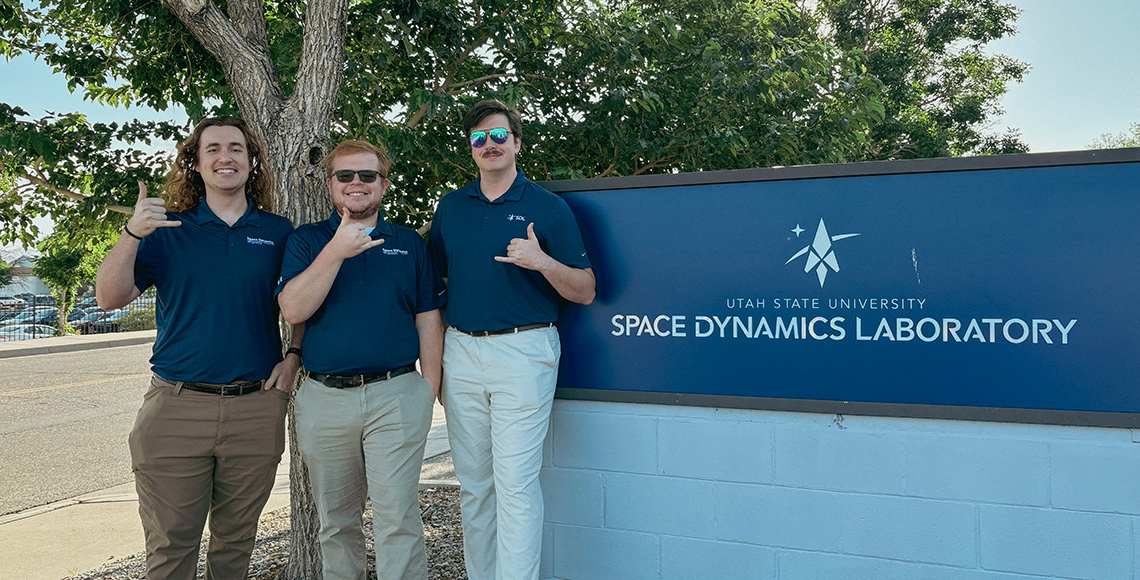
And he isn’t just imagining. The aerospace engineering major is on the cutting edge of research surrounding small spacecrafts. This summer, he and two other Gamecocks spent seven weeks in Albuquerque, New Mexico, in the University Nanosatellite Program Mission Concept Phase at the Space Dynamics Lab.
“I’ve had some experience with the aviation side of [aerospace engineering], but I was definitely excited to get to step into working with such a notable laboratory and just getting to develop satellites in general, because I’ve always been more interested in the space side,” says Boutin.
In Boutin’s first year at the University of South Carolina, he joined the university’s chapter of the American Institute of Aeronautics and Astronautics (AIAA), the world’s largest aerospace technical society, and became the leader of the Small Satellite Committee. Through this leadership role, and an invitation from SCHC alumnus Patrick Bailey (2023 aerospace engineering), Boutin learned about a summer internship at the Space Dynamics Lab and accepted. For Boutin, who has been interested in engineering and flight since middle school, the internship was the chance for him to turn dreams into beyond-the-classroom experiences.
Small but mighty
Universities and labs across the country are entering the burgeoning field of small satellite research, which Boutin says is an exciting change, as most satellite research is conducted exclusively by NASA. Small satellites weigh less than 24 kilograms and measure less than 24 U in volume — a U is 10 cm x 10 cm x 10 cm cube.
“The real benefit of small satellites is they’re a relatively cost-effective way to test out space-based experiments that you really can’t do on something like the International Space Station,” Boutin explains. “Small satellites are an area of interest for me that is relatively new. It’s not something that I really knew a lot about before coming to USC, and as I just learned more about them and their value — that’s where the interest came from.”
This summer, Boutin and his peers were challenged to prove that a 3D printer could function on a nanosatellite. It was the perfect opportunity for Boutin to put the practical skills that he’d gained in his math, science and engineering classes into action — and to receive feedback from seasoned engineers. The team participated in two separate two-hour critique sessions throughout the summer.
“I was definitely surprised by the amount of holes in our logic that we as students didn't really notice. It was great getting to work with these professionals,” he says. “But I was also surprised by the amount of things that they just were able to poke at — that was super valuable feedback. And it really taught us, as a group, a lot about the importance of the small things, and how that that can make or break what you're doing for sure.”
Countdown to launch
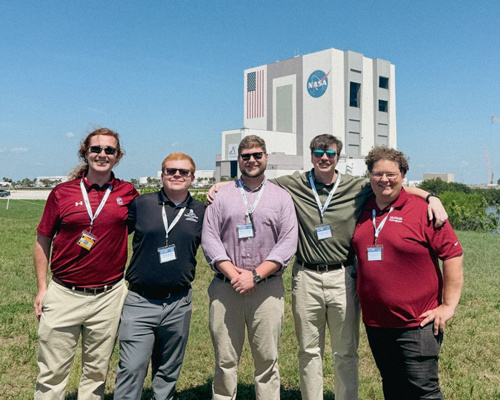
To conclude their summer experience, Boutin and his team shared what they had learned and developed in a poster presentation at a culminating conference in Utah. They had the opportunity to network with students from across the country, as well as industry leaders in flight technology. This fall, Boutin will draw on this feedback as he resumes research with professor Wout De Backer at the McNair Aerospace Center for Aerospace Innovation and Research. He plans to continue working on the nanosatellite project with the AIAA until its launch date, which he anticipates will happen during his master’s program.
“As a university, designing and launching a satellite built here in South Carolina can place us among a select group of institutions worldwide that have space programs,” says De Backer. “This is a goal we are actively working toward and are committed to. The involvement of undergraduate students, like Jacob, in this effort provides them with valuable experience that prepares them for careers in space engineering, while strengthening USC’s position as a contributor to aerospace innovation.”
As Boutin reflects on his first experience conducting nanosatellite research, he’s surprised and excited by how quickly he was able to start and “learn on the fly.” He encourages his peers to explore this area of aerospace and become involved with the AIAA’s nanosatellite project — and not just his engineering peers. There’s room for many disciplines in space flight research, from computer science to the arts and humanities. The path to space, as it turns out, is interdisciplinary.
“I know it sounds intimidating, but just don’t be afraid to take the leap,” he says. “You can find a way to get involved if you look hard enough and find a university that’s really working on a project that is going to need your skillset.”