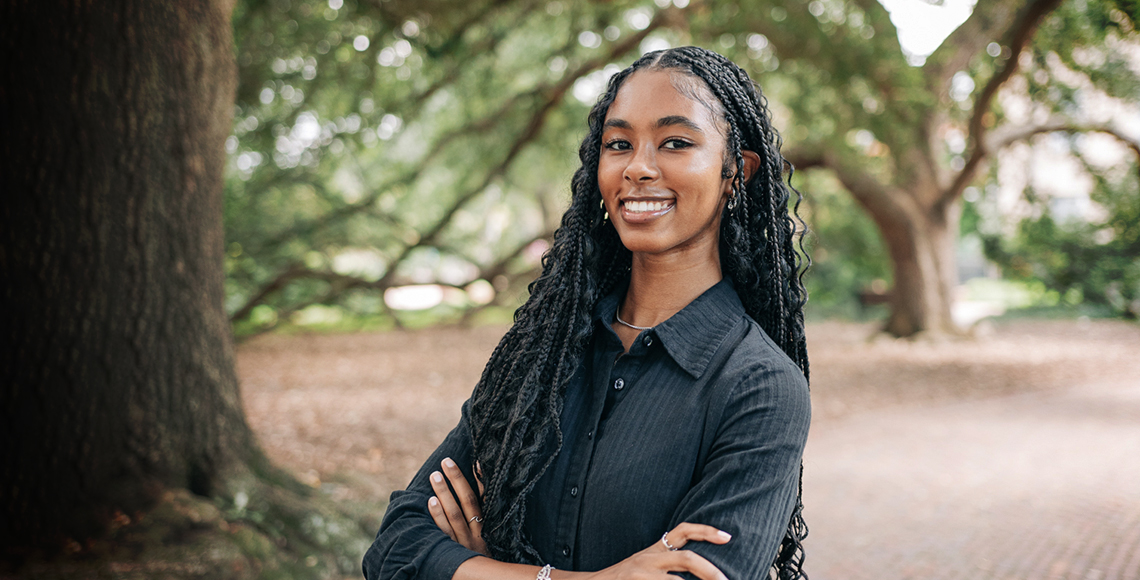
When Kamryn Carter visited the University of South Carolina, she knew that she’d found a community in which she could thrive.
“When we attended an Honors College session, some of the students there were so sweet that I was like, ‘I have to come here. I have to be part of this community because I already feel so welcome,’” she reflects.
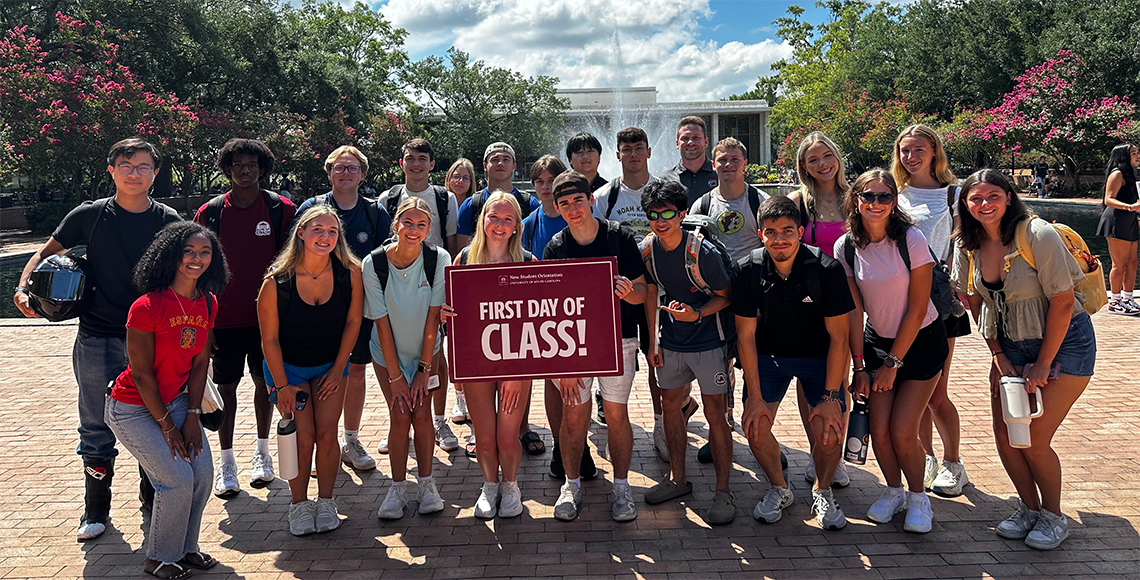
A philosophy and religious studies double major from Buffalo, New York, Carter is fascinated by people, particularly the ways in which they act and the beliefs they hold. And the people she found at USC and the South Carolina Honors College have empowered her to grow as a leader, engage in enriching dialogues and explore her fascination with ethics in and beyond the classroom.
“I don’t think that she (my first-year self) ever would have imagined that I would be doing the things that I’m doing now,” she says.
That’s because Carter is no longer just appreciating the SCHC’s welcoming community — she’s helping to foster it. And, as she prepares to graduate this December, her societally centered goals have only grown more ambitious.
‘A piece of the college experience’
Carter also felt at home in the Honors College because it embodied the values that her family had instilled in her from an early age. She credits her grandmother in particular with fostering a love of learning and asking deep questions. Though Carter’s grandmother did not attend college, her commitment to being a lifelong learner inspired Carter’s own intellectual curiosity and underscored the importance of education.
“Throughout each semester, I would share with her the things I learned in my classes ... giving her a piece of the college experience she would’ve loved to have,” she says.
She was sure about a philosophy major “from the jump,” and added her religious studies major after taking professor Marko Geslani’s Religion and the Arts course. Through her courses in the Religious Studies department — she's taken a class with nearly every professor, and Geslani is her Honors senior thesis director — she has investigated why humans feel drawn toward particular religions.
“What, specifically, does religion do for us, in a way? And how does that inform the decisions we make? And I think the same thing in a philosophical context: How do the beliefs you hold influence the way you act?”
As an aspiring attorney and social justice advocate, these are important questions to ask.
To prepare her for a legal career, Carter sought an undergraduate education that discussed the application of philosophy and religion in society. She credits courses such as professor John Mandsager’s Law and Religious Traditions class and professor Agnes Bolinska’s course, How to Think in an Age of Political Polarization, for providing educational frameworks to discuss important ethical concepts.
“It’s so important to not only have opinions on political and controversial issues, but also to be able to know how to communicate them and have productive conversations with those who might have different or the opposite beliefs,” says Carter. “So many issues we have today are exacerbated by an inability or unwillingness to really listen to those outside of your echo chamber.”
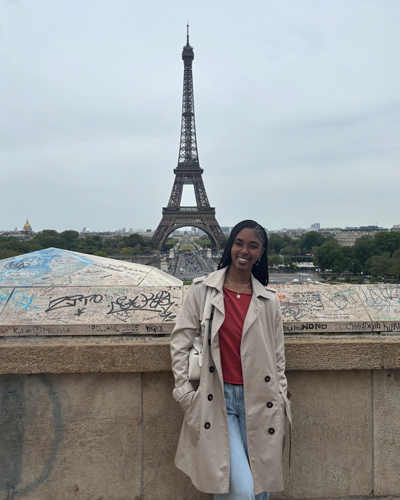
She also had the opportunity for self-reflection. One of her most memorable courses was an SCHC Maymester study abroad experience in Paris, France. The class focused on American expatriates in France and how they discovered themselves through writing. She also immersed herself in Southern culture through Nature Writing and the 21st Century Southern Sublime, a course taught by professor Tara Powell.
“We talked about the environment and the effects of people on the environment, but specifically within the South and South Carolina. And the texts that we read were so interesting,” she says. This class was one in particular that she shared with her grandmother, who was an avid reader.
‘So much more than ourselves’
She grew into a self-reflective and societally focused scholar, Carter also developed her leadership skills. At the start of her undergraduate experience, she didn’t see herself as someone who would vie for leadership positions. But as she became more invested in the SCHC and USC community, she realized that, if she wanted to be a leader and advocate, she would have to seek those opportunities.
“I’ve been able to meet so many incredible people that have instilled that confidence within me to know: ‘I am capable of doing this, and I will excel at it,’” she says.
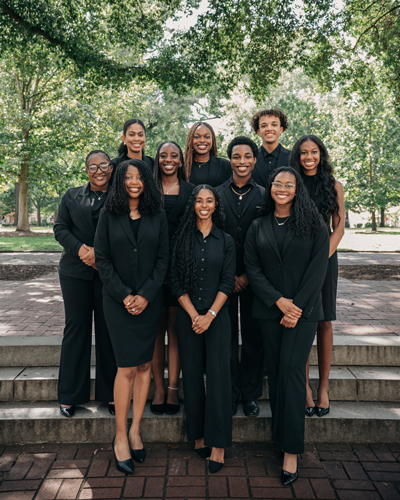
Within the Honors College community, Carter serves as the secretary of the Black Honors Caucus; across campus, she can also be found mentoring students as a University 101 Peer Leader and the vice president of marketing for the Carolina Judicial Council. Though her roles vary, the underlying motivation is the lesson she learned from her father, another of her academic inspirations: the power of advocacy through education.
“Being a U101 peer leader, I am able to advocate for my students to make sure that they have the best first-year experience that they can,” she says. “And I think that my role as their peer leader, making sure that they’re informed about all of the resources that this campus has — because we have so many — that’s the biggest thing I want to bring to the table.”
On the Carolina Judicial Council (CJC), Carter combines her passion for leadership and ethics. Student members of the committee uphold the tenants of the Carolinian Creed and serve on panel hearings for honor code violations. As Carter explains, the Council operates as an appellate court for students and works closely with the Office of Student Conduct and Academic Integrity. While this is an immense responsibility, Carter appreciates the opportunity to observe ethical codes in action — the perfect opportunity to prepare her for a career as a lawyer.
‘A part of vast legacies’
Carter is applying for a host of law schools in Washington, D.C., and she aspires to a career in criminal law. She plans to draw from experiences on the CJC and through interning with a criminal court judge in her hometown.
“I think that there’s a lot of value in that and ensuring that our trial process is upheld, because I really do think that is ultimately the crux of our legal system, our justice system, is that trial process,” she says. “I want to be working with people, like public policy, social justice ... going back to my whole point about advocacy, I want to be able to advocate for people, for my clients. The legal field is broadly inaccessible for many, and I want to work to close that gap.”
Before she begins law school, however, she has one defining undergraduate experience remaining. Carter was selected to be a Senior Marshal and will speak at the SCHC December Revocation ceremony. It is bittersweet for Carter, as one of her academic inspirations — her grandmother — will not be able to attend. But, being the philosophy major that she is, Carter has reflected on the significance of this moment.
“She (my grandmother) passed away last December, so she sadly will not be able to see me graduate, but in my ability to walk the stage twice, both as a graduate of the University of South Carolina and of the South Carolina Honors College, I carry her with me,” Carter says. “My being selected as a Senior Marshal is a reflection of and a dedication not just to the work I have put in, but also the foundation provided for me by my grandmother and so many other important figures in my life. It’s a reminder that we are so much more than ourselves; we’re a part of vast legacies that have and will continue to guide and shape our lives.”