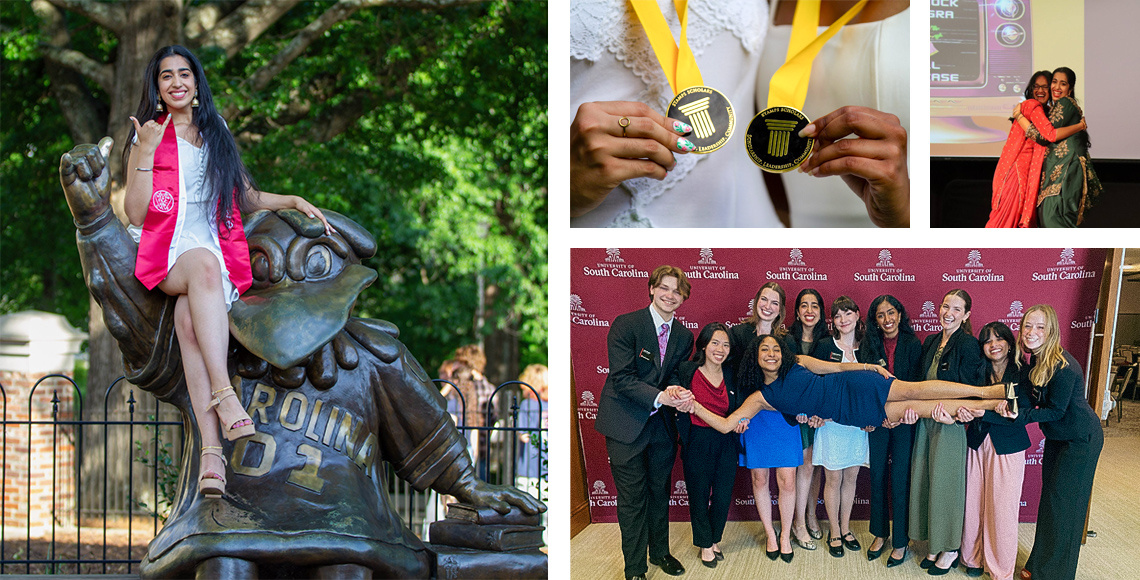
When Muskaan Makkar studied abroad in Switzerland in the spring of 2024, she motivated herself to travel independently by seeking out Sikh temples. The goal, and the connection to her home and family, was a source of strength — a bit of familiarity amidst a new country and culture.
“I found that that provided me a lot more comfort and contentment in my own self,” says Makkar. “It's like, ‘Well, I don't need anyone else to be here to do these things — I can do them and push myself beyond my limits a lot more than I thought possible.'”
For Makkar, a public health major and Stamps scholar from Summerville, South Carolina, community is at the center of her life experience, no matter where in the world she is. And that is because Makkar doesn’t just draw strength from her community: She also invests in it. In her words, giving back to one’s community is “the point of human civilization.”
Her undergraduate career at the University of South Carolina is a testament to her determination to do just that. From her coursework as a public health major to her impacts on campus, Columbia and the Stamps scholars community, Makkar’s commitment to others is undeniable.
Tying threads
As a first-year student, Makkar sought to bridge the distances made necessary by the Covid-19 pandemic. With few in-person opportunities available, Makkar proposed the idea of starting a pen-pal program to unite Stamps scholars from universities across the country. The Stamps Foundation embraced the idea and disseminated information to scholars. According to Makkar, about 50 students participated, and many had the opportunity to meet in person at the Stamps Convention the following year.
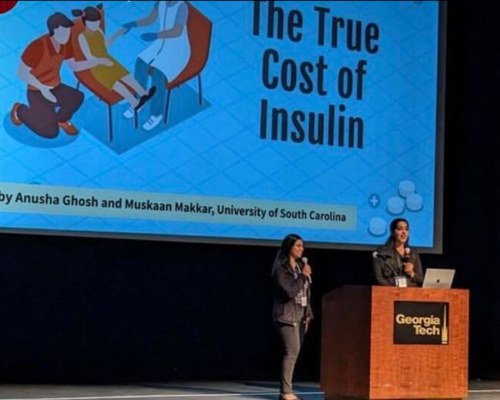
At the 2023 convention, which drew about 800 attendees, Makkar and fellow Stamps scholar Anusha Ghosh (BARSC-MD) led a “thread”: a four-hour presentation and conversation about the presenters’ topic of choice. Each Stamps Convention features about five threads, and Makkar and Ghosh were selected to give their proposed presentation about the burden of insulin in America.
“One of my best friends at the time, she has type 1 diabetes, and I started thinking about that a lot more because I've never been around someone who had type 1 diabetes,” Makkar recalls. “I’d never seen how much it consumes of their lives in terms of time, burden, but also cost burden.”
Makkar and Ghosh combined their interests in public health and medicine to create the four-hour presentation. They also brought in guest speakers, such as Makkar’s friend, and a nonprofit insulin manufacturer.
“That led to an internship with them for me,” says Makkar. “So it was just a bunch of really, really cool opportunities of how to build a project and how to really explore things from all different facets. And I knew she (Ghosh) was the perfect partner in crime for that. I could not have done it without her. I think we complemented each other extremely well.”
Tackling national concerns
This wouldn’t be the only time that Makkar and Ghosh would combine forces to face a challenging public health and well-being issue. In the fall of 2023, Makkar, Ghosh and Capstone scholar Hima Vadlamani partnered for the Tulane Health Policy Case Competition. Their case centered on solutions to homelessness in New Orleans, Louisiana. The trio worked through their fall break to prepare their presentation, and when they were notified that they were finalists, they didn’t realize the magnitude of that distinction.
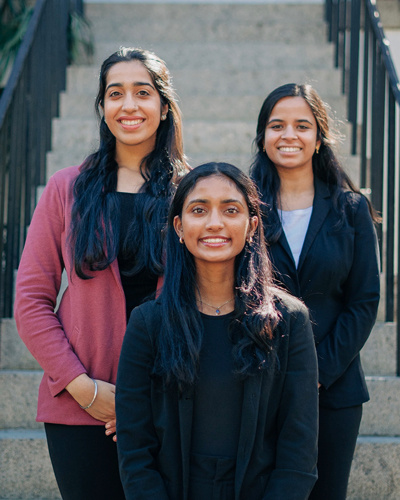
“We got the call or got an e-mail a week after we submitted it,” says Makkar, “‘Congratulations, you made it to finals,’ and we're like, ‘Oh my gosh, probably everyone makes it to finals.’ No. When we got there, we found out it was three teams.” Makkar, Ghosh and Vadlamani had earned a spot out of 63 teams.
Their method? Seeking community input. While preparing their case, the trio called shelters and care providers in New Orleans to hear their concerns and make informed suggestions. Along the way, they discovered that the phone line to the largest shelter in New Orleans wasn't functioning.
“We recorded the fact that the line was disconnected and showed in our presentation exactly what happens when you call them, and I think that the snippet of the voice clip really won them (the judges) over because I don't even think they realized the line was disconnected,” says Makkar. “If we keep observing issues in isolation, what is the point of this case condition? What is the point of me doing research?”
Their attention to detail won them the case competition, but more importantly: The line is now back in operation.
A community of dance
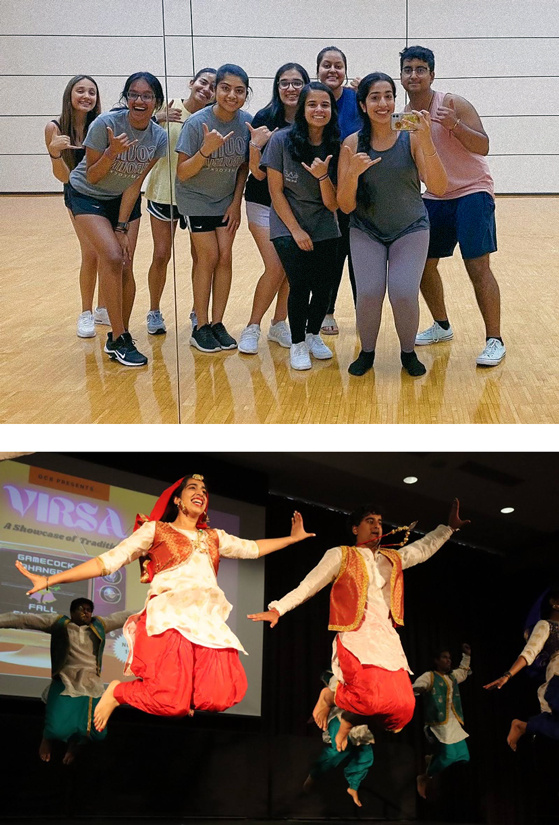
Initiative is a strong trait of Makkar’s. At USC, she revitalized the Gamecock Bhangra organization. Makkar learned Bhangra, a traditional Punjabi folk dance, from her cousin; her family encouraged her to continue while in college. Makkar recruited six members to join and started developing choreography — a new skill.
“I really gained an understanding of how to teach and also how to public speak, in a way, because most practices I'm teaching and talking and explaining these moves,” she says, “and really breaking things down for people in a way that I think really did help me in my academic experience, breaking things down for people as a teacher.”
Makkar appreciates that the group doesn’t compete, which allows them to schedule performances within the USC and Columbia communities. For their first performance, for example, Gamecock Bhangra performed at the Columbia Museum of Art. The group now consists of about 14 regular members — most of whom had no prior experience with the dance — and gives annual showcase performances, as well as dancing at various events and festivals around the state.
In the classroom and beyond
Amongst all of this community involvement, it might be easy to forget that Makkar is also a student. But she is, and, not surprisingly, some of her most impactful classes have had a service element.
“My biggest mentor in Honors College is Dr. Deborah Billings,” says Makkar. “She taught the Honors Mutual Aid and Advocacy class, which is all about getting invested in your community and working to solve problems outside of the government in a way and outside of broader systems.”
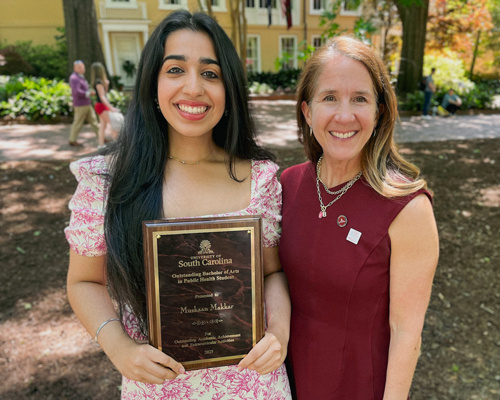
In the class, Makkar focused on reproductive justice, interviewing healthcare providers, lawyers, a medical student and other stakeholders. Makkar appreciated professor Billings’ dedication to helping students have a quality learning experience and giving them the flexibility to tailor projects to their interests.
Makkar also cites professor Jim Thrasher as an influential mentor. She worked with him to research front-of-package nutritional labeling. For Makkar, whose interests in nutrition and nutritional epidemiology had developed throughout her undergraduate experience, the opportunity was a perfect fit.
“Both of them are just really, really incredible mentors,” says Makkar.
Her coursework, mentors, community involvement and personal growth have helped her future goals take shape. She plans to continue pursuing her interests in food policy, nutrition, public health and health accessibility after graduation, earning graduate degrees in public health and nutrition. As her time at USC draws to a close, she’s earned the Outstanding Public Health Student Award, the USC Outstanding Senior Award, the President’s Award and the South Carolina Public Health Association’s Public Health Scholarship.
She's also earned a Fulbright Scholarship to research in France. Makkar will continue working with professor Chantal Julia, a connection she made while studying abroad, to research nutritional labeling.
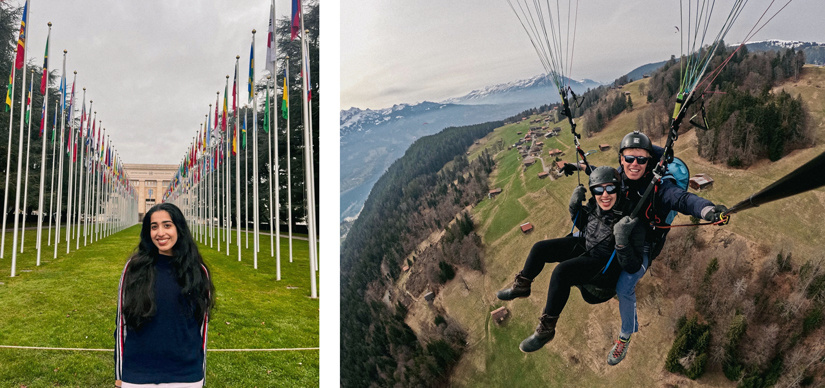
“What is home, even when you’re far away?” Makkar asked herself while in Switzerland. “Home is what gives me strength.”
No matter where she’s living, Makkar’s dream is to make individual impacts as a registered dietician while working on large-scale public health issues. She hopes that she’ll never lose her sense of initiative and commitment to improvement.
“If I get an idea of something, I can't let it go,” she says. “I have to act on it and see what comes out of it.”