
When Carter Mulchaey opened an email promoting a funded year of study in Oxford — an opportunity exclusively for two South Carolina Honors College international business students — he couldn’t quite believe it.
“Wait, you mean Oxford?” he thought as he read. “Not, like, Oxford, Ohio?”
Considering that Mulchaey (2025, international business and finance) is from Columbus, Ohio, it’s reasonable that his first thought would be about a city of the same name in his home state. But as he read the email, the reality of the opportunity came into focus: He could spend a year after graduation in England at the University of Oxford, one of the most renowned institutions of higher education in the world.
He knew that he needed to apply. “I can’t pass up an opportunity as unique as this.”
For Amber Tu (2025, international business and operations and supply chain), the IB Oxford Scholar program was a distant dream. The Carolina scholar from Charleston, South Carolina, learned about the program as a junior while working on her Honors senior thesis. Her thesis advisor, Nancy Buchan, associate professor of international business at the Darla Moore School of Business, encouraged Tu to apply.
As a first-generation student, Tu felt that Oxford was “quite a stretch.” By her senior year, however, she’d connected with Oxford Scholar alumni and realized that this would be the perfect opportunity to explore another academic area before entering the business world. “They were encouraging (me) to study things that weren’t business,” she says. “I was really interested in anthropology.”
Mulchaey and Tu are the University of South Carolina’s most recent IB-Oxford Scholars. This relationship between the South Carolina Honors College, the Darla Moore School of Business and the University of Oxford-Lady Margaret Hall College provides funding for two international business students to spend a fifth year of study at Oxford.
Kendall Roth, former senior associate dean for international programs and partnerships, developed the idea for the program, and professor Buchan established the partnership between the University of South Carolina and Lady Margaret Hall. The program launched in 2014, and alumni have gone on to careers with the Foreign Service, law and businesses across the country.
“The program opens to our students an entirely new way of learning, a more thoughtful and intensely-studied manner of expressing their ideas, exposure to world leaders from all walks of life and interest...who speak at the Oxford Union, and the chance to connect with peers from all over the globe who themselves may become the next generation of world leaders,” says professor Buchan, who serves as program coordinator.
‘What could you not want to study at Oxford?’
Mulchaey wanted to diversify his business skillset throughout his three terms at Oxford. A self-professed lover of learning, he knew that the university’s academic rigor would challenge him to explore the fields of economics and computational neuroscience.
“I worked a lot on AI and large language models, computational processes in the brain, modeling processes through Python code,” he says. “I really chose to focus on the tech side of that.”
He appreciated Oxford’s tutorial structure and focus on self-motivated learning. Mulchaey’s tutors worked with him to determine exactly what he wanted to study in each subject area, then tailored the term’s material accordingly. Instead of attending content-heavy lectures and completing homework assignments or group projects, Mulchaey studied the assigned content independently. The tutorials were an opportunity for discussion, questions and in-depth analysis.
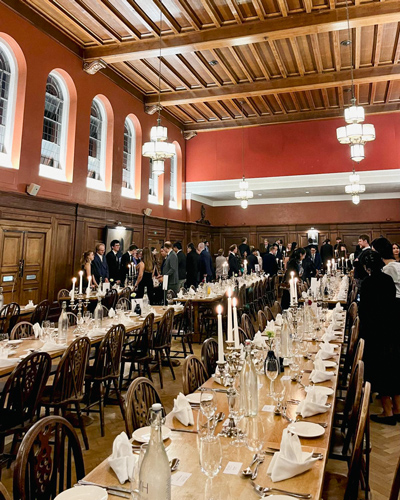
“When I was studying game theory, I was really taken aback by, not only (am I) at Oxford and (I’m) studying with some of the greatest professors, greatest tutors in the world, but the fact that my game theory tutorial was a one-on-one session...I felt like I was so immersed in, because I was so close to the tutor, everything that I did,” he says. “I was getting immediate and direct feedback from somebody who knew exactly what they were doing.”
The collaboration continued outside of the classroom, as well. Mulchaey made connections with dormmates, at mealtimes and through the rowing society. When he wasn’t studying, he was biking into the city to meet peers for lunch or planning trips to Istanbul and India with his new friends. He also enjoyed the weekly Friday night formals, at which students could enjoy a three-course meal and an evening of conversation with their professors.
“Networking opportunities at Oxford, and not even just in the sense of going to events and things, but making friends and connections there is invaluable,” he says. “Just to be able to say that I now have friends all over the world studying law, doing a Ph.D. or doing a master's program at some of the best universities in the world is incredible.”
‘I would recommend it to people who would like to really delve deep into something.’
Tu was the first program participant to study anthropology. Though she chose a non-business subject, Tu attests that Oxford’s tutors were supportive and accommodating of her academic goals. Her interest in anthropology sparked while studying abroad in Hong Kong, and she was eager to make the most of her year at Oxford.
Her instructors challenged her to support her developing views and debate theirs during tutorials. They also encouraged Tu to think critically about research studies and scrutinize methodologies. Tutorials focused on social-cultural anthropology, medical anthropology and ethnobotany. Throughout her three terms at Lady Margaret Hall College, Tu explored signs and symbols of different belief systems, the ways in which different cultures experience sensory pain, and the relationships between coffee and cultures.
While these might not be topics on most business syllabi, Tu drew connections between her anthropology subjects and her USC coursework.
“I felt it could really connect to my international business background and that there was this overlap in better understanding cultures: Being more accepting of them and really understanding the people behind the overall greater frameworks and theories I learned throughout my undergrad,” says Tu.

She also wanted to meet students from different backgrounds. Due to the course structure, Tu had to make friends outside of the classroom instead of in lectures. She joined an origami society and a traditional Chinese dance society, which helped keep her occupied through England’s dark and chilly winters. Tu also frequently used Oxford’s piano practice rooms.
Tu says that her experiences at Oxford — both inside and outside of the classroom — bolstered her adaptability skills, which she believes is crucial to an international business career.
“Business is an ever-changing kind of industry. There are new rules, new regulations, new taboos all the time,” she says. “Going to England...as some country that also speaks English, you would think there are a lot more similarities, but there are actually quite a few differences, and you still need to adapt.”
The Oxford impact
While Mulchaey and Tu studied different subjects, their interests did intersect in one area: artificial intelligence. To conclude their studies, both scholars presented their large language models (LLM) research at the Oxford AI & ML Competency Centre. Mulchaey’s presentation focused on AI-driven input steering and prompt engineering, while Tu conducted a cross-linguistic study of cultural values and Chain-of-Thought reasoning across different LLMs.
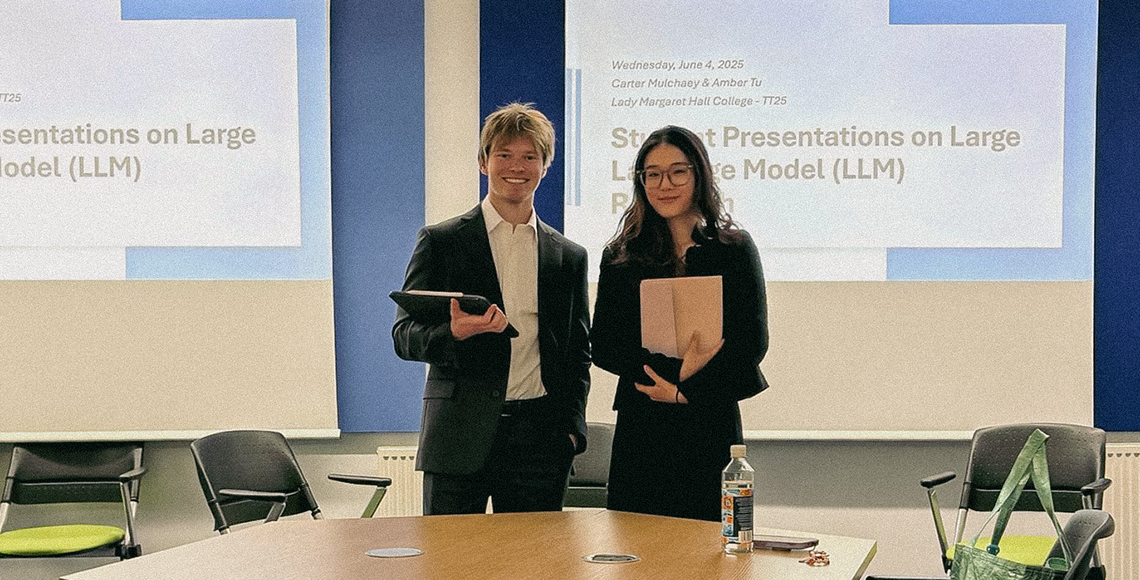
Both leverage the skills they gained at Oxford in their current roles, with Mulchaey stating that he believes that having Oxford on his resume helped him secure his first post-graduation job. Mulchaey combines his finance and tech backgrounds as an analyst at a tech consulting firm in Washington, D.C.
Tu is completing her master’s in international business at the Moore School and intends to pursue management positions at multinational companies, utilizing her cultural competency skills.
And they’re also in agreement about the value of IB Oxford Scholar program experience.
“You study really hard, and you work really hard for these classes that you're interested in, but then you also have an incredible time going to the pubs with all of your friends...and so I would say it's just a lot of fun to put yourself out there,” says Mulchaey.
“Because everyone around you was so motivated, people were in the library on Saturday mornings because the library was open 24/7, and people were just on it,” says Tu. “I definitely felt very motivated and challenged and encouraged to do better.”