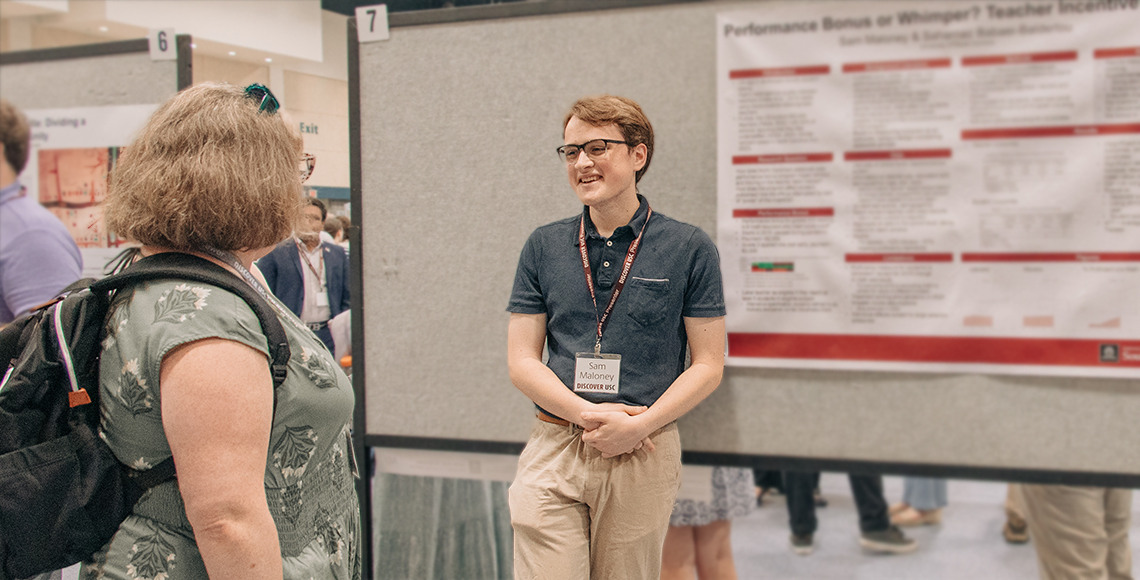
The Center for Disease Control reports that 100,000 Americans died of opioid overdoses in 2023. In 2024, there were 80,000 more deaths.
“The amount of people suffering from OUD (opioid use disorder) remains staggering, with the recent decrease likely largely being due to a fall in the purity of fentanyl sold in the U.S. market which could prove temporary,” writes Samuel Maloney in the opening pages of his South Carolina Honors College senior thesis. Maloney, who graduated with degrees in economics and math in 2025, is familiar with these alarming statistics. He spent three semesters researching drug non-prosecution policies in the United States, analyzing their effects on opioid overdoses.
The result of his efforts is a 23-page thesis, “Opioid Treatment Matters: an Analysis of District Attorney Non-Prosecution,” which reveals the complexity of writing policies to address addiction-related crimes in the U.S.
In the late 2010s, district attorneys across the country implemented non-prosecution policies in an attempt to reduce the fear of being incarcerated for drug-related crimes. The goal was to remove barriers for those with OUD to seek treatment.
“I’m essentially looking at the effect of district attorneys — or broadly, jurisdictions — choosing either not to prosecute or really drastically reduce the punishment of drugs and drug-related crime,” Maloney explains. “And I’m looking to go through and see: Is this working to reduce opioid overdoses?”
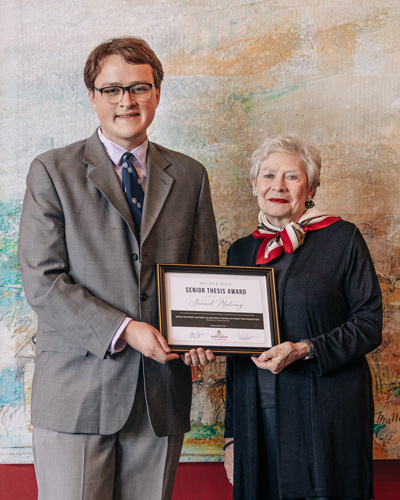
His research question, data collection and analysis earned Maloney the 2025 William A. Mould Senior Thesis Award. Named in honor of the late William A. Mould, inaugural dean of the Honors College, this award recognizes outstanding thesis projects with broad impacts in the student’s field of study.
“No one has looked at the effect of these (non-prosecution) policies on a major intended outcome: reduction of drug-related overdoses,” wrote professor Christina Andrews about Maloney’s efforts. In addition to serving as associate professor in the Department of Health Services Policy and Management at the Arnold School of Public Health, Andrews directed Maloney’s thesis. “As such, Mr. Maloney’s study represents a novel contribution to the scientific literature that has important implications for policy."
Starting early and focusing locally
Maloney, a McNair scholar from Marietta, Georgia, wasted no time engaging in undergraduate research, and that’s his most important piece of advice to Honors students: When it comes to the senior thesis, get an early start. And when it comes to undergraduate research and academics, asking questions pays dividends.
“My advice is to be ambitious with what you ask, within reason,” he says. “In the professional realm, people are often very generous with time, generous with tips, if you have the initiative and if you have done a little bit of thinking.”
Maloney started researching with Andrews his first semester on campus. Andrews’ work focused on medical policy evaluation, which inspired Maloney to investigate non-prosecution policies for drug-related crimes. In particular, he wanted to focus on a project with applications to local areas.
“This branch of economics is called urban economics, or maybe broadly spatial economics, that essentially studies local areas, and I think that that’s broadly understudied in most things,” says Maloney. “It’s the local areas that tend to have the really interesting things happening.”
Maloney’s intellectual curiosity sparked in the classroom, as well. He approached professor Orgul Ozturk, professor and chair of the Department of Economics in the Darla Moore School of Business, about taking a Ph.D.-level econometrics course so that he could learn more about a form of analysis called the Synthetic Control Method. Though he expected to have to wait until his senior year, Maloney was able to enroll as a sophomore.
“He is one of our best Honors College students, demonstrating both exceptional academic promise and a great personality,” wrote professor Ozturk in her nomination letter.
No single solution
Mentors, ambitious academic experiences, research projects and two summers spent working at the Federal Reserve (Philadelphia and Boston) helped Maloney build the skills needed to undertake his thesis research. Since his research topic was novel, there were no comprehensive data sets available for him to analyze to achieve his specific research goals. Therefore, Maloney spent the spring of 2024 hand-collecting data regarding district attorneys’ non-prosecution policies on drug use and drug-related crimes, combing through public records and media reports from 30 counties.
Though accessing and collecting the data was often challenging, by late fall, Maloney was ready to start analyzing. He wrote his own code for analyzing the data sets, utilizing the Augmented Synthetic Control Method; this method allowed him to correct for bias and account for the staggered implementation dates of these policies. The difficulty and advanced nature of this task, which is more commonly performed at the doctoral level, did not go unnoticed.
“Mr. Maloney completed the work with great independence, seeking guidance from the committee as needed, much in the way an advanced doctoral student works with a dissertation committee,” wrote professor Andrews.
Maloney’s analysis finds that, despite their intentions, the non-prosecution policies had a null effect on opioid overdoses. He maintains that further study is needed to refine these conclusions, but, “I can pretty comfortably conclude that these policies of non-prosecution — it’s not reducing overdoses.”
He hypothesizes that other factors are at play, such as access to treatment for opioid addiction, as well as the nature of addiction itself decreasing the desire for treatment. While the solution to reducing opioid overdose deaths is many-layered and complex, Maloney believes that the issue needs to remain front and center for both researchers and policymakers. He hopes that his thesis, which he intends to publish, will be a starting point for future studies.
“That’s my hope,” he says, “while this question is still important.”
In the fall, Maloney will begin a Ph.D. program in economics at Northwestern University. He plans to continue pursuing research, though his interests are broad; whether drug policy-related or otherwise, his goal is to ask compelling research questions and strive for data-driven answers.
“The most important part of research is the research idea,” he reflects. “A good idea can go very far.”