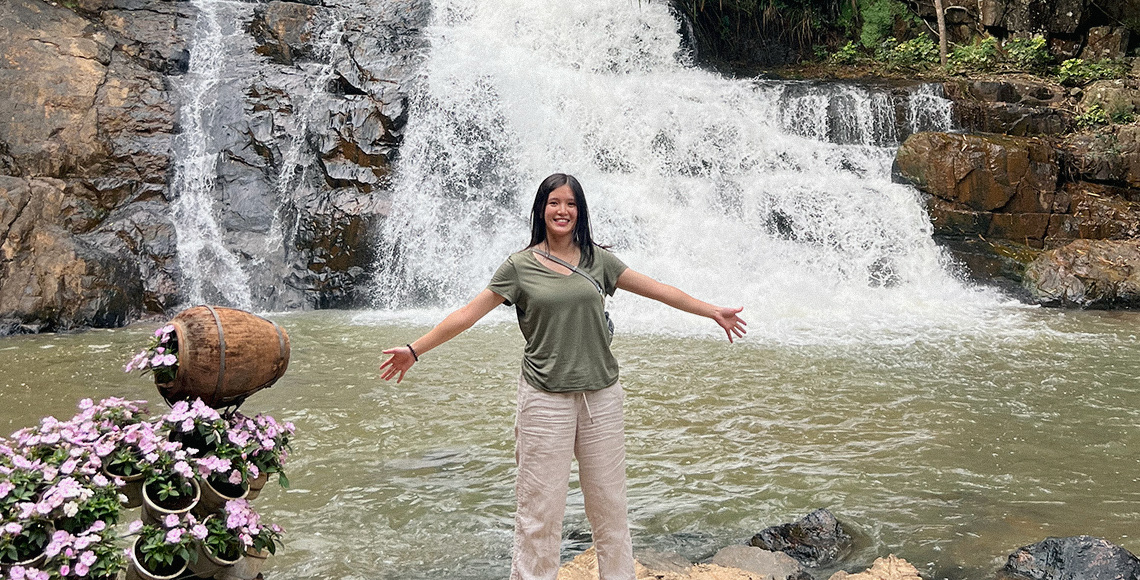
Tam Dinh is no stranger to decision-making. Some decisions, such as choosing to apply to the South Carolina Honors College, have been simple.
“For the plentiful exciting courses and enriching learning opportunities, applying to the South Carolina Honors College was a no-brainer,” says Dinh.
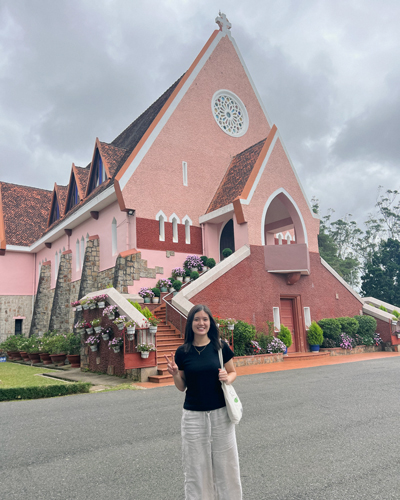
Others, like electing to apply for the Benjamin A. Gilman International Scholarship to fund a summer study abroad program in Vietnam, required more time and guidance from University of South Carolina resources. The hard work paid off: Dinh was awarded the Gilman Scholarship and spent the past summer reconnecting with her family’s Vietnamese heritage.
But one in particular hasn’t been so straightforward. Dinh, a junior from Greenville, South Carolina, has a wide range of intellectual curiosities, which made selecting a major one of the most challenging decisions she’s faced. Through a variety of meaningful experiences both in and beyond the classroom, she has been able to explore her interests and confidently declare a major in psychology.
To celebrate First-Generation Student Week, the Honors College asked Dinh to share about the mentors and experiences that have informed her growth and goals. Her responses have been lightly edited for length and clarity.
How did your plans develop throughout your time at USC and in the SCHC?
This question made me laugh, because those who know me will probably tell you I’ve changed my major at least once a semester. I was interested in business and public health, then pre-med, which I stuck with as a biological sciences major for my first two years — until this semester. Through various courses and extracurricular experiences, I decided to switch my major to psychology. I originally only had a psychology minor, but I realized that I was way more engaged and curious in my psychology classes than the other courses I was taking. There’s just so much about the human mind and behavior that fascinates me, and so much more that I look forward to learning. The Office of Exploratory Advising is probably tired of me by now, but I’m so thankful to them and the professors who inspired me to pursue this passion.
Which Honors class has been the most influential on your academic journey?
So far, I would say my Honors Survey of Developmental Psychology course has been most influential as it was one of many psych courses that revealed to me how interested I was in the subject. It also helped me develop an interest in working with the youth population within psychological science and mental health.
What is an impactful beyond-the-classroom experience that you’ve had? How did this allow you to explore your intellectual curiosities?
This past summer, I had the incredible opportunity to study abroad in Vietnam through the Traditional Medicine and Community Health program with the School for International Training (SIT). Through hospital shadowing, specialized lectures and a final research project, the program taught me about the different components of East Asian/Vietnamese traditional medicine and health care infrastructure in Vietnam. As a pre-med student at the time, it was interesting to learn about the differences between traditional East Asian medicine and Western medicine. Traditional pharmaceutics, cupping and acupuncture were all new treatments to me, and it was awesome to get to see in practice.
However, I was particularly struck by the lack of mental health education and services in Vietnam. We visited many hospitals that practiced both traditional Vietnamese medicine and Western medicine, yet they didn’t have any specialists or departments in psychiatry/psychology. This was definitely a culture shock, and I became more curious to explore cross-cultural mental health stigma and barriers to health access. Aside from traditional Vietnamese medicine, I also got to take a Vietnamese course which came in handy in the country but also helped me toward my personal goal of becoming fluent in the language.
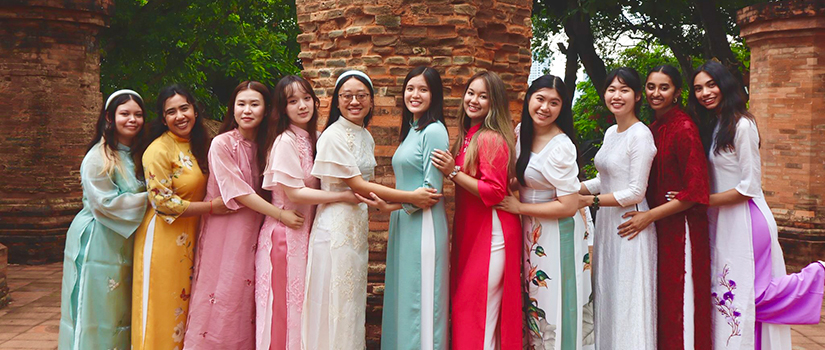
Though this program was only six weeks, it was life changing. I chose to spend my time abroad there because of my Vietnamese roots, which I sought to understand better and grow closer to. I loved seeing my relatives in Vietnam (it had been six years since I last visited) while also exploring my family’s motherland and culture through a different lens. I had the immense privilege of sharing this time abroad with the most fun and bright cohort of peers and supportive program providers. The people I met truly shaped this beautiful journey into what it was. And of course, I’m so grateful for the funding I received from the Education Abroad Office and Benjamin A. Gilman International Scholarship with support from the National Fellowships team, which made my experience possible.
Have you had the opportunity to connect with other first-gen students at USC and/or participate in any first-generation programming?
Yes! In my first year, I was a part of a first-gen Honors focus group where we met to discuss our unique college experiences and challenges in order to promote ways to support other students. Aside from this focus group, I also got to connect with peers through fun first-gen events in the Honors Residence Hall, and I had an amazing first-gen Honors mentor — shout out to alumna Sarah Tra! Having faced imposter syndrome for most of my academic career, this community reminded me that I wasn’t alone.
What advice would you give to other first-generation students in the SCHC?
I’d like to emphasize a message which has stayed with me from my first-year Honors advisor Amanda Heinsman: You were selected to be here for a reason. People saw you as someone who could both make valuable contributions to this community and also grow from it. Whether or not you know your passions or where you’re headed after graduation, there are so many individuals and resources available at USC to support and guide you. Stay open-minded, explore your interests and take a leap of faith when cool opportunities come your way. You never know what you’re capable of and what you can learn until you try!
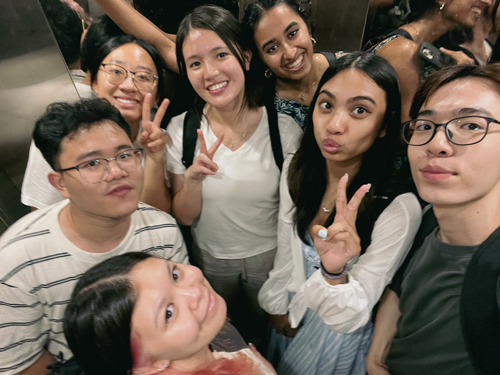
Dinh plans to spend the rest of her undergraduate degree delving into psychology courses and staying involved in the campus community. And, now that she’s feeling certain about her major, there are post-graduation decisions to be made.
“After graduation, my intent is to eventually attend graduate school for psychology,” she says. “However, I want to take a gap year first to work on my applications and, by God’s will, maybe return to Vietnam and teach English abroad!”