Honors course blends love of coffee with foundations of chemical engineering
Honors course blends love of coffee with foundations of chemical engineering
Posted on: February 12, 2026; Updated on: February 12, 2026 By Adianna Macklin
A new Honors course blends a love of coffee-drinking with the foundations of chemical
engineering while helping students scientifically explore and analyze the design of
the popular beverage.
Associate scientist and instructor Mehdi Zare of the Chemical Engineering department started teaching the Science and Design of
Coffee last semester as a new way to introduce Honors students to chemical engineering.
“It’s very interesting to teach because, especially for non-engineers, they don’t
have any kind of background in engineering, and I’d like them to have this understanding
that engineering is not that hard. Everyone can do it,” Zare explained.
The three-credit Honors course dives into the tedious process of roasting, brewing
and tasting coffee, combining the foundational concepts of chemical engineering with
the analyzation of coffee tastes. In the course, students are encouraged to learn
and experiment, ultimately brewing the best-tasting coffee.
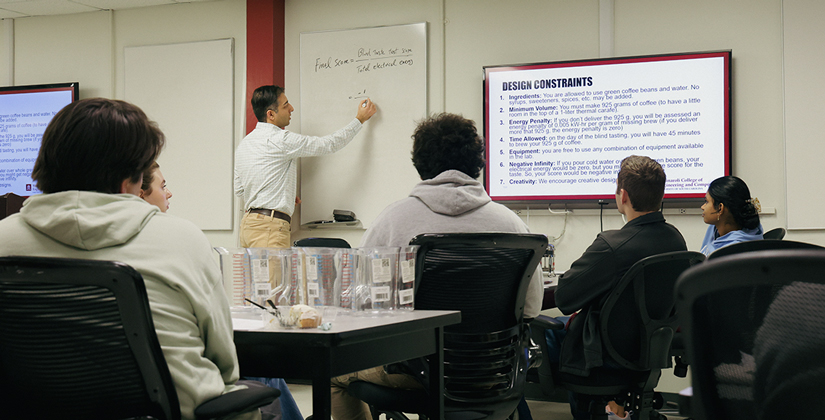
To prepare students for the lab portion of the course, instructor Mehdi Zare begins
class with 30 to 45-minute lecture in the Biomedical Engineering Core Lab building.
Challenging their inner scientist
Junior Sarah Grace Richardson said, “I’ve always loved coffee! It’s something I enjoy every day, so I was intrigued
by the idea of studying it from a scientific perspective.”
Zare believes this course allows the students to challenge their inner scientist through
a topic that interests them.
The course is primarily lab-based, with a heavy focus on experimentation and curiosity.
The first 10 classes cover the science and knowledge behind coffee-making, and the
last four cover the design of coffee. At the end of the course, the students participate
in a design competition, testing their skills to make the best-tasting coffee.
Students are graded on their scientific reports written from their lab experiences.
Scientific writing is a relevant skill to have today, in Zare’s opinion, and one that
he believes the students “can use in their major and in their life.”
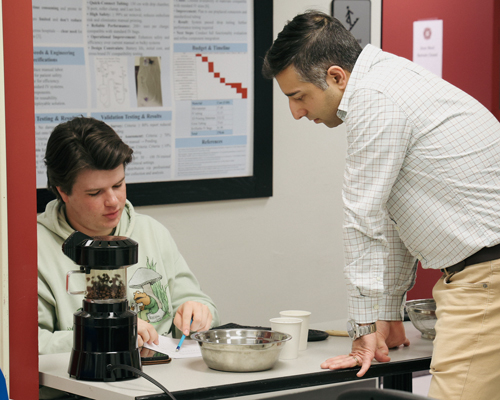
Honors student Benjamin Deaton discusses his lab notes with Instructor Zare while
roasting coffee beans.
Connecting concepts beyond coffee
For Zare, the emphasis on student curiosity is an integral part of his teaching method
so that the learning is genuine. “We are interested in a lot of things and we ask
questions, but sometimes we ignore it because we don’t have the answer for it or we
don’t have the time. I believe if you ignore all of them, then you don’t question
anything. It’s your nature –– we are curious,” Zare said.
The course seeks to connect simple scientific concepts to more than just coffee. Lectures
often utilize everyday things to describe foundational concepts, such as using a household
washer and dryer to understand the second law of thermodynamics.
Zare says that natural phenomena, like how food is produced, how fuel is utilized
or how photosynthesis works, for example, are good ways to apply what students learn
in the Science and Design of Coffee. “I want them to pay attention to the processes
in their environment and natural processes and ask questions and try to discover.”
Zare urges his students to think critically about their experiments, understand why
they got a specific result and change the variables for their next experiment, all
the while connecting what they learn in class to the natural experiences they see
outside of class.
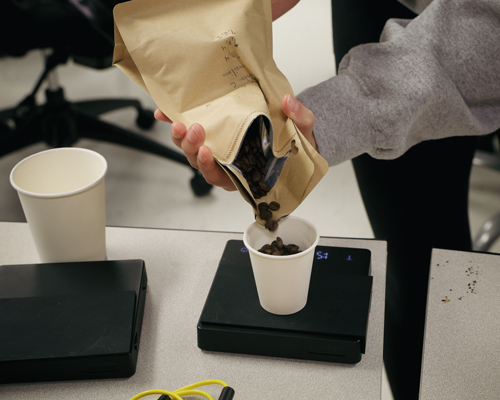
A student measures coffee beans on a scale to test her lab group’s design.
“This course pushes students to think more deeply and critically. It reminds us that
even the simplest everyday experiences can be questioned, explored and understood
through science,” Richardson said.
A growing course
Zare implements mid-semester evaluations to see how the students feel about the course
–– what is working and not working –– to make improvements. As the course continues
to grow, he is hoping to expand their offerings.
“Our goal is to expand. Next semester we’re offering two sessions for the whole university,”
Zare said.
About the Author
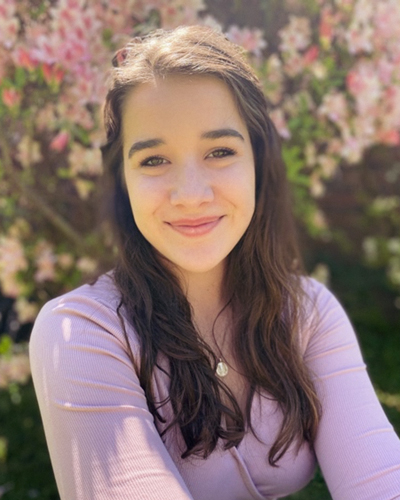
Adianna Macklin
Adianna Macklin is a senior in the Honors College pursuing a degree in visual communications.
She wrote this story for the Honors Writing for Mass Communications course taught
by Bertram Rantin. Beyond being an avid coffee drinker, Macklin is passionate about
reading, traveling and the great outdoors.
All photography provided by Adianna Macklin.
Challenge the conventional. Create the exceptional. No Limits.