Clay County, Kentucky is a small Appalachian community that for decades has faced economic hardship, elevated cancer rates and lingering effects of the opioid epidemic. A traditional coal mining community where the median income is among the lowest in the United States, access to general health care can be limited and specialized services often require hours of travel.
Ashton Farmer, a native daughter of Clay County and Floyd School of Medicine Genetic Counseling student, hopes to change that.
“I was born and raised there, so I saw firsthand the level of health need, the low health literacy, and the barriers to access, and how all of that impacted people in my family and my community,” Farmer said.
I want to give back to the people who gave so much to me my entire life. I know I'm a bit biased, but these are the best people in the world. I will always be proud to say I'm from Clay County.
Service has always been central to her life. Farmer’s family was deeply involved with the church and launched youth sports programs and opened a nonprofit coffee shop next to their church when she was 13.
“That coffee shop changed everything for me,” Farmer said. “I got to interact with people in my community every day, people I wouldn’t have otherwise met. I got to serve them, pray with them and just love on people.”
She later volunteered at a local rehabilitation center and at a child advocacy center. Service became inseparable from her career aspirations.
“I wanted whatever I did professionally to feel like that,” she said.
Farmer didn’t have to wait long to find a career to match her passion for giving back.
“In eighth grade, I visited a hospital and realized there were healthcare careers beyond being a doctor or nurse,” Farmer said. “I felt strongly, even then, that I needed to figure out my future. My mom helped me research careers, and we found an article listing top growing non-clinical healthcare fields and genetic counseling was on that list.”
She later had an opportunity to shadow a genetic counselor from the University of Kentucky, and the fit became even more appealing.
“After I shadowed, I knew right away. I had explored other roles, but nothing compared,” she said. “I fell in love with genetic counseling, and now, the person I shadowed serves on my thesis committee.”
Following her undergraduate degree from the University of the Cumberlands, the first-generation college graduate turned her attention to graduate school studies in genetic counseling. Narrowing her interest, she entered her three final admissions interviews with a clear goal: to study rural health care access in Appalachian Kentucky.
The response was mixed.
“At some schools, I got blank stares,” she said. “Rural health isn’t really a focus in genetic counseling yet.”
But at the School of Medicine, she said, faculty responded differently.
“They didn’t just say they valued rural health. They showed it,” she said.
Faculty supported her thesis proposal, allowed her to conduct research back home in Kentucky and provided funding assistance for survey incentives. Classroom discussions, she said, actively encouraged diverse regional perspectives.
“They’ve truly championed this work.”
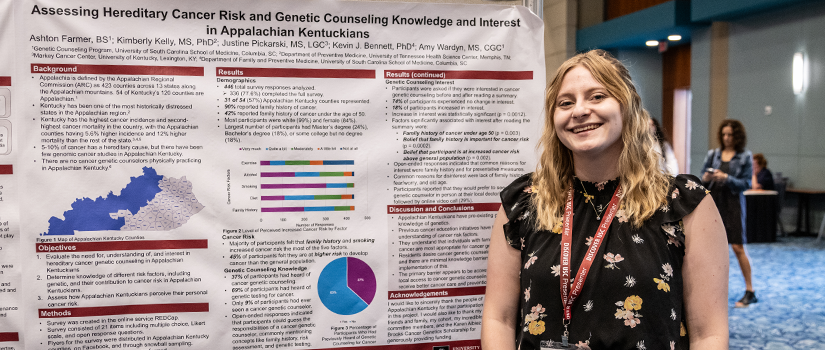
Her thesis focuses on cancer genetic counseling access in Appalachian Kentucky, a region that has some of the highest cancer incidence rates in the country. Yet there are no practicing genetic counselors in Appalachian Kentucky. Most are in Lexington, Louisville and Northern Kentucky.
Her research surveyed almost 450 residents in the region, far exceeding typical survey participation for graduate research. asking whether they understood what a cancer genetic counselor does, whether they would want to see one and what they believed contributes to cancer risk. Over 90 percent of respondents reported a family history of cancer.
“There’s a perception that maybe people wouldn’t be interested,” she said. “But there is interest. There’s both a need and a want.”
Her long-term hope is that her research will encourage hospital systems and politicians to expand access to genetic counseling in eastern Kentucky. She is already working at the policy level, speaking with state and federal lawmakers about expanding access. While more has been done, a focus on available specialty services still remains a point of emphasis. Whether she personally fills the role or helps build the system that makes it possible, the mission is clear.
In a region defined by what it lacks, Farmer only sees possibility.