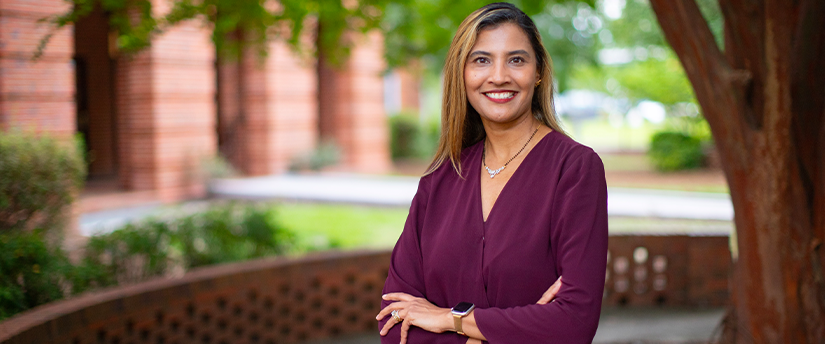
Dr. Srinivasan spoke with us about her work in geriatric psychiatry and her passion for mentorship and advancing the field to meet the growing needs of the nation.
Question: What drew you to geriatric psychiatry?
Dr. Srinivasan: When I was in medical school, going through my clinical years, I really enjoyed various aspects of medicine, including the science of medicine and the art of medicine. Where the confluence of the two seemed to really show up was in psychiatry, which has many facets of the mind-brain connection and the science behind it, as well as the human connection.
That was a big part of what drew me into psychiatry, but I have always had a foundational interest and affinity for older adults, partly because of formative relationships with older family members, my grandparents, and other relatives.
During psychiatry residency training, I gravitated toward the challenging aspects of psychiatric care, including the intersection of neurologic and medical conditions, which was more prevalent in older adults. But it was beyond just that complexity. It was the richness of life histories, lived experiences, and stories, and the wealth of wisdom, resilience, and experience that older adults bring that I found both intellectually stimulating as well as professionally and personally rewarding.
I had a non-traditional entry into geriatric psychiatry fellowship training, which usually occurs right after residency. After completing psychiatry residency training, I worked for three years in a rural, underserved area in community mental health. I provided psychiatric care to older adults with psychiatric and complex medical care needs, as well as social determinants and psychosocial factors - transportation, finances, and social supports - that amplified their medical and psychiatric conditions.
While I had a great foundation in general psychiatry, I felt the need for more training to work with this older adult patient population. So, I returned to the training world for fellowship training in geriatric psychiatry, to gain immersive, subspecialized training .
Question: In your career in geriatric psychiatry, what have you found to be the most challenging or most rewarding part of working with that patient population?
Dr. Srinivasan: I like to say my patients give me more than I can give them. I find it very professionally rewarding.
Geriatric psychiatry exemplifies working in the service of, and in the interest of, the patients and communities we treat, but also working in teams. Geriatric psychiatrists are well trained in working within interdisciplinary teams, and even leading those teams. We organically practice by collaborating with others.
It is not just about what is happening with the patient when they are in our office, clinic, or unit. It is also about family dynamics, community linkages, and connections with others in their healthcare sphere, whether that’s a patient’s primary care practitioner or other specialists. We really see practicing geriatric psychiatry as a team sport.
Question: As the demographics of the country shift towards an older-aged population, how do you see the demands of geriatric psychiatry evolving?
Dr. Srinivasan: By the year 2035, individuals above the age of 65 - the age group considered part of the geriatric demographic - will exceed individuals under the age of 18 in our country.
There already is a demand, but it is not matched by supply. There are not enough geriatric psychiatrists to meet the needs of this burgeoning population, both in our state and across the country.
Disparities lie in early exposure to training. Not every medical school or residency program has access to specialized geriatric psychiatrists. The incorporation of geriatric principles into undergraduate medical education and subsequently into graduate medical education is further challenged by access to adequate numbers of trained faculty.
According to graduate medical education requirements, a minimum of only 4 weeks of geriatric psychiatry exposure is required during a four-year general psychiatry residency program. This is but a drop in the ocean, which is why more clinical exposure and training is critical.
At the Floyd School of Medicine, medical students work with geriatric psychiatrists (who are School of Medicine faculty) both during clinical rotations as well as didactic lectures during their M3 psychiatry clerkship and M4 elective/AI rotations. Furthermore, Prisma Health Midlands has a general psychiatry residency program where geriatric psychiatry experiences are robust, and go well beyond the 4-week minimum. PGY 1, 2, and 3 residents have geriatric psychiatry clinical experiences, that sequentially and longitudinally during each of those clinical years of training. Prisma Health Midlands has an established geriatric psychiatry fellowship program, and the fellowship also collaborates clinically with USC’s Brain Health Center. In summary, all these components spanning UME at the Floyd School of Medicine, GME at Prisma Health Midlands, and geriatric psychiatrist faculty clinical incorporation all promote having this expertise for patients and their families in our community.
Question: Can you talk a little bit about your role as president of the American Association for Geriatric Psychiatry and what that entails? How has it changed your calendar, and what is your involvement now?
Dr. Srinivasan: It is an honor to be on faculty with the Floyd School of Medicine and to be a physician with Prisma Health Medical Group. I see my identity as a clinician educator - I treat and I teach. That identity has been shaped by various aspects of my professional role, both here and through other spheres of engagement with my national organizations.
Similarly, I am honored to be a member of AAGP, the American Association for Geriatric Psychiatry, and serve as President this year. I have been an AAGP member since shortly after my fellowship training. It is an organization dedicated to the mental health and well-being of older adults. AAGP involvement helped shape me professionally through mentorship and engagement, and it gave me a platform to broaden my skills and bring them back here to teach medical students, train residents and fellows, and see patients.
I have followed a leadership trajectory within AAGP: member, committee member, chair of subcommittees, scientific program chair for the 2018 annual meeting, board member at large for three years, and then elected office, secretary-treasurer elect, secretary-treasurer, president-elect, and now president.
Through those leadership opportunities, I have been able to highlight geriatric psychiatry and the resources available for budding geriatric psychiatrists, medical students interested in working with older adults, and residents in whatever specialty or area they choose. It has also empowered me to collaborate with faculty to amplify interest in the field and provide service to patients. It has provided a platform to foster and expand professional connectedness.
Question: Between your roles with your national organization and here on campus, what misconceptions do you hear medical students have about geriatric psychiatry?
Dr. Srinivasan: One misconception is that all older adults have dementia, or that dementia is an inevitability of aging, which it is not. Another is that depression is a natural consequence of aging, which is also a misconception. Part of the impetus of learning about older adults and mental health is learning about healthy aging, resilience with aging, and wellness with aging, and not viewing aging merely through the lens of a deficit model, meaning what is wrong with a person, but also what is right with a person.
Question: Are you optimistic about the future of the field?
Dr. Srinivasan: I am, because geriatric psychiatry, and how we are clinical partners in treating conditions in older adults, are areas that are burgeoning in terms of research and advancement.
A case in point is neurocognitive disorders, or dementia. Research, novel interventions, and treatments have skyrocketed in development in just the last three to five years. This has created renewed enthusiasm and hope in the community and in the field to be able to offer and do more for patients and their families.
That, in turn, creates renewed interest in learning about the field, which trickles down to learners. It also creates renewed interest in collaboration, opportunities for engagement with other practitioners, and a need for infrastructure development. We are seeing that through entities such as the Brain Health Center and other avenues in the community.
At the end of the day, what affects our field is directly informed by the needs of our community.
Question: Why do you feel South Carolina, both as a state and through the university, is a place where you are excited and motivated to be part of the process? It is an underserved, largely rural state, but there are growing opportunities such as the Brain Health Center and the new Health Science Campus. What about South Carolina and its communities excites you about the future here?
Dr. Srinivasan: I have been on faculty here for over 20 years, and I think my experience is not unusual. The leadership of the medical school, the leadership in my department through Dr. Meera Narasimhan, my chair, and the governance of the healthcare system through Prisma Health and the university are very strategic and supportive not just about recruitment, but retention.
This academic-healthcare environment not only makes you want to come here, but stay and thrive professionally here. Our state’s demographics, its growth, infrastructure, and resources also promote this retention. South Carolina is positioned in a way that provides access to resources that promote academic and scholarly growth, clinical advancement, and a growing population across different demographic areas.
Older adults are moving here because the state offers opportunities for retirement without some of the challenges other areas may face, whether climate-wise or cost-of-living-wise. There are so many opportunities in South Carolina when considered through the layers of the community, population, and healthcare infrastructure, lend themselves to making people want to stay and contribute.
That includes institutions of higher medical learning that are attracting high-caliber students, faculty, and staff. The connectivity and interface among medical schools and healthcare systems offer avenues for growth and professional development.
I find it hard-pressed to answer, “Why South Carolina?” versus, “Why not South Carolina?”