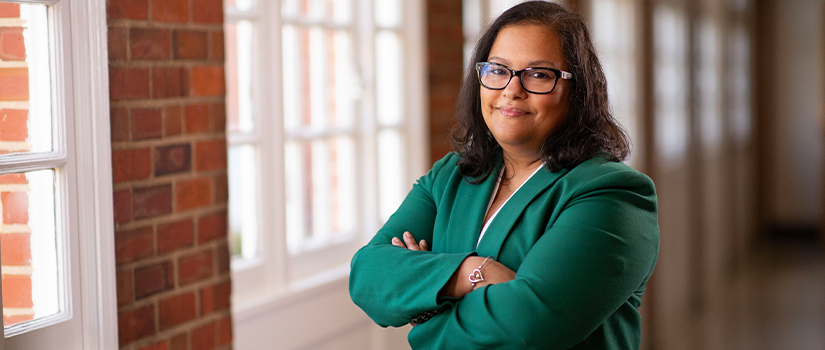
For many Deaf individuals navigating education, employment, and healthcare systems, the barriers they face are not due to ability, but access. For Aileen Pagán-Welch, a student in the Counseling and Rehabilitation program at the Floyd School of Medicine, that reality is all too real and is the foundation of her career ambitions.
As a Deaf professional, she understands firsthand the barriers her clients face. In 2016, she went to seek help finding a job, but her eyes were opened by a disheartening response.
“I told them, I speak three languages, I have two degrees. I would like to work in an office or a college. They offered me a job washing dishes,” she recalled. “That showed me that they think Deaf people are subpar. There was nothing wrong with my brain. Communication is different. I can't hear, but I can do everything else."
A native of the Bronx, Pagán-Welch relocated to Charleston where her husband served in the navy for 21 years. After his retirement from the service, the couple moved to Columbia for work.
Pagán-Welch served as a regional rehabilitation counselor for the Deaf at South Carolina Vocational Rehabilitation (VR), where she worked to help Deaf clients across the Midlands prepare for employment, pursue education, and access training opportunities. Her clients faced challenges obtaining and maintaining employment, and as she looked closer, she began to see a pattern stemming from frustrations and barriers between the Deaf and hearing worlds.
"I observed that they appeared to face challenges unrelated to their job responsibilities, such as unaddressed trauma, coping skills deficits, and anxiety," Pagán-Welch said. "These issues can potentially impact performance and job retention. I understood that prioritizing mental health support was essential to effectively address overall well-being and professional stability."
Her work involved helping clients rebuild confidence, recognize their strengths, and pursue goals that once felt out of reach.
"Being a Deaf individual working with a Deaf counselor can be highly impactful. This is because, rather than focusing on disabilities, we recognize potential. Since beginning my work with the Deaf community, I have observed an increase in the number of Deaf individuals pursuing training and educational opportunities," she added. "Additionally, the quality of employment they are securing has improved. Having a counselor who understands their language, challenges, and concerns can make a significant difference. Currently, South Carolina lacks an adequate number of Deaf counselors, and there is a critical need to expand this professional workforce."
It was affirming and gratifying work, but to continue to grow in the field, Pagán-Welch also needed to complete Comprehensive System of Personnel Development (CSPD) courses to continue working for VR. It was during this time that her life took an unexpected turn. Pagán-Welch was diagnosed with cancer and had to add seven months of chemo once a week and six weeks of radiation every day on top of her career and schooling.
Through that experience, her purpose became even more clear.
"It made me recognize that I aspire to achieve more in my life and to find a greater sense of purpose. I am motivated to work with individuals with disabilities who are also navigating life's challenges and seeking the best path forward for themselves and their families."
Pagán-Welch enrolled at the School of Medicine to pursue a second master’s degree, this time with the focus on becoming a licensed mental health counselor serving Deaf clients. Going back to school after raising three kids and working raised doubts, Pagán-Welch admitted, but was quickly supported by the Counseling and Rehabilitation faculty and staff.
I appreciated how they always made me feel valued and respected, recognizing that my Deaf identity did not define my intellectual capabilities and encouraging me to utilize my skills fully. They did not merely tolerate my interest in visual tools, experiential activities, or accessible handouts, they actively nurtured it. They helped me see that my unique strengths were integral to the counselor I was developing into, rather than quirks to hide. Their belief in my ability to integrate advocacy, accessibility, and clinical skills continues to shape my approach with clients and influences the counselor I strive to become.
Pagán-Welch stepped away from SC Vocational Rehabilitation in December in order to focus on her final semester of school. Now, as graduation nears, Pagán-Welch is interning with All Access Counseling, working with Deaf clients. In March, she was recognized by the American Rehabilitation Counseling Association as the Master’s Student of the Year. Additionally, she will be celebrated at her USC graduation as a recipient of the 2025-2026 Award for Clinical Excellence in Counseling and Rehabilitation. This recognition highlights Aileen’s leadership, advocacy, and dedication to serving the Deaf and rehabilitation communities.
Her journey from facing barriers to helping others break their own is one she hopes to pass forward. By doing so, she hopes to not only build a career but also reshape systems, expand access, and ensure that Deaf individuals are seen, heard, and supported.