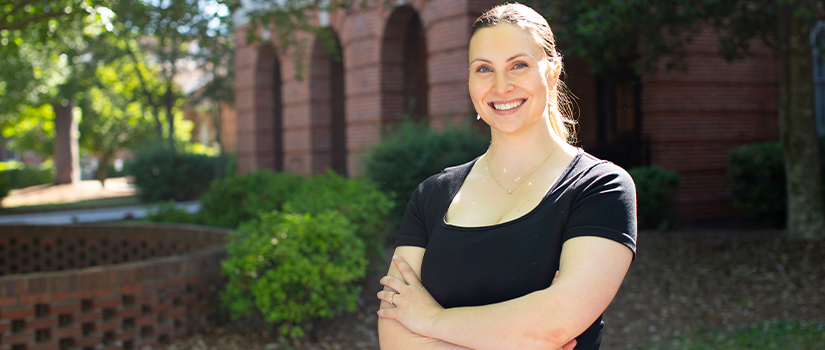
Stephanie Wilczynski’s path into the field of research began with a question.
As an undergraduate student at Boston University on a pre-med track, an experience while working as a patient care coordinator at Massachusetts General Hospital, revealed to her an interest not in just clinical outcomes, but more about the mechanisms behind them.
“I was much more interested in the how versus the what,” Wilczynski said. “I always wanted to know more. What’s the story behind this? Why does this happen?”
Her curiosity, particularly with why patients with similar conditions can experience vastly different outcomes, sparked a shift toward research. While many of her peers remained focused on clinical practice, she recognized early on that her interests lay elsewhere.
After earning her undergraduate degree in 2020, she brought that mindset with her to the Floyd School of Medicine, but her graduate studies had an inauspicious start due to the COVID-19 pandemic. With her lab not yet operational when she arrived on campus, she played an active role in building it from the ground up, providing an experience that would deepen her appreciation in the field of research.
I had never thought about what it takes to set up a lab. We moved in and calibrated all the equipment, and at that time it was just me and a postdoc. I felt more invested in the lab’s growth and health. It gave me a sense of ownership.
Stephanie’s research interests quickly centered on women’s health, an area she saw as greatly underexplored. While her current dissertation focuses on erectile dysfunction in men, her broader work emphasizes gaps in research related to women’s sexual health and function.
Her review of existing literature revealed an imbalance, with thousands of studies focused on male sexual health and significantly fewer addressing comparable aspects of women’s health. That disparity reinforced her commitment to the field, a commitment that later became personal following her own diagnosis with ovarian cancer.
Her work has already gained recognition within the scientific community, emboldening her to continue the work. She received strong feedback while presenting early research on improving vaginal smooth muscle elasticity using an FDA-approved drug, done in collaboration with researchers at the Vanderbilt University Medical School. She was encouraged her to pursue further development of the idea.
“Multiple people told me it should be patented,” Wilczynski said. “I had built the protocol from scratch, so that recognition meant a lot.”
Beyond her research, Stephanie also has leaned on her background as an athlete to help in leadership roles within the school.
“My involvement in the School of Medicine was more innate,” Wilczynski said. “I played sports in college, and after isolation during COVID, I wanted to be more involved. My first year, I was vice president of the Biomedical Science Graduate Student Association (BSGSA), then became president and have stayed in that role.”
Her leadership style is rooted in collaboration and connection.
“My sports background helped build a sense of camaraderie. There’s so much diversity here, people working, raising families, or coming straight from college. It recreates that team environment.”
Her focus with the BSGSA has been on ensuring that graduate students feel represented and supported, particularly in navigating the complexities of academic life. That includes organizing professional development events, volunteering efforts and much more.
“We’ve expanded to include more disciplines and focus on inclusivity and accessibility … One of my favorite memories is seeing strong attendance at events we organized. It felt validating.”
For her efforts, Stephanie was recently awarded the Dean C. Barnhart Award from the Biomedical Sciences Department. The honor goes to a doctoral student who “demonstrated outstanding service to the Biomedical Sciences Graduate Program throughout their graduate career.”
Wilczynski’s emphasis on lifting others comes from her own experience working with the school's faculty and staff.
“My mentors, Dr. Clinton Webb and Dr. Fernanda Priviero, have been instrumental, along with postdocs who helped train me in new techniques,” Wilczynski said. “Working with my mentors helped me develop critical thinking. I’ve learned how to connect ideas and think more deeply.”
As she approaches graduation, Stephanie continues to refine her work while preparing for what comes next. She hopes to apply her research skills to help our country’s armed forces. She is currently pursuing a position in aerospace physiology with the U.S. Navy, a role that would allow her to bridge science and real-world application.
“I’m really interested in the translational aspect of science, applying research in real-world settings,” Wilczynski said. “Aerospace physiology involves education on flight hazards like hypoxia, G-forces, how the body reacts, and how to prepare for those conditions. It can also involve equipment training and systems development.”
Her interest in the field started during a clinical research internship with the U.S. Army, where she studied metabolic stress in basic trainees. That experience introduced her to a world of new research opportunities within the government.
Now in the final stages of the application process and graduation just days away, she remains optimistic about the future. She will celebrate the end of her journey at the School of Medicine with her son; after surgeries to combat her ovarian cancer, she beat the odds and got pregnant, delivering in January of 2024.
“It’s been a long road, and I’m happy to have been successful.”