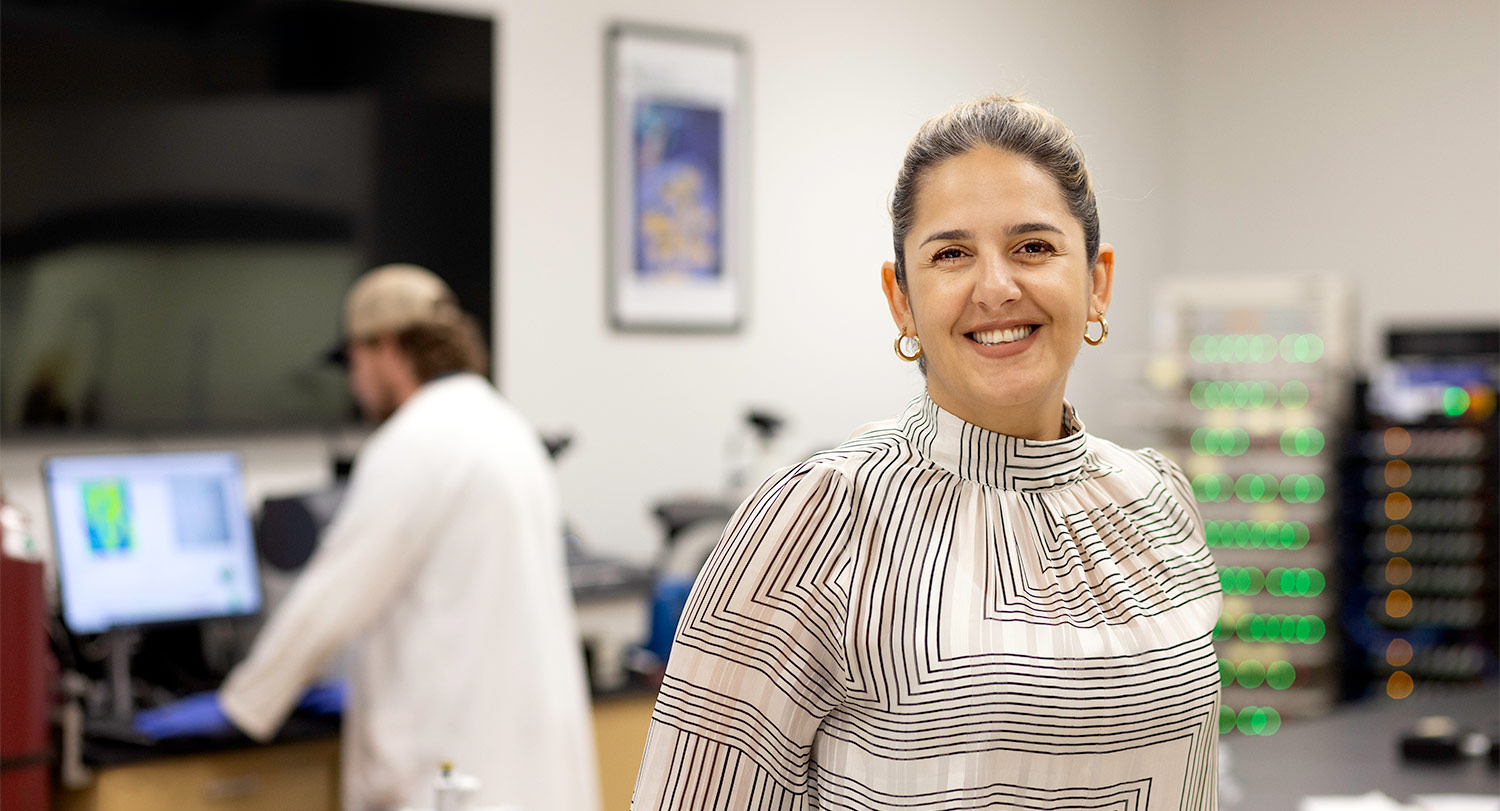
A rechargeable battery system with lower component costs and higher energy density potential than commonly used lithium-ion batteries is the focus of an industry-sponsored study by a chemical engineering research team at the University of South Carolina.
Lithium-sulfur batteries, which don’t require expensive cobalt, nickel and manganese components used in lithium-ion batteries, have been intensively researched for more than 40 years but are yet to be widely deployed. Goli Jalilvand, an assistant professor of chemical engineering in the Molinaroli College of Engineering and Computing, is leading a multi-year study of Li-S battery improvements, sponsored by California-based battery manufacturer NantG Power LLC.
“Our goal is to understand and mitigate the complexities of the Li-S battery, increasing its achieved energy density and its durability,” says Jalilvand, who is involved in several other sponsored research projects focused on lithium-sulfur technology. “We’re looking into different cell components, materials, chemistries and hierarchical structures at different length scales from the atomic level all the way to the macro level.”
Li-S batteries’ theoretical energy density potential is more than five-times higher than that of Li-ion batteries, but even the most advanced Li-S batteries tend to degrade faster than Li-ion systems. Current research efforts are aimed at increasing both the lifespan of the Li-S system while maintaining its energy density for practical applications.
“Based on the current state of knowledge, I would say Li-S batteries may not be the best solution for fast-charging applications like commuting EVs, but there are many other applications that don’t require fast charging for which Li-S batteries can be a fantastic option,” Jalilvand says. “For aerospace applications, heavy-duty electric trucks and planes and stationary applications such as grid-level storage batteries, Li-S can be a great alternative to Li-ion batteries.”
“The Li-S battery is a very complex system that still has many unknowns about it, and that is what drives us, the engineers, to keep trying to solve the challenges."
Li-S batteries and Li-ion batteries both move lithium ions between two electrodes to generate electricity. The chief difference is that Li-S batteries use inexpensive and naturally abundant sulfur as the cathode material while Li-ion batteries use cobalt, manganese and nickel.
“There are so many issues around those Li-ion cathode elements, particularly cobalt, with more than 80 percent coming from the Republic of Congo and the child labor issues that have caused humanitarian concerns and notable price increases,” Jalilvand says. “Nickel and manganese recently followed the same trend in price. Sulfur is cheap and abundant. Countries aren’t going to fight over it because everyone has a lot of it.”
Tweaking the Li-S battery materials to materialize its energy potential and increase the number of times the battery can be cycled is the holy grail of Jalilvand’s research efforts in the partnership with NantG Power LLC, which began in 2022 with an initial proof-of-concept in coin cells phase. Phase two, focusing on more practical configurations, will end in September 2026.
“The Li-S battery is a very complex system that still has many unknowns about it, and that is what drives us, the engineers, to keep trying to solve the challenges,” says Jalilvand, whose dozen-member research group includes a post-doctoral fellow and graduate and undergraduate students. “The day we have a challenge but no unknowns, that’s when we can say we’re stuck, but after 40-plus years of Li-S battery research, we’re still far from stuck.”