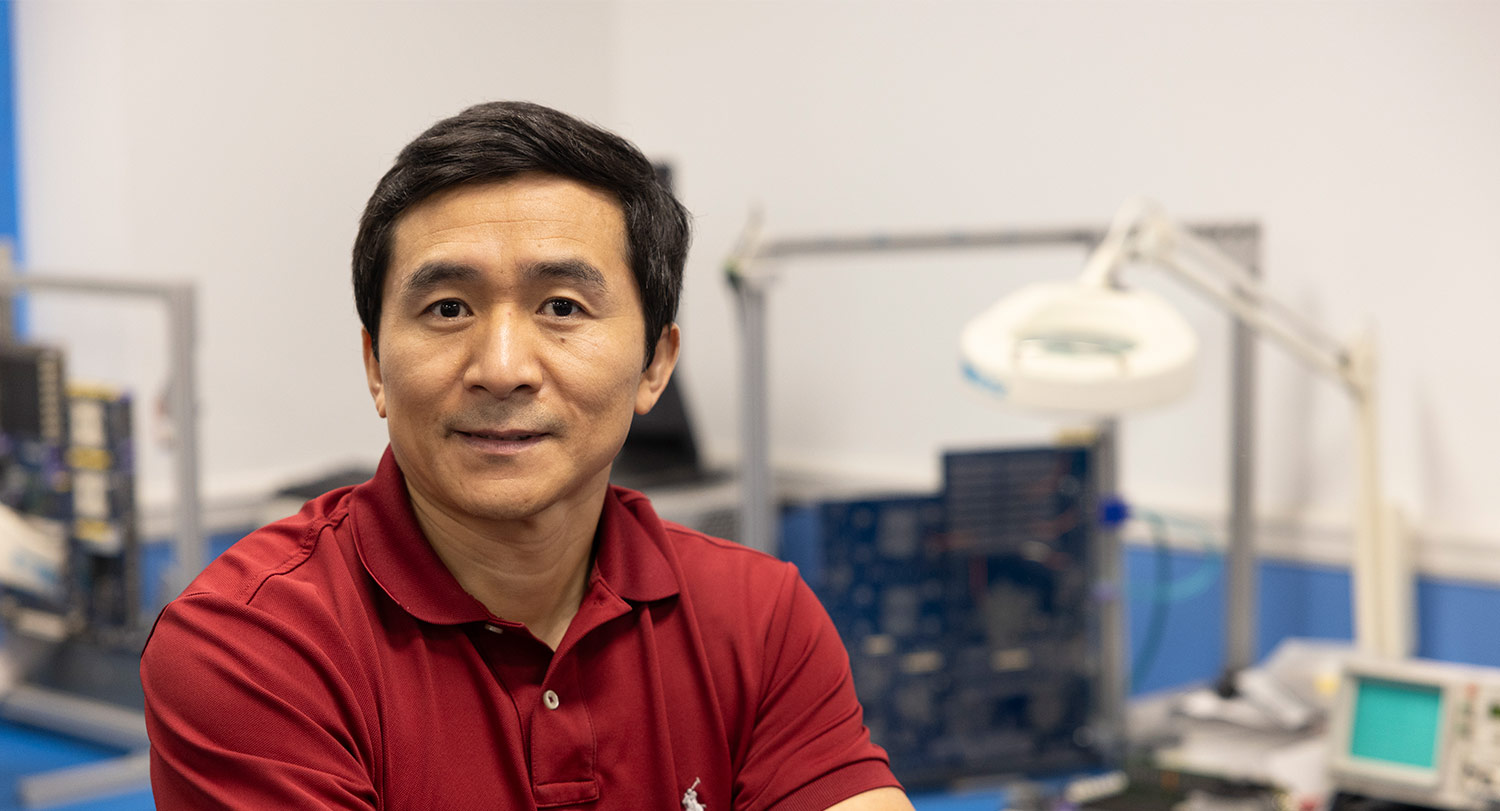
Guoan Wang got his first U.S. patent while in graduate school more than 20 years ago, and he’s been on an inventive roll ever since.
The electrical engineering professor in USC’s Molinaroli College of Engineering and Computing now has more than 60 patents to his name and more than 50 additional patents pending. Little wonder the National Academy of Inventors elected him to its 2024 Class of Fellows, the highest professional distinction awarded to inventors. Worldwide, there are 2,058 NAI fellows who collectively hold more than 68,000 U.S. patents, which have led to more than 20,000 licensed technologies and some 4,000 company startups.
Wang is only the third faculty member from the university to be named an NAI fellow. Prakash Nagarkatti, a professor in USC’s School of Medicine Columbia and USC’s former vice president for research, received the distinction in 2018. Mitzi Nagarkatti, a Carolina Distinguished Professor also at the School of Medicine Columbia, earned election to the academy in 2020.
“Getting this many patents has been a long journey,” says Wang, whose research is focused on improving the spectrum efficiency, power efficiency and size efficiency of wireless communication technologies. “I want to connect scientific research closer to practical applications. I closely follow the trend of technology development so we can identify new needs.”
Wang joined the university in 2011 after several years working for IBM. That early exposure to industry helped train him to look for solutions to real-world problems while conducting research, he says. He now encourages his graduate students to think about filing patents in the course of their research.
“Most of my Ph.D. students have at least one granted U.S. patent before graduation,” he says. “Even undergraduate students have the potential to have patents of their own. I always tell them when they’re doing undergraduate research in my lab to focus on practical applications because we are a college of engineering — we don’t focus on just pure science.”
Wang teaches undergraduate- and graduate-level courses and says he chose academia over industry for two reasons — a greater freedom to choose his research endeavors and the opportunity to mentor students.
“I like to teach students. Mentoring them allows me to make much more of a contribution to this field because they will go to do great things,” he says. “I have trained a few Magellan Scholar students, and one recently went to Georgia Tech for a Ph.D. and another went to Ohio State. They definitely have the potential become inventors in the future.”
Wang’s research has received funding from several federal agencies, including the National Science Foundation, the Office of Naval Research and the National Institutes of Health.