Fabio Matta can tell you a lot about the world’s most stunning bridges. Originally from Italy, the University of South Carolina civil engineering professor has an appreciation for history’s architectural wonders.
The 16th-century Palladian stone bridge that hunkers over the Tesina River, connecting two sides of his hometown of Torri di Quartesolo, was an early fascination. But his interest spans the globe. He has often marveled at the iconic Brooklyn Bridge, the longest suspension bridge when it was built in the late 1800s. Then there’s the Smithfield Street Bridge in Pittsburgh, a rare example of the metal-arched lenticular truss design.
Ask Matta to name his favorite bridge, though, and he shakes his head.
“It’s like naming your favorite song or your favorite movie,” Matta says. “There are too many. But there are many special ones, and we should take care of them as much as possible. They’re part of our history. They’re part of our culture.”
Not all of the utilitarian concrete bridges that span South Carolina’s highways and rivers hold the same cultural significance, but they are critical links between the state’s communities. Matta has long believed they should be taken special care of, too — particularly now that many are at the end of their intended lifespans.
In 2024, he and his team — Nicole Berge and Paul Ziehl at USC and Prasad Rangaraju
at Clemson —
received a large grant from the South Carolina Department of Transportation and the
Federal Highway Administration to study next-generation building materials. Their
findings will inform updated engineering codes that guide bridge construction and
repairs in the state.
“One of the responsibilities we have for the bridges that need to be replaced or rebuilt is to ask, ‘Do we build them the same way? Or do we take advantage of the technologies we have ready?’”
Aging bridges, many of which date back to the U.S. infrastructure boom of the ’60s and ’70s, aren’t a new problem. Since 2018, the National Bridge Inventory — a database managed by the U.S. Department of Transportation and Federal Highway Administration — has rated more bridges as “fair” than “good.”
“The bridges rated as fair are not deficient, but they’re going to be a concern later on,” Matta says.
What causes their deterioration over time? One factor is wear and tear from increased
loads — trucks
today weigh more than they did in the past, and electric vehicles are heavier than
non-electric cars.
Corrosion is another contributor. Beneath the exterior layer of bridge deck concrete
is a grid of steel bars. When saltwater trickles through the concrete, the steel corrodes.
This effect is amplified in coastal
salt marshes and areas where salt brine is used to de-ice bridge decks in winter.
With more than 9,000 bridges in South Carolina, the challenge to maintain and rebuild them really comes down to the numbers. Matta believes that’s where innovative materials can help.
“The DOT has been doing a remarkable job, but the number of bridges in need of help is simply overwhelming,” he says. “One of the responsibilities we have for the bridges that need to be replaced or rebuilt is to ask, ‘Do we build them the same way? Or do we take advantage of the technologies we have ready?’”
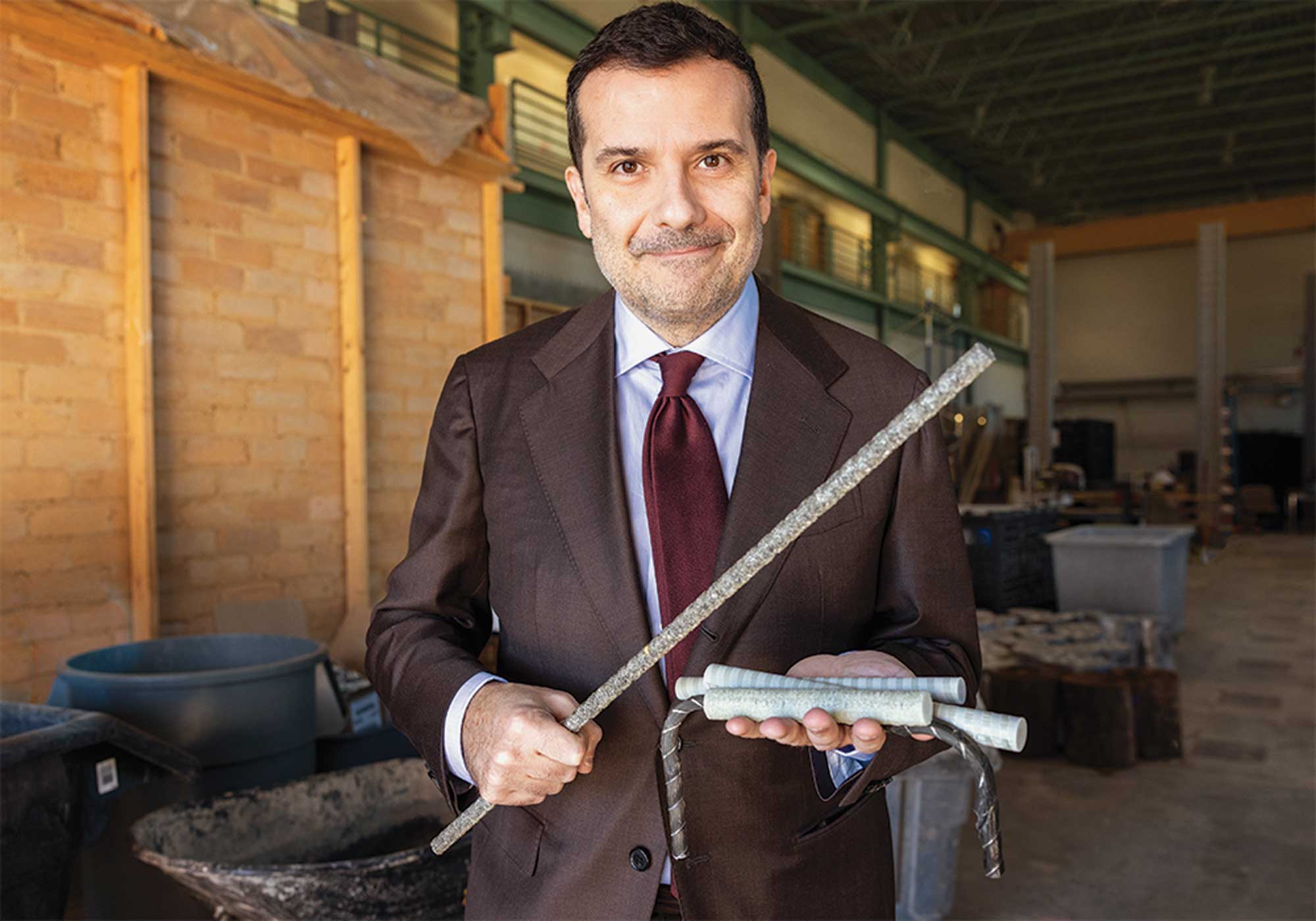
His team is testing fiber-reinforced plastic bars — essentially, glass fibers immersed in a strong polymeric resin. These bars, he explains, are manufactured in the U.S., are stronger than steel and don’t rust.
There’s another perk: Because this material is lighter than steel, it’s easier to build with. Matta witnessed this during the recent upgrades to Charleston’s historic Low Battery seawall. Though the construction workers were unfamiliar with the new material, which was chosen over steel reinforcement due its corrosion resistance, they quickly got the hang of it.
“They realized they could save a lot of time by avoiding using forklifts or excavators, moving things by hand,” he says. “And since they’re lightweight, they preassembled parts of cages made of bars, then popped them into place, connected them and moved on with the concrete casting. So the work was actually significantly faster.”
The project is collaborative and multifaceted. Matta is leading a structural assessment
of new bridge deck materials, which entails simulating real-life load conditions in
the lab using full-scale bridge decks. Berge, an expert in life cycle cost analysis,
is studying what these new construction processes will ultimately save over the lifetime
of a bridge. In partnership with Clemson University, the team is also examining options
for
more durable and sustainable concrete.
Once complete, the project’s findings will allow for evidence-backed updates to the state’s bridge design provisions as well as training on their implementation.
“When the design provisions become reality, that will be a big deal because then engineers will have a document with mandatory guidance that they can follow to actually design with these different materials,” he says. “We do not have that in South Carolina, as we do not have it in many other U.S. states. We would like South Carolina to be one of the states that leads the way by embracing innovation that is practical and that makes a difference.”
Sometimes research means developing new materials from scratch. But with that part already done, Matta’s goal is to bridge the gap between the cutting edge and field application.
“From a research standpoint, it’s just as exciting,” he says, “because this is an opportunity to see some benefit from our work. That’s ultimately what we seek as engineers.”