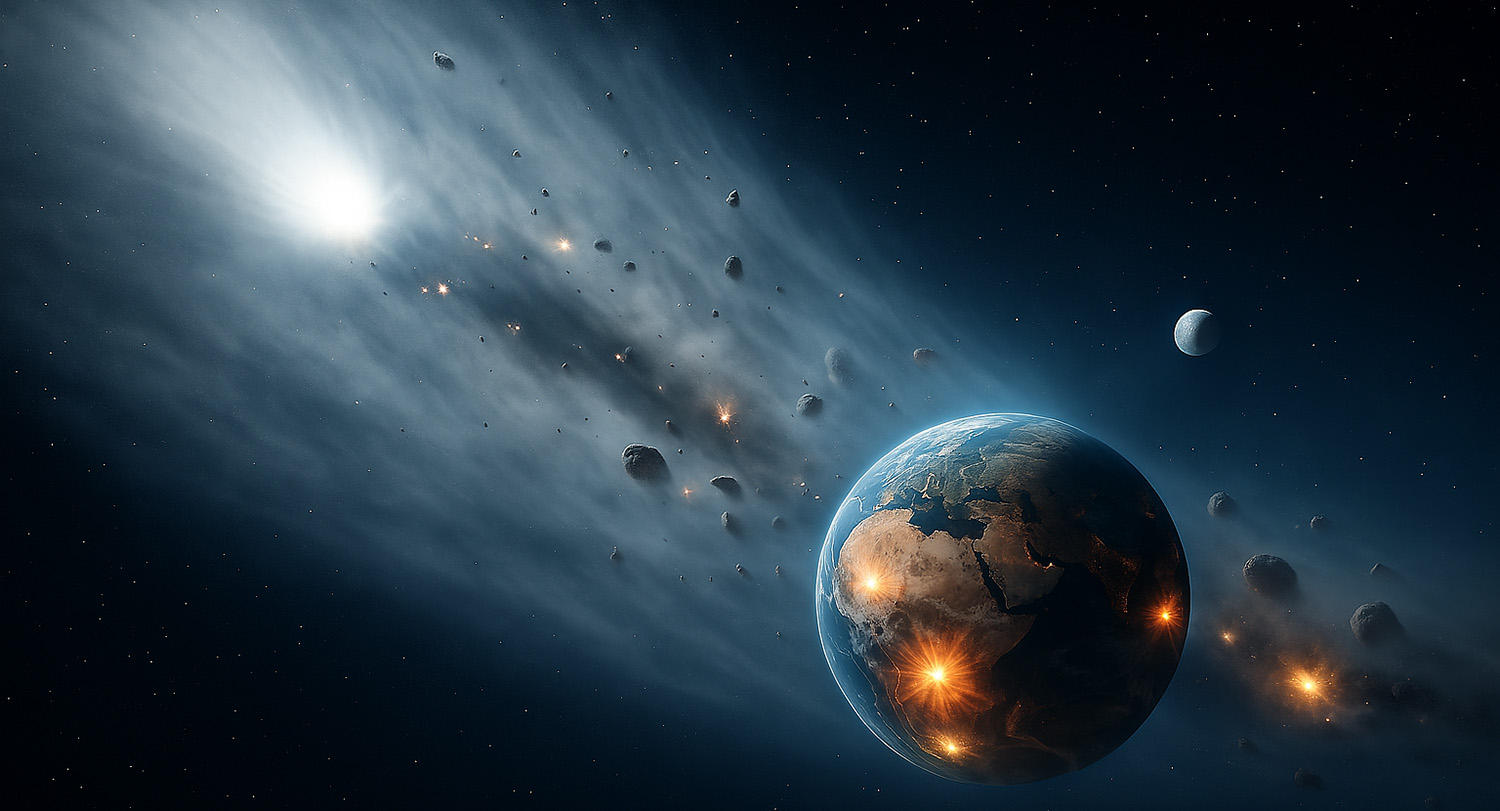
Few things capture the imagination like seeing a ball of fire descend from the sky. South Carolinians witnessed this spectacle this summer. While stunning, such events are fairly common. However, the largest historical comet impacts can reveal much about dramatic shifts in life on Earth.
Christopher Moore, research professor with the Institute for Archaeology and Anthropology and director of the Southeastern Paleoamerican Survey at the University of South Carolina, recently led a team that analyzed sediment from the ocean floor in Baffin Bay, Greenland. This investigation, for the first time, produced evidence — sourced directly from ocean cores — that a comet impact could have triggered an abrupt cooling of the atmosphere during a period known as the Younger Dryas 13,000 years ago.
“This is the first time we have found evidence in ocean cores,” Moore says. “Evidence on land has been accumulating since 2007.”
The “balls of fire” that impact Earth usually are not intact comets but rather fragmentary debris that have broken apart. To identify possible impact events, scientists look for evidence of “impact proxies,” such as comet dust enriched in platinum and other rare elements or microspherules (small spherule-shaped balls of melted sediment formed in the plume of an airburst). These impact proxies can be deposited when the Earth passes through the trail of a fragmented comet. These fragments often explode upon entering the Earth’s atmosphere, dispersing impact proxies globally.
Our identification of a Younger Dryas impact layer in deep marine sediments underscores the potential of oceanic records to broaden our understanding of this event and its climatological impacts.
Moore noted that meteors hitting the ground intact are rare. When they do impact, they usually hit water because 70% of the Earth is covered by oceans. So the statistical probability for danger to humans is generally low.
“Most meteorites don’t make it to the ground,” Moore says. “They explode in the atmosphere.”
In another first, researchers used a groundbreaking new technique to identify the presence of platinum nanoparticles, a key comet dust marker placing such particles within the lower Younger Dryas Boundary.
Moore’s colleagues, professors Mohammed Baalousha in environmental health sciences and Michael Bizimis from the School of the Earth, Ocean and Environment, led the way using a revolutionary new technique for detecting and identifying nanoparticles deposited in the cores and laser ablation to identify metallic debris consistent with comet dust, including iron- and silica-rich microspherules, which are formed by low-altitude airbursts and surface impacts of widely dispersed comet proxies.
“We also found twisted and folded metallic dust particles made of oxygen-depleted iron and nickel, which are likely produced by comet dust,” Moore says.
Younger Dryas hypothesis
Researchers on four continents around the world have discovered evidence in dry land cores of a large cosmic event roughly 13,000 years ago, potentially causing the extinction of dozens of large animal species, disrupting human populations and triggering an abrupt cooling of the climate that some call a “mini-ice age.” Moore’s discovery comprises the first corroborating evidence of Younger Dryas to be harvested from the ocean floor.
From the cores, researchers found platinum, a rare element in the Earth’s crust but common in asteroids and comets. They also identified high-temperature meltglass, which is known to be formed by impact events.
I think there is small stuff raining down all the time, every day. Most falls into the ocean.
Scientists have characterized this cooling period of about 1,000- years as the “Younger Dryas,” a name derived from a flower (Dryas octopetala) that thrives in cold conditions. The Younger Dryas hypothesis suggests that a fragmented comet event dispersed celestial debris across the Northern Hemisphere, destabilizing its ice sheet.
This destabilization of the glacial ice sheet triggered the release of massive freshwater lakes that bled into the ocean and shut down the circulation of ocean thermal currents, triggering the Younger Dryas cooling. Previous research by many members of this team also found evidence of a massive wildfire that burned up to 10 percent of the Earth’s biomass.
To look up or not to look up
Moore believes the Earth is impacted by celestial debris far more often than has been documented.
“I think there is small stuff raining down all the time, every day,” he says. “Most are really small and don’t do any damage. Most fall into the ocean.”
The Younger Dryas impact hypothesis remains an ongoing debate in science, with significant ramifications (if true) for prehistoric archaeology, the cause of ice-age megafauna extinctions and catastrophic climate change. Researchers will continue to gather evidence to test this hypothesis.
“Our identification of a Younger Dryas impact layer in deep marine sediments underscores the potential of oceanic records to broaden our understanding of this event and its climatological impacts,” Moore says. “The Younger Dryas was a catastrophic global event. It released so much dust and soot into the air that it blocked out the sun for several weeks to months, starting an ‘impact winter.’”
Good time to watch
August is an ideal time for stargazers to view a series of summer meteor showers, including the Perseids and Delta Aquariids.