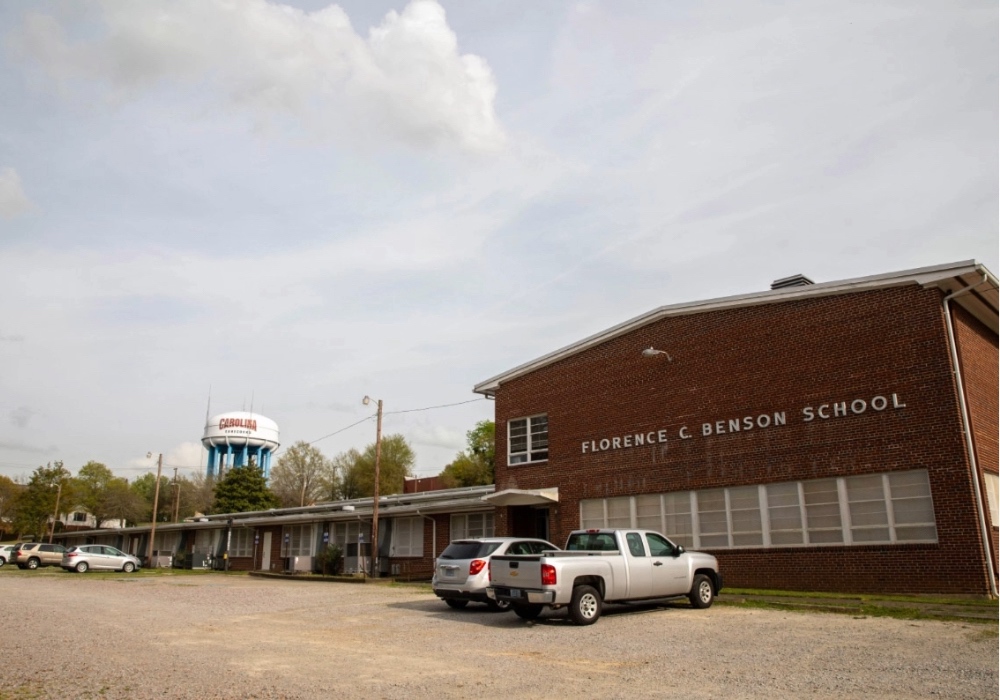
Tucked just blocks from the University of South Carolina, the red-brick building that once housed Florence C. Benson Elementary School stands as one of the last physical reminders of a historic African American community.
At first glance, the low, one-story structure appears to be a typical mid-20th-century school. But behind the walls of 226 Bull Street in Columbia lies a deeper story — one shaped by segregation, resistance, and an ongoing effort to preserve community history.
Today, the university is working to restore the building through a federally funded project aimed not only at renewing the structure, but also at honoring the legacy of the Wheeler Hill neighborhood it once served.
Recognizing its significance, the building was added to the National Register of Historic Places in 2009. In 2024, the University of South Carolina received a $4.25 million grant from the National Park Service through the African American Civil Rights Grant Program, which supports projects that document, interpret and preserve sites tied to the struggle for equal rights.
The restoration will focus on maintaining the building’s historic character while preparing it for modern use. Plans include replacing the roof, restoring the original metal windows, improving drainage and installing fire alarm and sprinkler systems. Construction is scheduled to begin in September 2026, with completion expected in April 2027.
“The project will restore the quiet dignity of the historic Benson Building exterior by installing an appropriate roof and refurbishing original steel windows that are emblematic of equalization architecture,” says Derek Gruner, university architect.
Looking ahead, university leaders say the goal extends beyond preservation to education
and understanding.
“Whatever happens, my hope is that when anyone goes into that building, they will
know the history of Benson School, and they will know the history of the Wheeler Hill
community,”
Built in the mid-1950s — originally as Wheeler Hill Elementary — the school served a historically Black neighborhood during segregation. It was one of many “equalization schools” constructed across South Carolina in response to Brown v. Board of Education, the Supreme Court decision that declared segregated education unconstitutional. Rather than integrate, state officials invested in new facilities for Black students in an effort to maintain the “separate but equal” system.
“South Carolina’s equalization program was its own form of massive resistance,” says Rebekah Turnmire, program coordinator for the African American Civil Rights Network at USC. “The state did this as a way to stay ahead of any potential Supreme Court decision toward integrating.”
When it opened in 1955, the school served about 270 students in grades one through six, replacing the overcrowded Celia Dial Saxon Elementary School. Enrollment eventually grew to around 500 students from the Wheeler Hill community.
In 1958, the school was renamed Florence C. Benson Elementary School in honor of a longtime teacher. The building itself reflects both the educational priorities and architectural style of the era.
Following integration and declining enrollment, the school closed in 1975. The University of South Carolina acquired the property in 1978.
“For me, Benson is an iconic structure in the historic Wheeler Hill community,” Donaldson said. “For African American residents, the Benson School was more than just a school — it is a landmark of that neighborhood.”
As urban renewal and university expansion reshaped the area, Wheeler Hill gradually disappeared. The school remains one of the last visible traces of what was once a vibrant community.
“Part of our goal is not only preserving the school and its structure,” Donaldson said, “but preserving the histories and the memories of that neighborhood.”
Turnmire noted that because much of Wheeler Hill no longer physically exists, efforts like this are especially important. The restored building will once again serve as a place of learning — ensuring that the story of Wheeler Hill and the legacy of segregated education remain visible for future generations.
“Anything we can do to preserve spaces that show the history of the city and the character of the communities that were there long before students lived on that hill is something we should do,” Turnmire said.