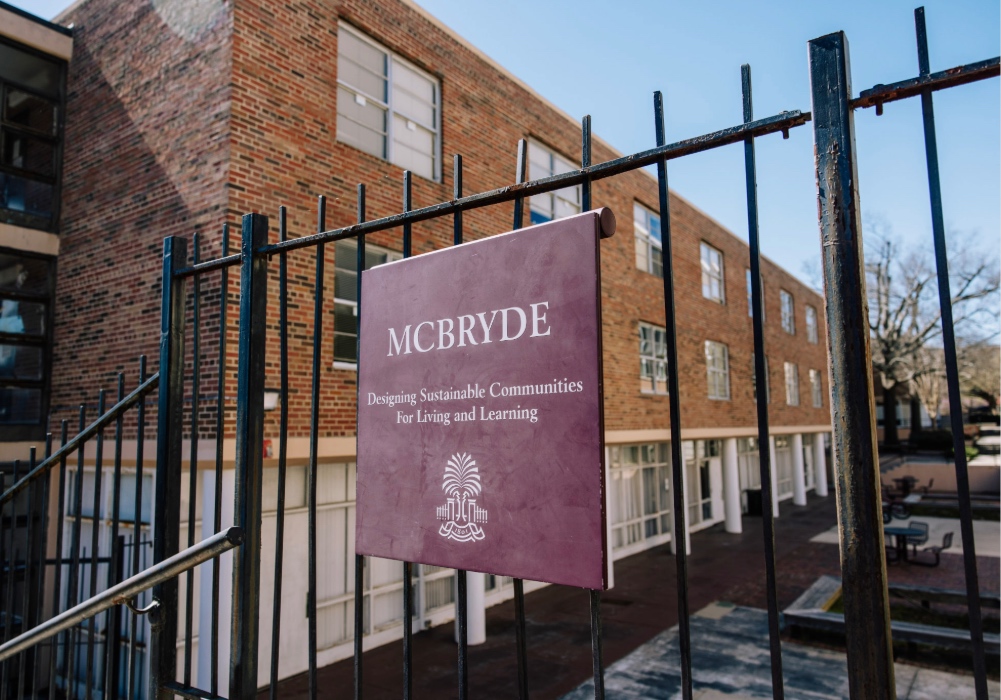
Demolition will begin in May on McBryde Quadrangle, ending the nearly seven decades of student life in one of the University of South Carolina’s most recognizable residence halls.
The dormitory’s demolition was first introduced as part of the Sumter Street project in USC Next, the university’s 10-year campus master plan, to modernize aging facilities and accommodate the demand for more on-campus housing.
The project includes building a six-story, 296,000-square-foot standalone residence hall where McBryde once sat and the construction of a new wing to the Honors College residence hall. Both are scheduled to open ahead of the fall 2028 semester.
The $165 million project will bring 1,086 beds to the heart of campus, part of the university’s initiative to reinvigorate the historic core of campus. Today’s McBryde houses roughly 260 students; the new building will hold about 900, dramatically expanding USC’s housing capacity.
But the demolition is more than a construction milestone. It closes a chapter on one of USC’s oldest first-year residence halls and the generations of students who passed through its doors.
McBryde’s story begins in the postwar era. Completed in 1955 amid surging demand after World War II, it consisted of seven three-story buildings arranged in a U-shape around a shaded courtyard.
“They put it up quickly because they needed space,” says Evan Faulkenbury, USC’s university historian. “It wasn’t necessarily built to last 70 years.”
The residence hall was purpose-designed for Greek life: lounges on the ground floors and fraternity housing above. Fourteen fraternities once occupied the quad, sharing commons, rituals and a distinctive campus culture.
“It was built very quickly in 1955,” Faulkenbury says. “The university had a surge of students because of the GI Bill, especially male students, and there was a rise in fraternity life. The design was really about keeping fraternities on campus.”
In 1968, the complex was renamed for John M. McBryde, a Carolina alumnus who served as president of the university from 1882 to 1883 and again from 1888 to 1891. During his tenure at South Carolina, he worked to expand academic programs and modernize the institution.
For decades, McBryde was a center of campus life. Tucked behind Thomas Cooper Library but steps from the Russell House, it occupied a unique position.
“It became its own little domain,” Faulkenbury said. “It was in the heart of campus, but also somewhat contained. That spatial design contributed to its culture.”
The McBryde Brotherhood, an informal fraternity dating back to 1949, helped build the tiger for USC’s annual Tiger Burn. Alpha Phi Alpha and Omega Psi Phi, historically Black fraternities, also called the quad home for years.
Like many residence halls, McBryde developed a reputation for pranks and mischief.
“We had these gang showers, and somebody got a big piece of plywood and stopped up the entrance to basically create a swimming pool,” said William Hubbard, dean of the Joseph F. Rice School of Law and a former McBryde resident in the 1970s.
“The water got about four or five feet deep before it broke and flooded the hall. There were pranks like that … but nobody got hurt.”
Faulkenbury said the dorm’s reputation was amplified by its design.
“You had 14 fraternities packed into one U-shaped quad. There were grills, gatherings, it was a cocoon,” he said. “Every campus has that kind of scene, but McBryde’s layout amplified it.”
McBryde served as the all-male dorm on campus with residents often referring to themselves as “McBros,” reflecting the tight-knit identity formed inside its walls.
Dante Pelzer, associate professor at the Medical University of South Carolina and a former McBryde resident in the 2000s and member of Alpha Phi Alpha, said the building represented more than its party reputation.
“It was a place of partying and a great time,” Pelzer says. “But it was also a place of community and identity.”
As USC moves forward with redevelopment, McBryde’s brick walls will come down. But for generations of residents who passed through its halls, the identity, friendships and lessons formed there may prove far more lasting than the structure itself.
“Generations of mostly young men were formed there,” Faulkenbury says. “It was a place of informal education. And that’s significant.”
Readers interested in exploring more of McBryde’s history can visit a digital exhibit created by Faulkenbury featuring archival photos and oral histories from some of McBryde's former residents.