Two young girls walked into a hospital one afternoon after school. Their grandmother had gone to the emergency department the day before with respiratory symptoms. She had traveled an hour from her rural home in Taiwan to the city hospital for treatment. Instead, the girls found her lying in a hallway, given a bed but not a room.
Peiyin Hung was about 10 years old that day, but she still remembers her grandmother’s words to her and her cousin: “Study hard so your voice will be heard.”
Just a few days later, Hung’s grandmother died of complications from a chronic illness which had likely progressed to pneumonia.
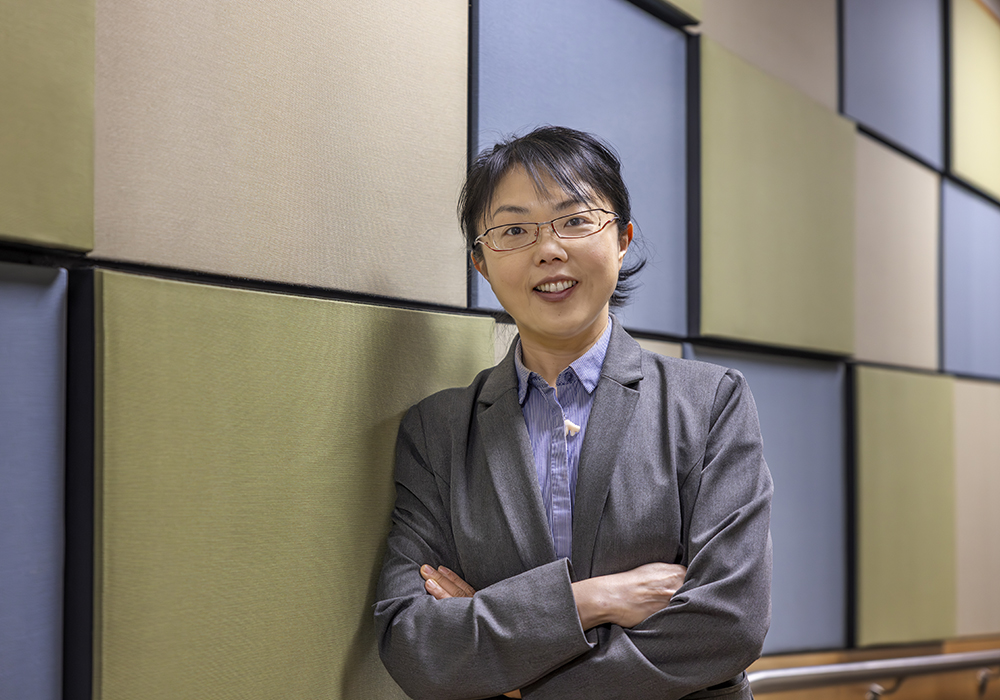
“Every time I talk about my path to public health, I come back to that moment,” says Hung, an associate professor at the University of South Carolina. “That day when my cousin and I went to visit our grandmother, we both had this feeling. We asked each other: ‘In the future, how can we do better?’”
Both girls took the situation to heart: Hung’s cousin became a physician in Taiwan, and Hung became a public health researcher, eventually finding her academic home in the Arnold School of Public Health.
“My goal is that I want to see all rural families, whether in Taiwan, South Carolina or anywhere in the world, to have the ability to access care where they live,” she says. “That’s what drives my work.”
Finding a passion for public health
Hung originally planned to become a hospital administrator, hoping to prevent situations like what happened to her grandmother. After finishing college in Taiwan, she had the opportunity to earn a post-graduate certificate through a program at the University of Washington. The experience reshaped her plans, setting her on course to become an expert in rural health and access-to-care issues.
“When I came to the United States, I discovered that the situations my family faced were not unique to Taiwan. And it was really striking to see even larger disparities in access to care across communities in the U.S. — especially rural communities,” she says.
Hung went on to study at Emory University and then the University of Minnesota, where her doctoral work established her as an influential researcher. Her dissertation examined the wide-spread shuttering of hospital labor and delivery units in the 2000s.
“I saw that more than 100 hospitals nationwide had shut down these units, and no one was talking about it,” she says. “I knew I had to write about it, and that decision changed the course of my career.”
The resulting article, which identified four top reasons hospitals were closing obstetrical units, entered the national conversation in a major way. In 2017, just as she was graduating, national legislation citing her work made it to Capitol Hill as the H.R.315 Improving Access to Maternity Care Act. State representatives read her work, and a few even invited her to meet with them and read drafts of the proposed legislation.
In 2018, the act was passed into law, requiring the U.S. Department of Health and Human Services to identify underserved communities to designate as maternity care shortage areas. Those targeted areas now receive additional resources and support to fill the gaps.
Growing her career at USC
The response to her research opened doors for Hung. She took on a postdoctoral position at Yale University and had her pick of offers for tenure-track positions. But when she saw a position open in the Arnold School’s Rural Health Research Center, Hung decided to cut her postdoc short to apply.
“South Carolina stood out immediately,” she says. “As a rural state with a very diverse population, I felt like there was an opportunity here to keep moving my research forward.”
The culture at the university sealed her decision. When she visited the research center, she found supportive leaders and a collaborative team environment.
“At USC, we share our ideas even outside of formal collaboration. That makes our research stronger, because you’re gaining from everyone else’s ideas and experience as opposed to competing with them,” she says.
In her first year at USC, Hung cast a wide net, pursuing three paths of research — rural health, mental health and big data — to see which one gained the most traction. All three still factor into her work, but funding opportunities have led her to focus more on maternal health, obstetrics and access to care.
“I just feel like that study goes back to my childhood, when I learned that geography can dictate your destiny, your health. What’s striking is that is still happening in the U.S. today, despite being such a well-developed country.”
She received an ASPIRE grant from USC’s Office of Research in 2019, which she used to fund a project studying urban and rural maternal care disparities in South Carolina.
“Resources like ASPIRE really help junior faculty feel more certain about their future here. ASPIRE gave me a foundation. It allowed me to hire an assistant, buy data and generate the preliminary work that led to everything else,” she says.
Additional funding followed, and Hung has been prolific in her research efforts, which have earned her national recognition and awards. She now serves as co-director of the Rural Health Research Center and as core faculty in the Center for Healthcare Quality and the Big Data Health Sciences Center.
Hung is still trying to make a difference for people affected by hospital and obstetric unit closures in rural and underserved areas. Her work remains anchored in a central question: What happens to residents when care disappears?
“Half of rural moms in South Carolina travel from rural communities to urban settings to give birth in part because of those closures. Many of them didn’t follow up with postpartum care, and a lot of them died or suffered from serious complications,” she says.
Her work also examines the intersection of maternal health with race and socioeconomic factors, including the long-lasting impacts of historic redlining of residential areas. In one study, Hung found that women in heavily segregated, isolated Black communities face a disproportionately high risk of maternal morbidity — regardless of their race.
“Something is going on in these communities” she says. “The location is driving the disparity because of things like systemic urbanism. Now that we know where they are, we need to break that cycle and support infrastructure for those communities.
“I just feel like that study goes back to my childhood, when I learned that geography can dictate your destiny, your health. What’s striking is that is still happening in the U.S. today, despite being such a well-developed country.”