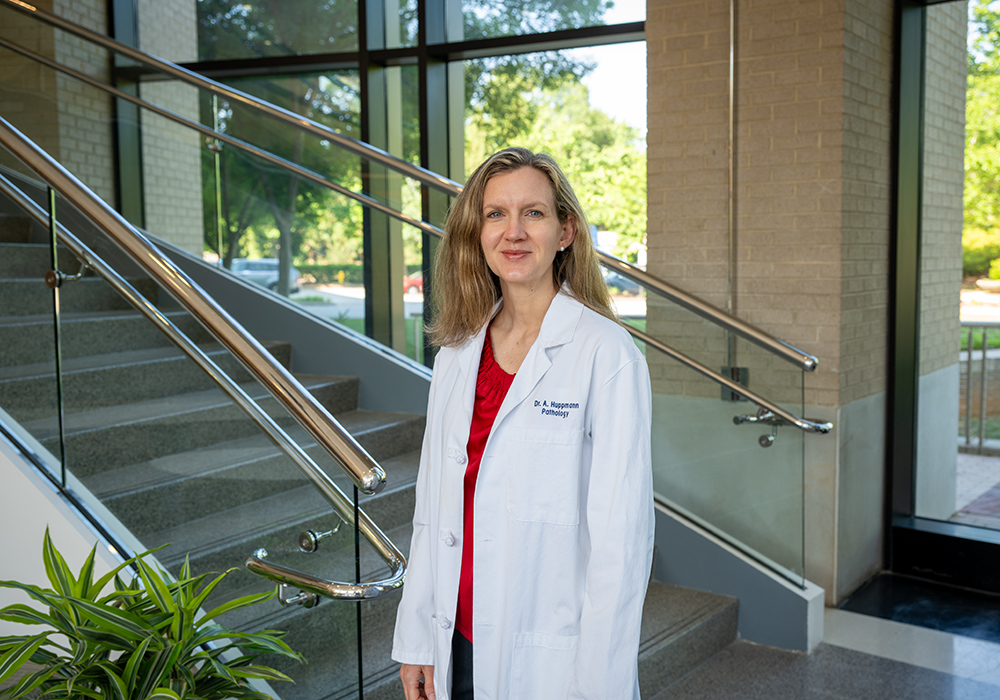
Next to a sealed envelope on a table, Alison Huppmann places a small plastic plate of simulated agar gel, its surface dotted with clustered growths. On the next table, she places a cup of red fluid beside a folder of test results. Next table: X-rays and a video of a child coughing.
As a clinical associate professor at the University of South Carolina’s School of Medicine Greenville, Huppmann teaches medical students in their first two years of the program — the pre-clerkship curriculum. Since joining the faculty in 2020, she has worked with colleagues to refresh this curriculum and make it more comprehensive, combining first- and second-year content to offer students a more holistic view of medicine.
Throughout the first two years, Huppmann and the other faculty hold special sessions to bring together everything students have learned in lecture. By working through group activities, students practice applying information and thinking through complex patient scenarios.
“A lot of the teaching we do is case-based instruction. We like to base it in patient care because that’s what the students are eventually going to be doing,” she says.
In her practice, Huppmann specializes in hematopathology and pediatric pathology; in the classroom, her goal is to equip her students with the broad understanding of medicine they will need both to pass their exams and to become good doctors. She strives to make her classes and extra sessions worth her students’ time through clear instructions. She also tries to inject a little fun.
Her efforts have now been recognized with the 2026 Garnet Apple Award for Teaching Innovation from USC’s Center for Teaching Excellence. Here, Huppmann shares more about her interactive sessions.
A case-based approach to learning
There is a session I do where students get material at different time points. First, they get the history and patient examination, just in written form. Then they get instructions to open a folder, and when they open it, they see what the patient looks like. Next, they learn that the patient had a biopsy. They have a picture of that to look at along with the results from pathology. And as they're going through all these steps, they have to think through, “OK, what did you initially think the problem was? After you saw this new information, did that change what you thought? Now what do you think?”
With sessions like this, the students work through all these cases and lab results that they get at different times. It creates a similar experience to what they would encounter in a clinical setting, where they might have to assess a patient first and then wait on lab results.
Understanding the clues
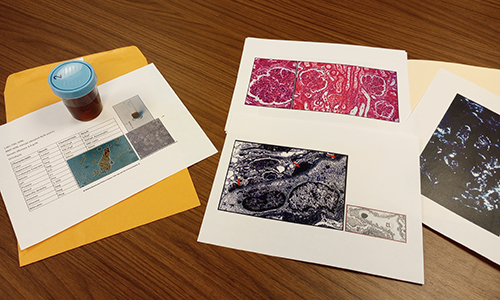
When I’m setting the sessions up, I try to incorporate some little props just to keep things interesting. For example, I use this brownish colored artificial urine sample. Once they look at that, they say, “OK, that’s not normal looking. What could make it that color?” And then they get a piece of paper with the lab results. Now they can start to think about categories of disease. Next, they get the results of another test that narrows it down to four or five specific diagnoses, but the patient also mentions that they recently had a sore throat.
By working their way through all the information, they’re eventually able to narrow it down to one diagnosis. In this case, it turns out to be post-streptococcal glomerulonephritis, which is a kidney disorder that can develop after Group A strep. But I try to emphasize that getting to the one right answer isn’t necessarily the point of these activities. Hopefully, as they're going through the session, they have to review multiple specific disorders. They don’t just have to know about one diagnosis and how to make it, but also these five other things it could have been before they had all the other information.
Keeping things in perspective
I always remind them that the first two years of medical school can present this very artificial world, whether it’s a test question or a teaching patient case, where it’s all nice and wrapped up neatly. But the real world doesn’t work that way, and you have to be able to think big picture. You can’t just immediately focus on the ‘one right answer’ because your real-life patients don’t always match the medical textbooks.
Since students aren’t being tested in these special sessions, I always tell them that this is the time to be wrong! There are some activities where, without fail, students get it wrong the first time, but they always tell me that they’ll never forget it after that. It’s so meaningful just when you can see the moment when students get what you are teaching them. Seeing those ‘aha’ moments is probably the most gratifying thing about teaching.