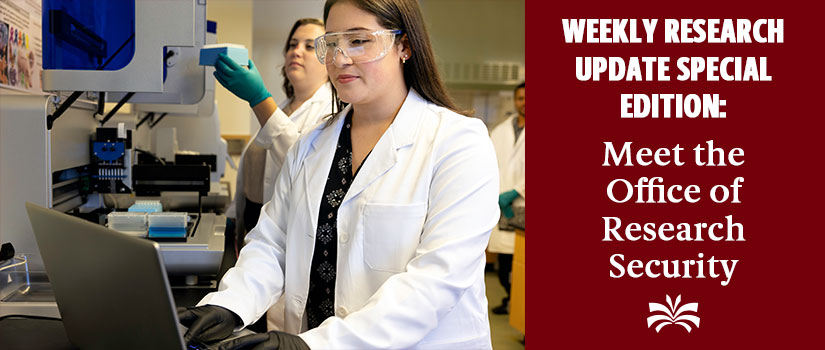
The Office of Research Security is now live on the web
This week, a new unit within the Office of the Vice President for Research came online. The Office of Research Security empowers the USC research community to pursue innovation, discovery, open scientific discourse and collaboration with the global scholarly community while keeping USC’s research enterprise secure. This new unit will ensure compliance with planned U.S. government and sponsor agency requirements that have been put into place methodically over several years, starting in 2021.
Helmed by USC Chief Research Security Officer, Steve Schrimpf, a security professional with more than 38 years of military and industry experience, the Office of Research Security is your partner in keeping research data, personnel and other assets secure.
I fully intend for the Office of Research Security to serve as a partner to USC’s research community. Our goal is to provide the tools, training and services that faculty, staff, postdocs, student researchers and others under our purview need to do their vital work with confidence, knowing they have a strong ally in their corner helping them maintain the security of their research every step of the way.
— Steve Schrimpf, USC Chief Research Security Officer
In this special edition of the Weekly Research Update, we are proud to introduce readers to the Office of Research Security, its key functions and its new website, which is packed with information and guidance to help researchers across the USC system protect our research enterprise as we generate new discoveries and collaborate with colleagues around the globe.
What is research security?
The National Science Foundation defines research security as, “Safeguarding the research enterprise against the misappropriation of research and development to the detriment of national or economic security, related violations of research integrity and foreign government interference.” Based on this definition, research security is a set of actions we take as researchers, research administrators and support staff, to keep data safe from those who would dishonestly take and use it in harmful ways. Learn more about USC’s research security program.
Who does USC’s research security program apply to?
At USC, we consider personnel who meet one or more of the following criteria to be covered individuals under the research security program:
- University personnel, meaning faculty, staff, students, postdoctoral scholars or university affiliate researchers serving as principal investigator, co-principal investigator or key personnel on a federally funded research project (including subawards).
- University personnel designated as covered individuals by a federal research agency.
- University personnel supporting federal contracts/awards with access to regulated data (controlled unclassified information, HIPAA, genomic, etc.).
- University personnel involved in export-controlled projects. Most USC research is not subject to export control regulations, which apply to research on specific technologies that could be used for military purposes and items listed on the United States munitions list.
- University personnel working on a federal agency contract/award requiring Operations Security (OPSEC) training.
These covered individuals are required to complete research security training, now available online through Research Training and Education Services.
What does the Office of Research Security do to support USC researchers?
The Office of Research Security is proud to serve as an information resource and support hub for USC researchers. Refer to the website or reach out to this unit when you need:
- Support preparing for foreign travel through enhanced risk awareness and guidance on information security best practices.
- To report concerns about suspicious activity or a potential malign foreign talent recruitment program.
- Help conducting due diligence and risk assessments for international collaborations.
8 May 2025