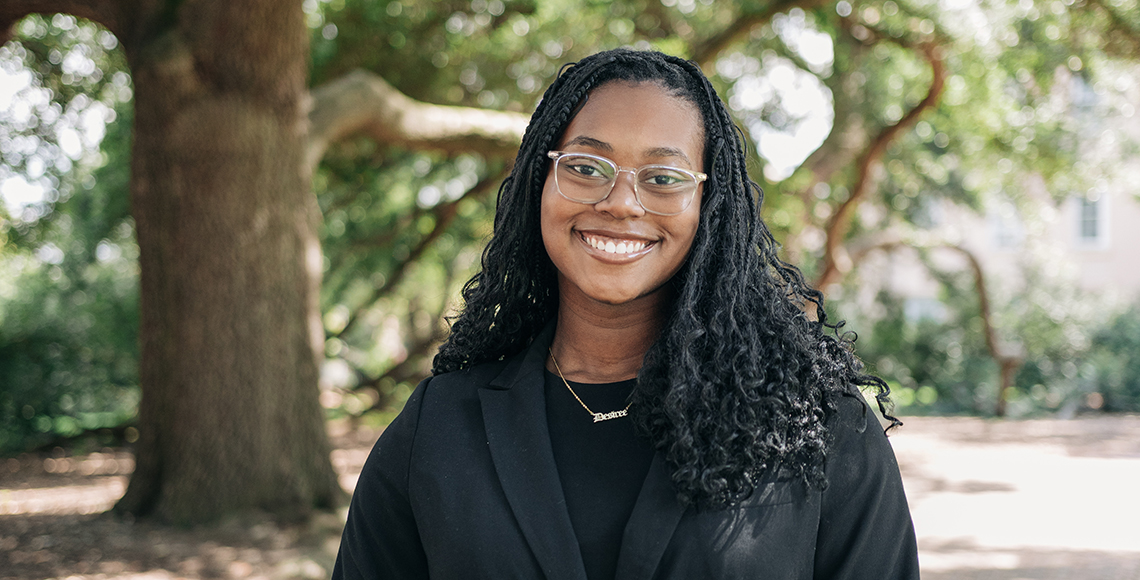
Desiree White’s connection to the University of South Carolina began before she could say, “Go Gamecocks!” Her parents are USC alumni, as well as her aunts and uncles. She also watched her older sister decide that South Carolina was the perfect fit. So, when it was her turn to choose USC, she knew that she was continuing a family legacy.
The decision to apply for the South Carolina Honor College, however, was all her own. Come May 9, White will be the first in her family to graduate from USC with an Honors diploma.
At a recruitment event held her senior year of high school, White met students from the Black Honors Caucus (BHC) who shared their Honors experiences with attendees. “That just blew my mind, to be able to see so many students who look like me being able to accomplish so many amazing things and be so supported,” she says. “Being able to have that (Honors) experience and know that there’d be a community here waiting for me to join and be a part of, that really spoke to me.”
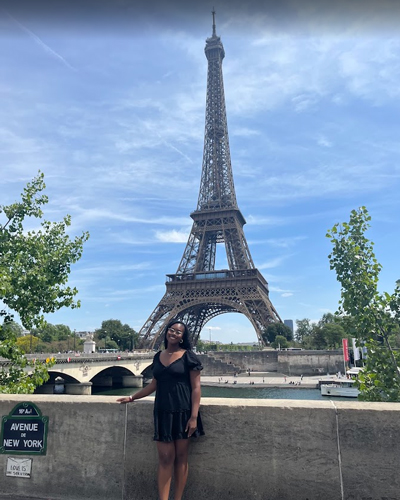
Emboldened and encouraged by that community, White has embraced every experience she’s encountered as an undergraduate. Created her own major through the BARSC program? Check. Engaged with the Columbia community? Check. Studied abroad? Check. Led the very organization that made her feel at home at USC? Check.
Wait — that’s giving too much away. But that’s what happens when you move at Desiree White’s speed: always involved, always eager for the next opportunity, always daring to learn.
White entered USC as a statistics major, keen to develop her knowledge in one of her strongest high school subjects. And the major was a practical one.
“When I came into college choosing a major, I was like, ‘I do want to be able to make money and support myself and my future family,’” she says. “That was something that really was tugging on me, which is a big factor as to why I chose a major.”
Though she enjoyed her coursework, she knew that something was missing: her artistic side. A lifelong musician — violist, singer, performer — White decided that she needed to unite practicality with passion. Enter the opportunity to create her own major: data analytics of music and culture. White combined coursework from statistics, music and anthropology.
“We’re not always taught to be bold in our learning,” she reflects. “There’s always a curriculum. There’s always something we have to follow. ... I think daring to learn is being bold to break away from that. I’ve been able to do that, honestly, throughout my entire experience here.”
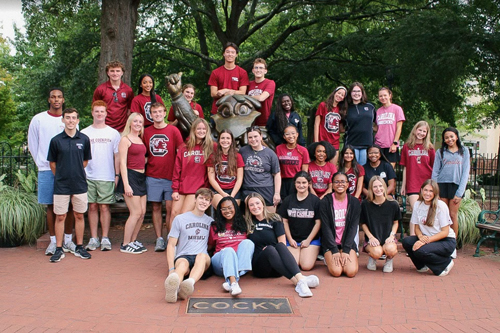
Her boldness opened doors to classes such as the Honors Experimental Music Workshop, taught by professor Gregory Stuart, that challenged her to view a bayou map as sheet music (a performance her parents still talk about). Or ethnomusicology courses, many taught by professor Birgitta Johnson, that introduced her to global musical traditions and “every cultural festival that we have in the area.”
As her experiences and interests grew, White had another realization: She didn’t just want to analyze the data behind the music industry. She wanted to experience the music and the cultures that created it — and help share the stories and traditions that the music conveyed.
“I've been seeing how important it is to not only educate people on other types of music outside of Western music, but to really preserve that here as well, especially when it comes to African American contributions to music,” she says.
White’s Honors senior thesis is her contribution to that larger social and scholarly conversation. Leveraging the skills she’s developed through her coursework, White wrote a thesis examining the role that music played in the lives of young African Americans during COVID-19. She interviewed USC students who experienced the pandemic as middle schoolers and high schoolers, collecting qualitative data about how they used music to cope and how their music choices reflected their emotional states. Her thesis also offers a data analysis of the different variables that predict social connection.
White’s interest isn’t limited to data, however. “I asked every single participant in my survey to give me a couple of songs,” she says. She compiled a playlist to complement her thesis so that readers can experience the music that represented the myriad emotions of the year 2020.
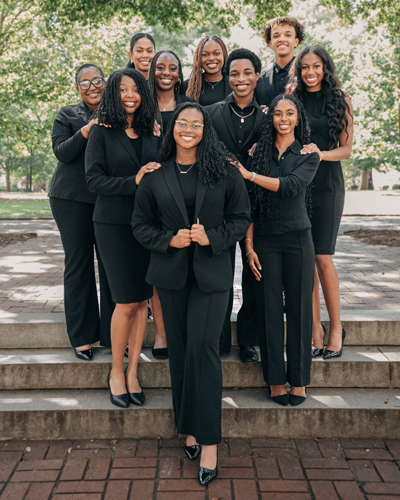
Her commitment to community extends beyond research. Remember the Black Honors Caucus student organization that inspired White when she was in high school? She’s the president now. Starting as special events chair, she grew as a leader through the BHC, and now, she’s honored to give back to the organization that made her feel at home on campus.
Her roles as Summer Honors College Ambassador and University Ambassador were the perfect opportunities to make other prospective and incoming students feel the same. “I got to showcase the Black Honors Caucus and what it was doing for me. And in turn, we had a really huge turnaround that next year, with so many new students coming in because I was able to showcase that organization, what it was doing for my life. Now they’re all on my executive board — the incoming first-year students that I got to talk to at New Student Orientation.”
These are the kinds of impacts someone can have when they move at Desiree White’s speed. As her final semester at USC draws to a close, however, she’s taking a different approach — one inspired by an Honors Maymester course in Paris, France, studying expat American authors. White and her peers were tasked with recreating that experience for themselves, and White learned an important lesson: slow down.
During her two weeks abroad, White moved at Parisian pace, rising early to find a bench along the Seine to read, eating leisurely European meals, abiding the schedules of public transit. The result, she says, was life changing.
“I learned that I had never seen people walk so slow in my entire life, but I realized how peaceful it was,” she says. “And that I wasn’t taking in as much life as I possibly could. I wasn’t living in the present.”
These days, as her undergraduate experience draws to a close, she is bold enough to slow down, to savor each moment — to look toward the future with curiosity and an open mind. She’s considering graduate studies in data analytics or ethnomusicology, as well as applying for jobs in the music or music museum industry. Anything is a possibility, as long as she can continue learning.
No matter what she chooses, or at what speed she approaches it, one thing is for certain: She will do it boldly.