A South Carolina Honors College chemistry course is teaching students scientific principles
in a tasty way by shifting from mixing chemicals to cooking food to learn how different
chemical reactions and theories work in our daily lives.
The course “The Chemistry of Food” is taught by senior instructor in the Department
of Chemistry and Biochemistry Dr. Amy Taylor-Perry. She has been a professor at USC for 14 years and recently started teaching this
course in fall 2024.
According to Taylor-Perry, the semester can be split into thirds. The first third
is spent reviewing basic chemistry concepts. The second focuses on macronutrients
present in food. The final portion of the course concentrates on specific ingredients.
A gourmet laboratory experience
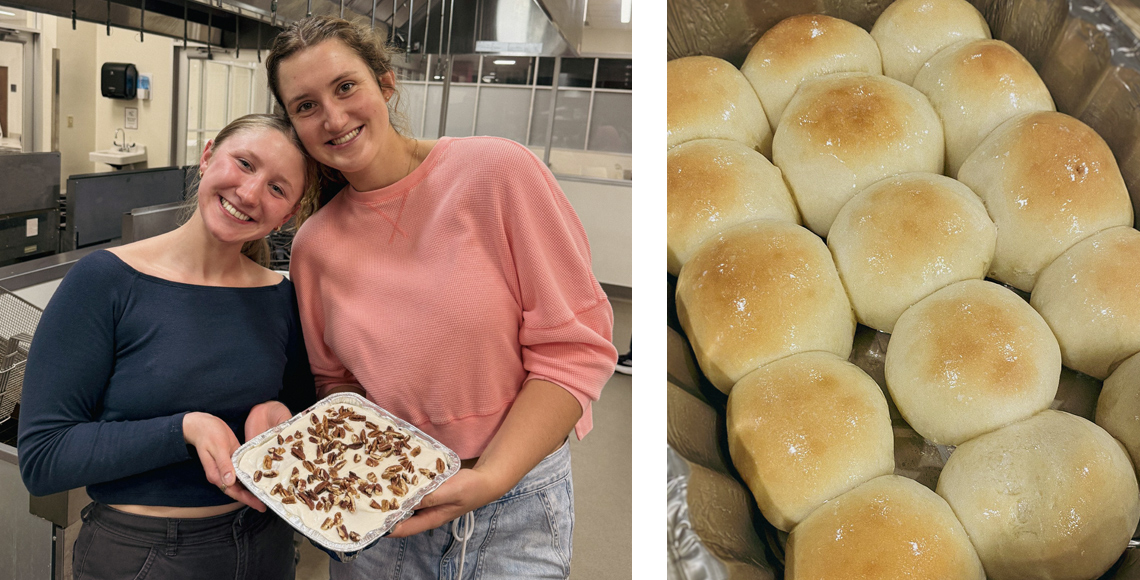
What makes this course particularly unique is the lab component. “Every week, we go
over to the kitchen in the Close Hipp building and produce some sort of food that
demonstrates the chemistry we’ve been talking about,” Taylor-Perry explained. “For
example, we did colligative properties which is looking at how the concentration of
a solution can impact the physical properties of a solution and an application of
that is making ice cream.”
After the lab, students get to enjoy their food creations. From a consumption standpoint,
Taylor-Perry's favorite lab experience is soups and sandwiches. But in terms of teaching,
her favorite is the kimchi lab. Kimchi is a traditional Korean dish consisting of
fermented and marinated vegetables like radishes and cabbage. This is often the first
lab experience of the semester, although Taylor-Perry explains that at this point
the students haven’t yet covered the material to understand the process. To make the
kimchi, students salt, rinse and season napa cabbage, and add sliced carrots, green
onions and Asian chives. Fermentation takes months, so students store their kimchi
in airtight containers in the refrigerator. Over the course of the semester, the natural
bacteria on the vegetables slowly ferment to develop the food’s true sour flavor.
Students finally have the opportunity to enjoy their kimchi with sushi that they prepare
during a lab near the end of the semester.
“By the time we get to where we actually consume it, it is interesting to look at
the [students’ growth] in understanding chemistry and this big topic that now we’re
suddenly able to talk about,” shared Taylor-Perry.
The chemistry of connections
Taylor-Perry also appreciates the relationships that begin due to the lab setting.
In comparison to the other courses she instructs without a lab component, she finds
she has more of an opportunity to interact with her students in one like this.
“I think what I like best about this is that I get to be in there with the students.
We’re doing hands on stuff. I am talking with them. They are sharing ideas with me.
We’re exploring concepts,” continued Taylor-Perry. “Anytime they have an idea, like
what would happen if I did this instead of that when following a recipe, we just do
it because seven other groups are making the same thing so we can experiment a little
bit sometimes.”
A course for any major, a dish for every student
The course is designed for non-science major students who may be chemistry averse.
Junior accounting and international business student Rylyn Reynolds hadn’t taken a chemistry class since high school, and shared that she is doing well
in this course.
“It’s designed for anybody. You can be a STEM major and take it, but you can also
have zero background and take it and do fine,” said Reynolds.
Reynolds also noted that sometimes labs don’t turn out as expected. Her group struggled
with the frying lab when the class was studying heat transfers.
“The frying lab was not my lab,” Reynolds joked. “We tried to make chicken nuggets
and fried shrimp, but ours turned out to be a huge fail.”
Despite her group’s unsuccessful attempt at frying, Reynolds and the other members
of her group were still able to enjoy fried Oreos from another group.
Reynolds’ favorite lab experience was when the class baked red velvet cake. Reynolds’
usually works with her classmate and junior marketing student Ella Maytas. Maytas is gluten-free and dairy-free, but that does not stop her from getting the
full cooking experience.
“We’ve been making everything with substitutes,” Reynolds said. “We made completely
dairy free and gluten free red velvet cake, and I thought ours was better than the
regular one, so that was really cool.”
Maytas was initially nervous about taking this course due to her dietary restrictions.
She now applauds Taylor-Perry for how cooperative she has been throughout the semester.
“She has just been so accommodating,” Maytas said. “She emails me to make sure certain
ingredients are okay and checks with me during class. She is really careful about
cross contamination and I really appreciate that.”
Developing skills for every day
The four-credit course meets three times a week for lectures and once for lab. The
late afternoon lab section serves as dinner for the students who choose to consume
what they prepare. Senior accounting student Van McAlister often brings his own container to fill with leftovers that he takes home to share
with his roommates. He recommends this course to other Honor students for a plethora
of reasons, the first being the professor.
“First off, Amy Taylor-Perry is a fantastic professor,” McAlister emphasized. “She
has a wealth of experience and tries to make class as fun and entertaining as possible.”
He also suggests this course to students who are interested in cooking or developing
new experiences. He appreciates how it helps strengthen a skill that students can
use every day.
“I think it’s important for [college students] to take the time to improve their cooking
skills because there’s no better time,” McAlister noted. “So, if a student is having
trouble finding time to work on their cooking skills, SCHC 403 is a great opportunity.”
Redefining chemistry’s reputation
Taylor-Perry encourages students to take this course for a different reason. The primary
reason she thinks students should take her class is because chemistry is fun.
“I think sometimes chemistry gets a bad reputation, and I hope this class encourages
people to explore chemistry more,” Taylor-Perry said. “I think the other reason students
should take this class is because it brings awareness to how chemistry is part of
everyday life and fundamental to everything we do.”
About the Author
Maggie Harmon
Maggie Harmon is a freshman in the South Carolina Honors College majoring in journalism
with a minor in Spanish. She wrote this story for the Honors Writing for Mass Communications
course taught by Bertram Rantin. In her spare time, she likes to read, cheer on the
Gamecocks and spend time with her friends and family.
Photography provided by Ella Maytas and Dr. Amy Taylor-Perry.