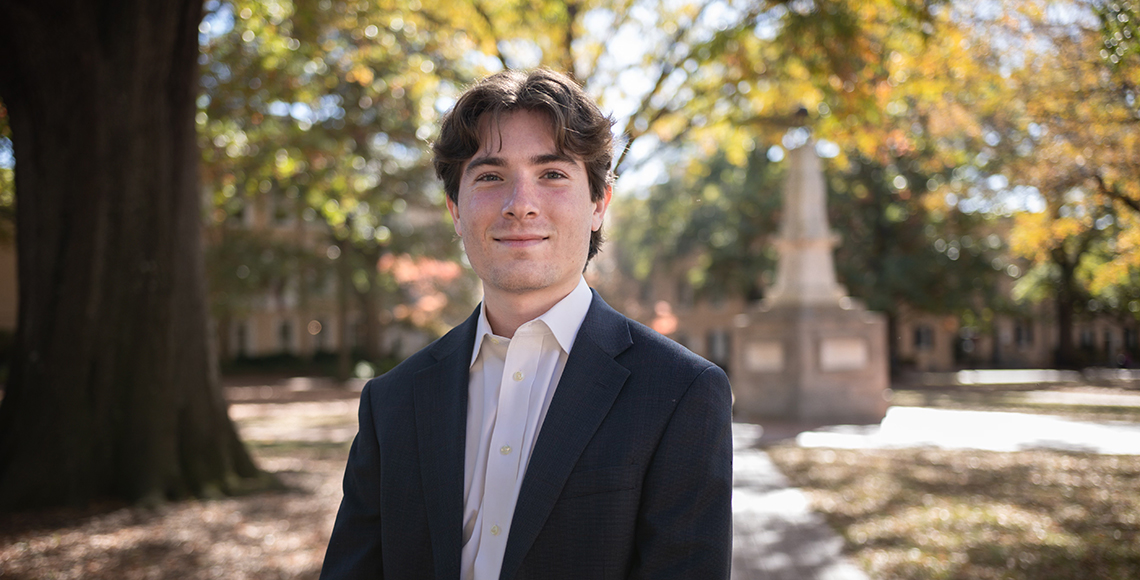
When Jake Arcement thinks back on the courses that impacted his undergraduate experience, the first one to come to mind has nothing to do with his neuroscience major.
Though Arcement has been a musician for most of his life — over his shoulder, guitars and instruments hang on the wall — the South Carolina Honors College Experimental Music Workshop challenged his perceptions of what music could be. To succeed in the course taught by professor Gregory Stuart, Arcement would need to keep an open mind.
“That’s a class and an experience that I wouldn’t have been able to get anywhere else than at this school and in this program,” he says of the course. “There were no tests or quizzes, but it was showing up and really pushing the limits of your creativity. It allowed me to learn that music is so much more than I thought it was.”
An open mind and thoughtful decision-making are hallmarks of Arcement’s experience at the University of South Carolina. The senior from New Orleans, Louisiana, knew that he wanted to experience small, discussion-based classes and a tight-knit community within a large university’s resources. The Honors College was a perfect fit, and Arcement has leaned into intellectual curiosity and community engagement since his first semester on campus.
“I’ve dared to keep an open mind,” he says of his Honors experience. “I’ve dared to learn more.”
‘It showed me what was meaningful to me.’
Arcement cites another Honors course, Food and Eating Behavior, as a transformative educational experience. Taught by professor Steven Levens, the course challenges students to investigate cultural traditions surrounding food and eating habits, nutrition and disordered eating.
For Arcement, who has personal experience with a family member’s struggle with an eating disorder, the class held particular significance.
“It was a challenging journey for all of us, but it also really inspired my interest in neuroscience, how the environment impacts our mental health and the concept of how important eating is, not just for your nutrition, but also culturally and socially,” he says.
Outside of the classroom, Arcement became involved with The National Association of Anorexia Nervosa and Associated Disorders (ANAD) Sibling Support Group, a once-a-week, online community that offers peer support for siblings of those affected by eating disorders.
“I got involved with the group and quickly realized that I had the capability and really strong desire to become a support group leader... It happens every Tuesday at 8 o’clock Eastern, and it’s open to all siblings sharing that lived experience, so we get people from all over the country. We’ve even gotten some people from Australia and the U.K.,” he says. “It changed my life in a lot of ways because it allowed me to reflect on what I was going through in a meaningful and healthy way. It showed me what was meaningful to me.”
Fostering connections through vulnerable, face-to-face conversations bolstered Arcement’s resolve to be more involved in his community; soon, his impact extended beyond Zoom and into Columbia. Arcement leveraged the language skills he was learning though his Spanish minor and volunteered at the Good Samaritan Clinic. He also mentored adolescents at Prisma Health Baptist Hospital, serving as a journal group leader for mental health patients.
With such a strong focus on community, connection and neuroscience, it would be reasonable to assume that Arcement began college with a clear goal of pursuing a mental health profession. Arcement attests, however, that his interests evolved organically, and by keeping an open mind throughout undergrad, “I made the connection between the neuroscience, the mental health and my lived experience. Everything came together.”
‘It’s really about human connection.’
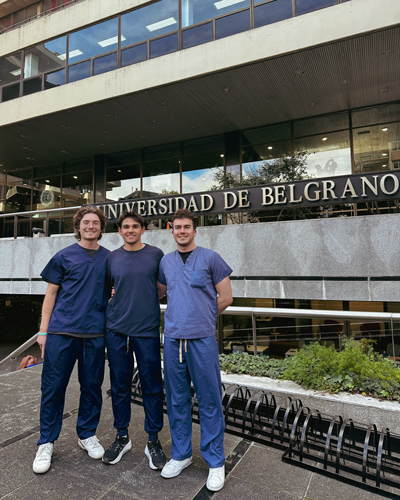
As Arcement’s interests came into sharper focus, his beyond-the-classroom activities provided more context and direction. A summer study abroad experience in Argentina, for example, allowed him to work with a professor who was also a practicing psychiatrist. Arcement learned more about Argentina’s approach to mental health, deepening his understanding of different systems of treatment and support.
That same summer, a month-long internship at Project Horseshoe Farm (PHF) in rural Alabama introduced him to another form of community-based care. PHF, a community health organization grounded in the biopsychosocial model, provides care for adults with mental illnesses and other vulnerable citizens. Arcement brought his guitar and musical skills to PHF, leading the community choir. He also built relationships through PHF’s Summer Youth and Health Partners Programs by supporting individuals toward improved health and social well-being.
“It’s really about human connection,” says Arcement. “It was a really beautiful thing to see how that kind of human connection can actually make a difference and be scientific and therapeutic.”
Arcement also expanded his knowledge of mental health and neuroscience through USC’s Brain Research and Development Lab, led by professor Caitlin Hudac. He credits the Honors College Research Grant with providing the financial support he needed to devote 10 – 15 hours to his projects per week. His current research investigates the connection between atypical auditory processing and behaviors such as hyperactivity and withdrawal in autism spectrum disorder.
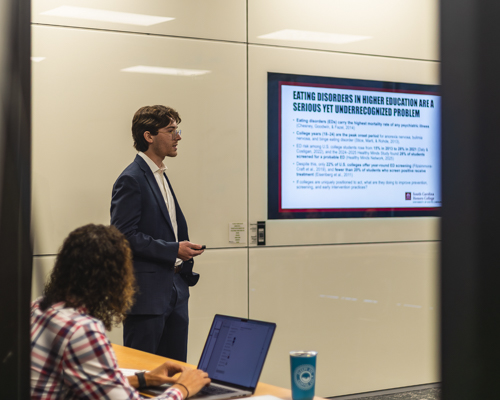
These passions culminated in Arcement’s Honors senior thesis, which examines eating disorder prevention and early intervention practices in higher education. By comparing approaches from different universities across the country, he aims to identify the gaps in advocacy and make evidence-based recommendations for strengthening eating disorder prevention efforts. He hopes that his thesis is just the first step toward implementing new initiatives nationwide.
‘The more I learn, the harder the decision becomes.’
Though he is narrowing his focus, Arcement’s dreams and goals have only grown wider. He was recently awarded a Fulbright English Teaching Assistantship to Spain, during which he can hone his Spanish proficiency and teaching abilities. These skills will enable him to provide mental health care to as many patients as possible in the United States.
His approach to that care, however, is what he is still daring to learn more about. He has diligently interviewed psychiatrists and clinical psychologists to discern his future plans: M.D. in psychiatry or Ph.D. in clinical psychology? A biomedical approach to mental health or a psychosocial one? These are questions for which he refuses to settle on an easy answer. With an open mind and the courage to continue asking questions, he is determined to discern his next steps with intention.
“I don’t want to make this easy for myself because I know how important this decision is. And I’ve discovered the more I learn, the harder the decision becomes,” he says. He wouldn’t have it any other way.
“I’m still not totally sure, but I have a passion for learning, and I want to learn as much as I can before making this really important decision. And I know that my perspective is going to continue to change the more that I learn. So, I think I’ve dared to keep an open mind, and while that has led to a lot more work and a lot more anxiety, and more uncertainty, I know that’s the way to go. That’s the only way that’ll work for me.”