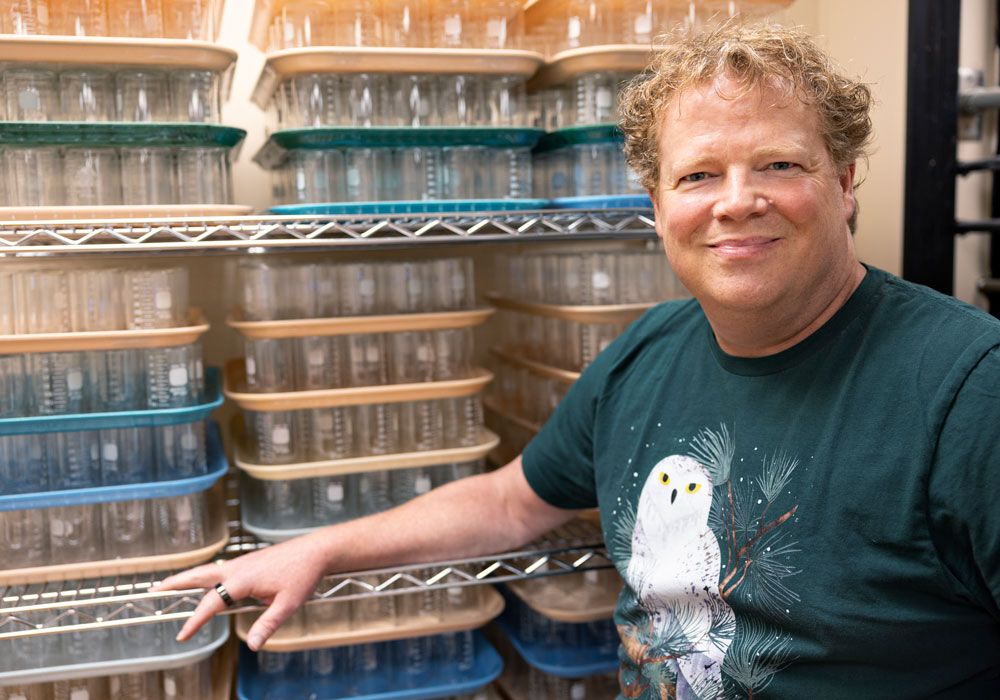
There are several nondescript fish tanks scattered through the biology lab on the sixth floor of the Coker Life Sciences Building, where students study water fleas, algae and other aquatic organisms. But one tank in particular, a humming saltwater aquarium, is home to a small menagerie of tropical creatures: a pair of Darwin clownfish, two azure damselfish, one gold assessor and a black-capped basslet who prefers to hide within the craggy reef rocks.
The tank’s tropical denizens aren’t research specimens — they belong to Jeff Dudycha, biological sciences professor and 2026 Michael J. Mungo Distinguished Professor of the Year. (And just in case that isn’t clear, a handwritten note taped to the aquarium’s side hammers it home: “NOT FOR EXPERIMENTS!”)
This space is the Jeff Dudycha Lab, where students dive into genomics, ecology and evolutionary biology. The professor’s research interests are as personal as they are professional. He points to Tab and Tony, his Darwin clownfish. Unlike Disney’s Nemo, these fish have black stripes instead of orange. But their namesake, not their coloring, is what appeals to him.
“When I found out there was a fish named after Darwin, I had to have it,” he explains, sprinkling granules of food into the top of the aquarium.
A quick history lesson: Charles Darwin was an English biologist who proposed the theory that life evolved through the process of natural selection. While visiting the Galapagos Islands nearly 200 years ago, he collected specimens of finches whose beaks had adapted to be whatever shape and size worked best with the available food sources.
Dudycha has also adapted over the years, slowly refining his classroom approach to help students better engage with the material. That includes incorporating nontraditional curriculum into his undergraduate Ecology and Evolution course.
To be clear, he isn’t anti-textbook.
“If they’re done well, textbooks are a very good, organized compendium of information that is structured in a way that you can assimilate,” he says. “But at the same time, they come across in a very formal style that is not necessarily fun to read. And so I was kind of casting about, thinking I wanted students to read something that they actually wanted to read.”
The solution? Pulitzer prize-winning nonfiction book The Beak of the Finch: A Story of Evolution in Our Time by Jonathan Weiner, which chronicles research expeditions to study the Galapagos finches again in the 1970s. Dudycha randomly assigns students questions on the reading, allowing them to become subject matter experts on specific topics. And whereas a textbook-based lesson might mean reviewing graphs to understand data, Dudycha flips the script: Students discuss the book’s data and figure out how to represent it visually.
“The Beak of the Finch is told as an adventure story, so it’s a really different kind of book,” he says. “Most students really like having something different, whether it’s because of the style of writing or because we spend about four or five days talking about this book, and they’re not having to pay attention to a lecture.”
Is Dudycha is taking a page from the English Department? Well, yes. Taking pages from other disciplines is kind of his thing. For years, he has partnered with School of Music professor Reginald Bain to teach Chords and Codons, a class in which composition and biology students build musical simulations of genetic processes. His senior-level Evolutionary Biology course takes a deep dive into the philosophy of science. Students read essays on the theory of knowledge and ponder how to achieve understanding in spite of uncertainty.
"It’s not that I think biology is inextricably linked with the other disciplines — I think thinking is inextricably linked with putting things together. My freshman year of college, I took an environmental science class, African literature, Iranian history and Russian language. I remember being struck by how things from one class would come up in another when those were four really different classes."
Then there’s the poetry. Haiku is scrawled on whiteboards throughout the lab, a writing exercise that challenges students to distill scientific concepts into just 17 syllables. Some of Dudycha’s favorites are posted to his lab website:
“Theoretically, / algae live in harmony. / But do they really?”
“Red, green or blue light — / Hey! That’s too bright. Nevermind. / This light is just right.”
“Daphnia evolve / from tubes to beakers to graphs. / Some grow fast, some don’t.”
There is a method to his madness.
“Structured poetry requires thinking very carefully about word choice,” Dudycha says. “A lot of our students haven’t really been taught how to write about science and will write the way they talk, and talking doesn’t necessarily involve careful word choice because you’ve got so much other stuff that helps you convey meaning in a way that writing doesn’t. This is a writing assignment where they have to really think, ‘What word am I going to use? How do I put together a sentence that is coherent? How do I keep it accurate? How do I give it a little bit of snap?’”
Dudycha is, himself, a man of multiple disciplines. He initially entered college as a history and Russian literature double major with the goal of going to law school. He abandoned that dream after taking his required science classes and doing an ecology study abroad program, but he gained a broader worldview.
“It’s not that I think biology is inextricably linked with the other disciplines — I think thinking is inextricably linked with putting things together,” he says. “My freshman year of college, I took an environmental science class, African literature, Iranian history and Russian language. I remember being struck by how things from one class would come up in another when those were four really different classes.”
Most of the students who enter his classroom are biology majors. Just as he mulls over how he can enrich their learning experiences by bringing in ideas from other disciplines, Dudycha also mulls over how to bring biology to people elsewhere on the academic spectrum. A finance major might only learn about certain topics when they feature into hot-button political controversies or trending news stories. This reality often narrows the scope of what non-scientists understand — it can even convince them they don’t like biology.
But everyone likes dogs, right? At least that’s what Dudycha is banking on. Next spring, he’ll teach a Carolina Core class on the biology of man’s best friend. Over the semester, students will explore canine evolution, genetics, behavior, physiology and health.
“I’m hoping to get students who are excited enough to learn about dogs that it will help them get over whatever reluctance they have about science,” he says. “Because the truth is lots of people are just intimidated by it. They haven’t had it explained to them in a way where they can see, ‘Oh, this builds from really simple pieces.’”