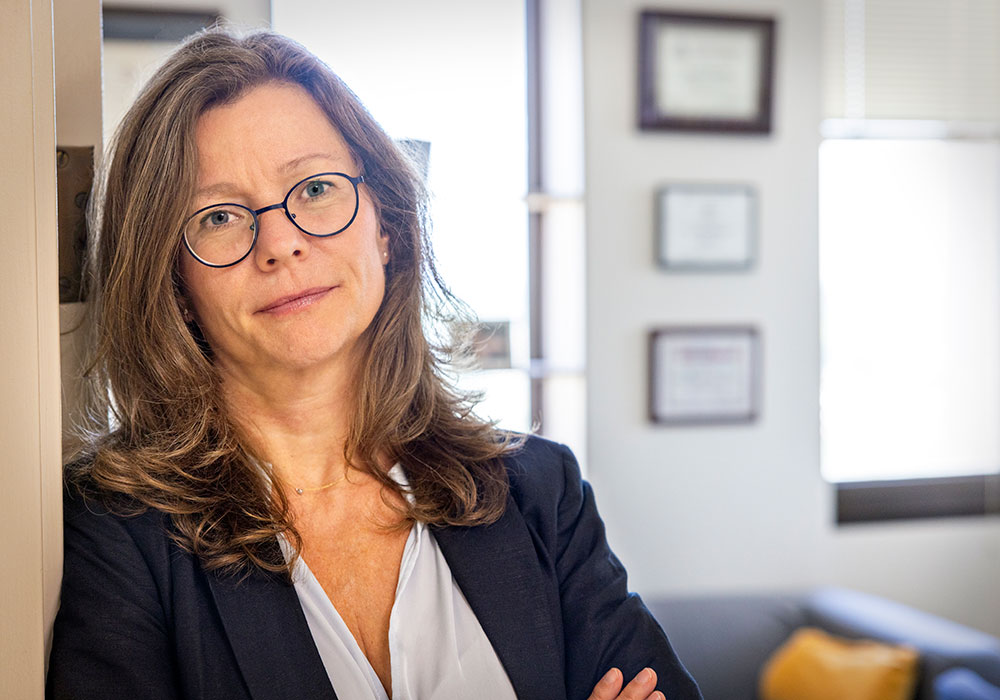
In the three decades Agnes Mueller has been an educator, the educational landscape has evolved with the introduction of new technologies and pedagogical theories. While she’s considered adopting new approaches to teaching, she’s realized sticking to the basics and keeping her classroom a tech-free zone yield the best results.
Her offline approach to instruction can be initially jarring to students, but it helps them better engage with and absorb original material. The McCausland College of Arts and Sciences professor says letting students explore the material through primary sources of text and other authentic media helps develop a deep curiosity and encourages true intellectual diversity during class discussions.
“Students don’t always come with curiosity,” says Mueller, who was awarded the Carolina Trustees Professorship award for 2026. “And the question is, ‘How do you get them to be curious about something?’ I typically start each class by saying, ‘What questions do you have about the material?’ And so those questions usually lead to great conversations, and it’s really that conversational element that’s the core of my teaching philosophy.”
She also brings the outside world into the classroom. For example, in her course Food in Film, she brings in local chefs and restaurateurs to speak to students or takes students to a local restaurant.
“It’s not easy to fit these experiences into everyone’s schedule,” says the director of the Program in Comparative Literature. “But students have commented on how it really brought together the topics that we talked about in class and made them think in different ways not only about food, but also the films and the ways in which food and culture connect.”
In the past three years, she has developed two courses for the Department of Languages, Literatures and Cultures. In addition to Food in Film, she created Literature and Pandemics, where students compare their experience with Covid-19 to how historical pandemics are represented in literature.
I’m most proud of my students — all of them. I have had incredibly rewarding teaching experiences, and I get to see how teaching has affected people’s lives down the line.
Outside of the classroom, Mueller has a passion for bringing her scholarship to non-academics. It’s why her seventh book, The Family’s Fight: Resisting State Control, will be commercially published. While it’s for a wider audience than her previous scholarly works, the book is deeply personal — it centers on her father’s time as a political prisoner in the German Democratic Republic.
“This project is really exciting for me personally, because I finally get to talk to more people, but it’s also really important for the humanities fields to branch out and reach larger audiences,” she says. Her book will also draw from the experiences of the family members of other political prisoners as well as archival material and her work on Holocaust memory.
Mentorship has always been important to her. After earning her master’s degree in Munich, she briefly took on a mentorship role for undergraduate students at her alma mater before earning a Ph.D. at Vanderbilt and beginning her teaching career. In her time at USC, she has mentored Ph.D. students in comparative literature, served on dissertation committees in other fields like history and English, as well as supervised honors theses.
“The core of mentorship is encouragement,” she says. “It creates one-on-one dialogue that can really move students to be more open, brave and have more courage. If they can have the courage to address difficult questions that are important to them and address gaps they see in the world then we need to nurture that.”
Over the course of her career, she has accomplished many things that have become points of pride in her professional development, like being selected for the Carol Strauss Fellowship in Jewish Studies at the American Academy in Berlin, but she says teaching is one of the highlights.
“I’m most proud of my students — all of them,” she says. “I have had incredibly rewarding teaching experiences, and I get to see how teaching has affected people’s lives down the line.”